Periodontal Knives (Gingivectomy and Interdental Knives)
Written by the Equate Instruments Technical Team · Reviewed by the Medical & Dental Board, Equate Instruments · Updated ·
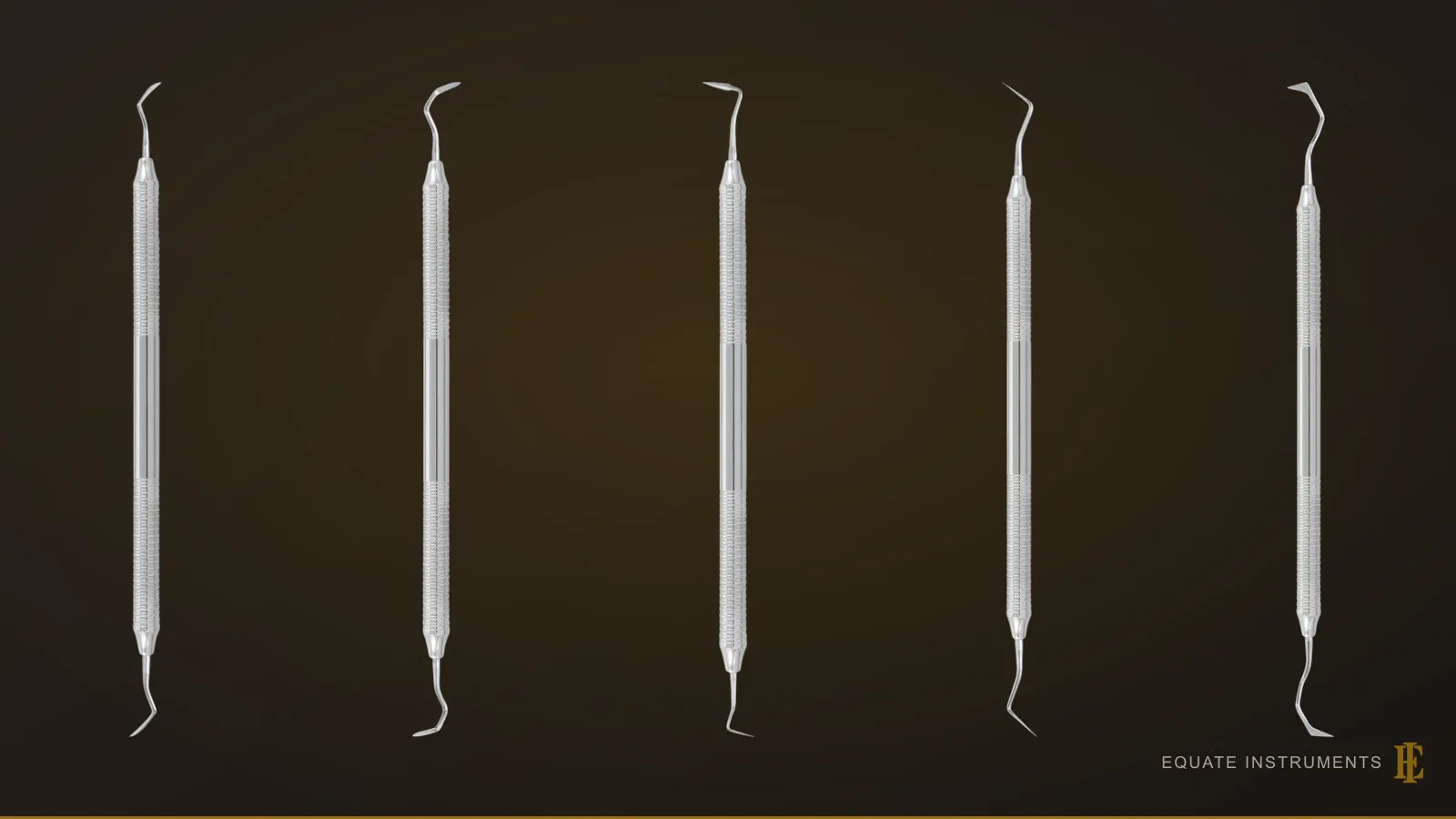
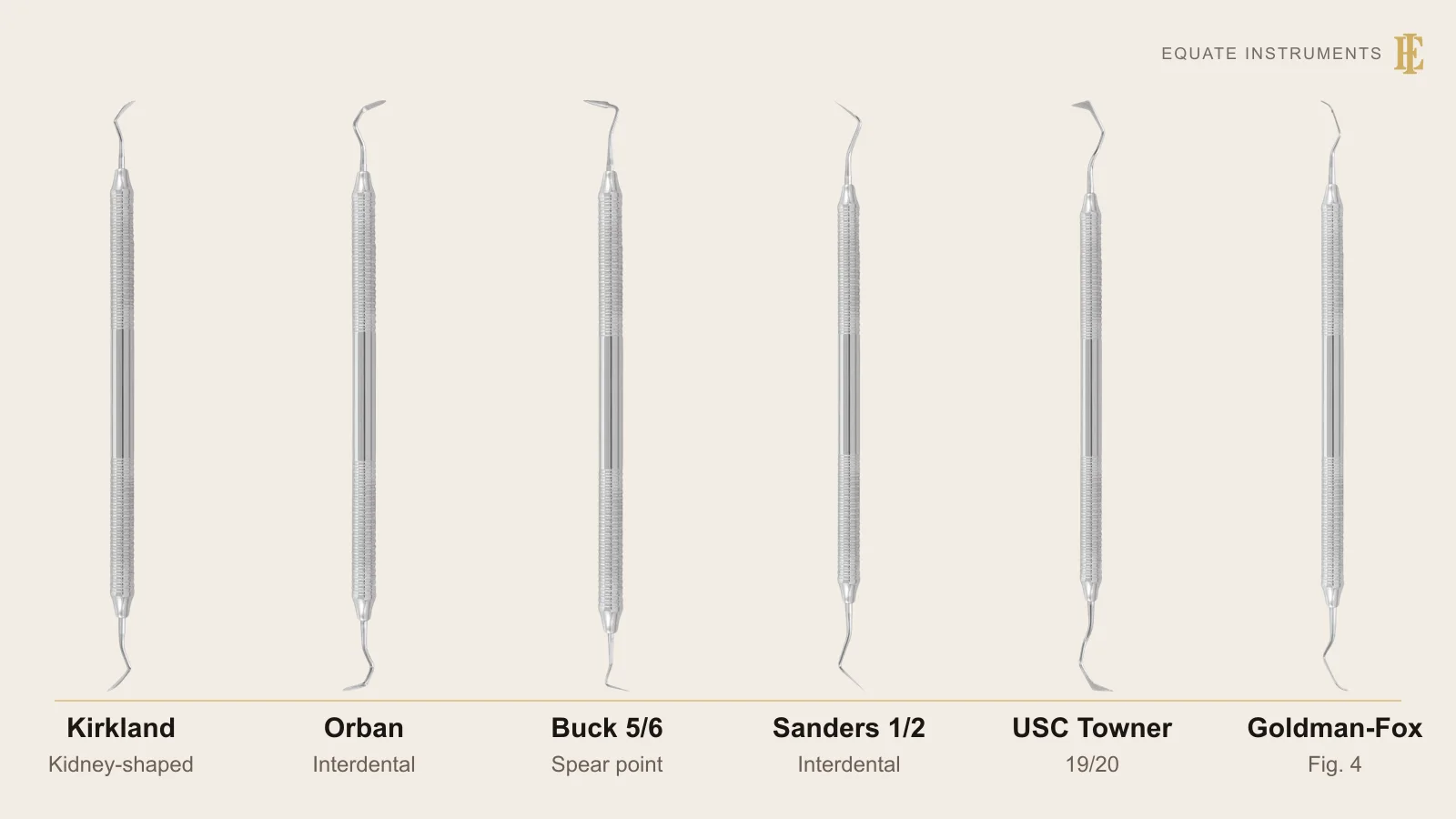
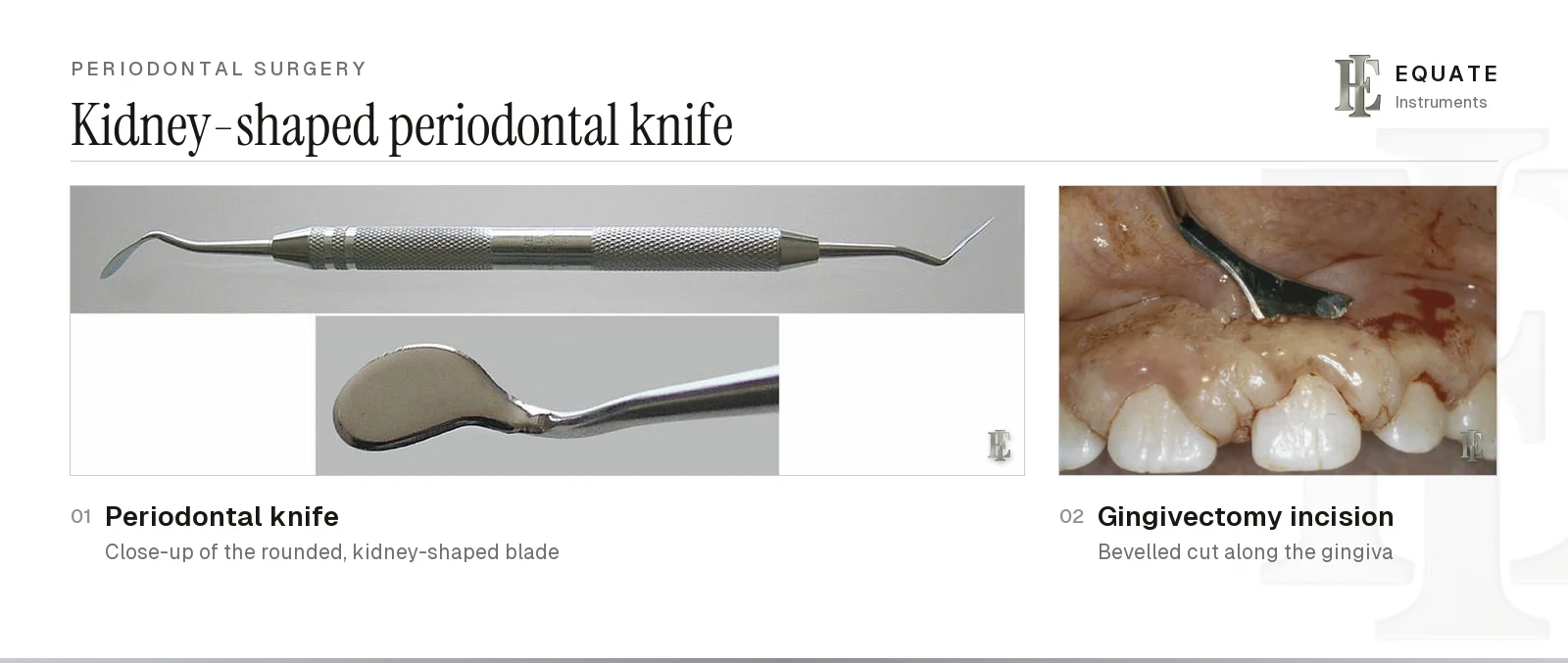
A periodontal knife is a reusable hand instrument with a fixed blade for cutting gingiva in gingivectomy and gingivoplasty. The Kirkland knife has a broad, kidney-shaped blade, sharp all round, for the long bevelled incision along the facial and lingual gum. The Orban knife has a narrow spear-shaped blade for interdental cuts. Buck, Sanders and Goldman-Fox knives are similar patterns.
Key points
- Kidney-shaped knives (Kirkland, Goldman-Fox) make the continuous external bevel incision; spear-shaped knives (Orban, Buck, Sanders) free the interdental tissue.
- Gingivectomy suits suprabony pockets and gingival enlargement; it is not used where bone surgery is needed or the pocket base lies beyond the mucogingival junction.
- Keep knives sharp: a dull periodontal knife tears gingiva instead of cutting a clean bevel.
What is a periodontal knife used for?
Periodontal knives cut and reshape gingiva. Their main use is gingivectomy, the excision of the gingival wall of a pocket, and gingivoplasty, the recontouring of the gum to a natural, scalloped shape. Gingivectomy is the oldest surgical approach in periodontal therapy. Today it is used mainly to eliminate suprabony pockets where there is enough attached gingiva, to reduce drug-induced or hereditary gingival enlargement, and to lengthen clinical crowns for restorations or a gummy smile.
The knives sit on the periodontal surgery tray with periodontal probes to measure and mark the pockets, dental curettes and scalers to remove the excised tissue and root deposits, and gum scissors for tissue tags. The other periodontal instruments (furcation probes, hoes, back-action hoes and files) are covered in the periodontal instruments guide.
What types of periodontal knife are there?
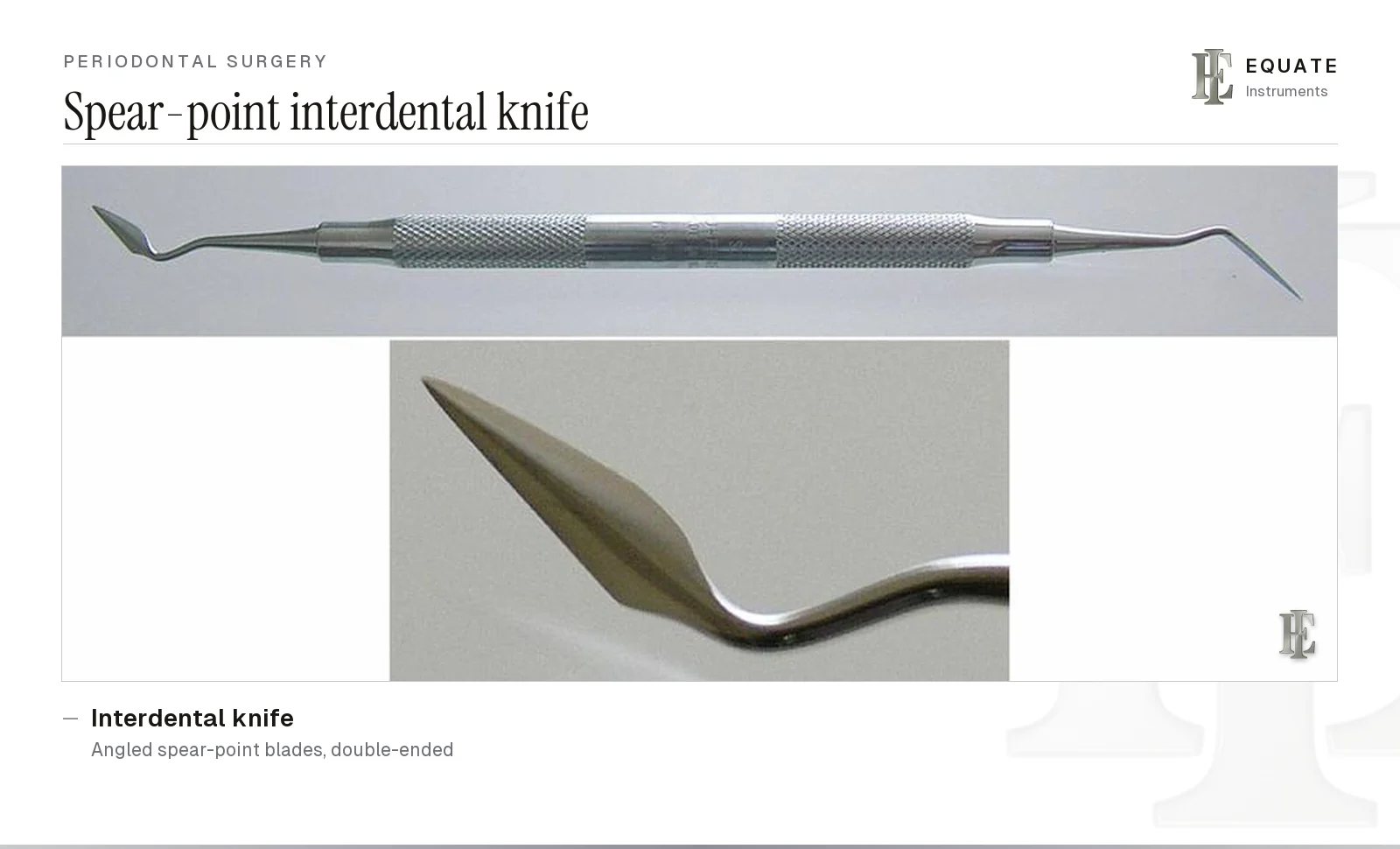
Boyd's pocket guide sorts them into two shapes: kidney-shaped knives for the long bevelled cut along the gum, and spear-point interdental knives for the tissue between the teeth. Where each sits among the probes, hoes and files of a periodontal tray is set out in the same periodontal instruments guide.
- Kirkland knives: a broad, kidney- or heart-shaped blade sharpened around its whole edge, double-ended for right and left, for the main gingivectomy incision on facial and lingual surfaces.
- Orban knives: a narrow, spear-shaped blade sharpened on both edges, for cutting interdental tissue and freeing the papillae.
- Buck knives: spear-pointed interdental knives, such as the Buck 5/6, used like the Orban.
- Sanders knives: slim interdental knives that reach the col area between the teeth, used like the Orban and Buck.
- Goldman-Fox knives: a numbered series of kidney-shaped and spear-shaped knives that covers both incisions.
- Solt knives: another kidney-shaped gingivectomy pattern named in Boyd's pocket guide; Equate does not list a Solt knife.
- Other patterns: the Widman knife for internal bevel flap incisions, the USC Towner for pocket-wall excision, and the hook-ended Crane-Kaplan pocket marker, which marks the base of each pocket with a bleeding point before the incision.
What is the difference between a Kirkland and an Orban knife?
The two are used together. The Kirkland cuts the long bevelled incision along the buccal or lingual gum, following the line of marked pocket depths; its curved edge can cut on the push and the pull. The Orban is a narrow interdental knife that reaches between the teeth to sever the interdental tissue that the Kirkland can't reach, so the excised collar of gingiva comes away in one piece.
| Feature | Kirkland | Orban |
|---|---|---|
| Blade shape | Broad, kidney- or heart-shaped | Narrow, spear-shaped |
| Cutting edge | Around the whole periphery | Both sides of the point |
| Incision | Continuous external bevel along the facial and lingual gum | Interdental cut through the papilla and col |
| Similar patterns | Goldman-Fox kidney knives | Buck 5/6, Sanders, Goldman-Fox spear knives |
How are periodontal knives used in gingivectomy?
Newman and Carranza's Clinical Periodontology describes the classic surgical gingivectomy. After anaesthesia, the depth of each pocket is measured with a probe and marked on the outer surface of the gingiva, usually with a pocket marker that makes a bleeding point at each pocket base. The Kirkland-type knife then makes a continuous incision apical to the marks, bevelled at about 45 degrees to the long axis of the tooth so that the cut ends at the base of the pocket and leaves a thin, tapered margin. A 2024 Cureus case report by Thakare and colleagues follows the same sequence: bleeding points made with a pocket marker, then an external bevel at 45 degrees with a No. 15 blade.
The Orban-type knife frees the interdental tissue, the excised tissue is lifted away with curettes or scalers, the roots are cleaned, and the new margin is shaped by gingivoplasty to a scalloped contour. The wound heals by secondary intention, often under a periodontal dressing, although Baghani and Kadkhodazadeh's 2013 review found no consensus that one is needed. Electrosurgery and lasers are alternatives to the knife, and a scalpel with a No. 15 or 15c blade on a scalpel handle is often used for the same incisions.
| Step | Instrument | Purpose |
|---|---|---|
| Measure and mark pockets | Periodontal probe and pocket marker | Bleeding points show the base of each pocket |
| Main incision | Kirkland or Goldman-Fox kidney knife | External bevel apical to the marks |
| Interdental cut | Orban, Buck or Sanders knife | Frees the papillae so the tissue comes away whole |
| Remove tissue and clean roots | Curettes and scalers | Clears the excised collar and deposits |
| Recontour | Knives, rotary instruments or electrosurgery | Gingivoplasty to a scalloped margin |
When is gingivectomy not the right choice?
Gingivectomy removes gingiva, so it can only treat pockets whose walls are made of gingiva above the bone. It is not suitable where bone surgery is needed to correct defects, where the base of the pocket lies apical to the mucogingival junction, so removing the pocket wall would leave no attached gingiva, or where the aesthetic result in the upper anterior region would be unacceptable. In those cases a flap procedure, raised with a scalpel and a periosteal elevator, is used instead.
Common mistakes with the knives are cutting too far coronal, which leaves a residual pocket; cutting with too flat an angle, which leaves a thick, blunt margin; and forcing a dull knife, which tears the tissue and leaves tags.
What does the Equate range include?
Equate's periodontal knives include Kirkland gingivectomy knives (15K/16K, 13K/14K and 13K-TG patterns) on solid 6 mm, hollow 10 mm and titanium-coated handles; Orban 1/2 interdental knives on solid and hollow handles and a titanium-coated version; Buck 3/4 and 5/6 knives; Sanders 1/2 and 4/5 interdental knives; Goldman-Fox knives in figures 1 to 9, 11 and 21; and a Widman knife, a USC Towner 19/20 and a Crane-Kaplan CK3 pocket marker. The periodontal knife subcategory also lists six laboratory wax and plaster knives, including Lessmann patterns, which are bench instruments rather than surgical ones.
They are part of the restorative and operative range. Each knife is made of passivated stainless steel, ultrasonically cleaned, shape-, boil- and performance-tested and individually packed. Clinics can request samples and a quote.
How do you sharpen and care for periodontal knives?
Periodontal knives must be sharp before every surgery. Sharpen a Kirkland knife by drawing a fine, flat sharpening stone along the curved cutting edge, keeping the original bevel and turning the stone to follow the curve; sharpen an Orban on both edges, preserving the point. Test the edge on a plastic test stick: a sharp edge catches rather than slides. Sharpen before sterilisation, not after.
Clean the knives with the surgical set and sterilise them as set out in the CDC's Guidelines for Infection Control in Dental Health-Care Settings or, in UK practices, HTM 01-05, following the manufacturer's instructions under ISO 17664-1. Store them in a cassette so the blades don't knock against other instruments, and retire a knife whose blade has been sharpened thin or has lost its shape.
The Equate difference
Equate lists 34 references in these subcategories: 5 Kirkland, 3 Orban, 4 Buck, 2 Sanders, 11 Goldman-Fox knives (figures 1–9, 11 and 21), a Widman, a USC Towner 19/20 and a Crane-Kaplan CK3, on solid 6 mm, hollow 10 mm or titanium-coated handles, plus 6 laboratory wax knives, including Lessmann patterns.
Equate Periodontal Knives (Gingivectomy and Interdental Knives) options

Kirkland Gingivectomy Knife Fig. 15K/16K - Titanium-Coated Solid Handle
EI-0056
Kirkland 13K/14K Gingivectomy Knife - Hollow Handle
EI-0071
Widman Curved Periodontal Knife
EI-0228
Kirkland 13K-TG Gingivectomy Knife - Solid Handle 6mm
EI-1900
Kirkland Knife - Solid Handle 6mm
EI-1957
Goldman-Fox Knife 7 - Solid Handle 6 mm
EI-2163
Goldman-Fox Knife 8 - Solid Handle 6 mm
EI-2164
Goldman-Fox Knife 9 - Solid Handle 6 mm
EI-2165
Goldman-Fox Knife 11 - Solid Handle 6 mm
EI-2166
Fig. 3/4 Buck Knife - Solid Stainless Handle 6 mm
EI-2167
Buck Knife 5/6 - Solid Handle 6 mm
EI-2168
Sanders Knife 1/2 - Solid Handle 6 mm
EI-2169Browse all restorative & operative instruments
Buying in your market
Frequently asked questions
What is a Kirkland knife used for?
A Kirkland knife makes the main bevelled incision in gingivectomy and gingivoplasty along the facial and lingual gum. Its kidney-shaped blade is sharp all round, so it cuts in either direction.
What is an Orban knife used for?
An Orban knife is a spear-shaped interdental knife used to cut the interdental tissue and free the papillae during gingivectomy, after the main incision has been made with a Kirkland-type knife.
What is the difference between gingivectomy and gingivoplasty?
Gingivectomy removes the gingival wall of a pocket. Gingivoplasty reshapes the gingiva to a natural contour, and the two are often done together with the same knives.
Can a scalpel be used instead of a periodontal knife?
Yes. Many clinicians use a No. 15 or 15c blade for the same incisions, and electrosurgery and lasers are also used. Periodontal knives are reusable and their shapes suit the angles of the incision.
How often should periodontal knives be sharpened?
Check the edge before each surgery and sharpen whenever it no longer catches on a test stick. Retire the knife once the blade is noticeably thinner or out of shape.
References
- Newman MG, Takei HH, Klokkevold PR, Carranza FA. Newman and Carranza's Clinical Periodontology, 13th edition. Elsevier, 2018
- Gehrig JS, Shin DE, Willmann DE. Foundations of Periodontics for the Dental Hygienist. Wolters Kluwer (periodontal surgery and instrument sharpening)
- Kohn WG, et al. Guidelines for Infection Control in Dental Health-Care Settings, 2003. MMWR 52(RR-17), Centers for Disease Control and Prevention
- Department of Health. Health Technical Memorandum 01-05: Decontamination in primary care dental practices, 2013 edition (NHS England)
- ISO 17664-1:2021. Processing of health care products — Information to be provided by the medical device manufacturer for the processing of medical devices — Part 1: Critical and semi-critical medical devices
- Boyd LB. Dental Instruments: A Pocket Guide, 7th edition. Saunders/Elsevier, 2020. Chapter 16, Periodontal Instruments and Periodontal Surgical Instruments (photographs used under licence)
- Thakare SS, Shirbhate U, Bajaj P, Wankhede A. Management of Orthodontic Therapy-Associated Gingival Overgrowth for Esthetic Consideration in Anterior Maxillary Region: A Case Report. Cureus 2024;16(7):e63709
- Baghani Z, Kadkhodazadeh M. Periodontal Dressing: A Review Article. J Dent Res Dent Clin Dent Prospects 2013;7(4):183–191
I am a…