Periodontal Surgery Tray Setup
Written by the Equate Instruments Technical Team · Reviewed by the Medical & Dental Board, Equate Instruments · Updated ·
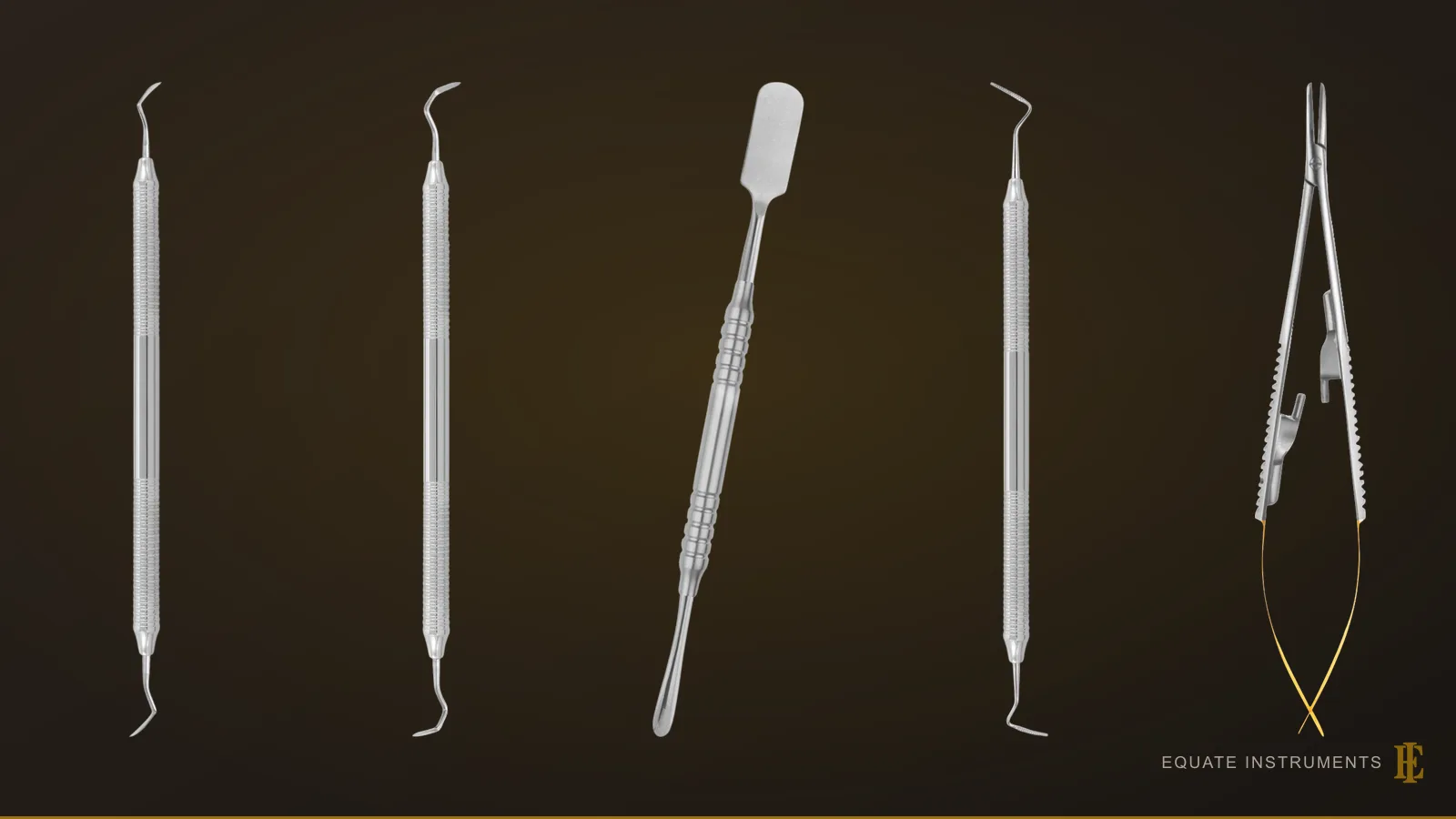
A periodontal surgery tray setup adds periodontal instruments to the universal surgical tray. It holds a periodontal probe and furcation probe, Kirkland and Orban periodontal knives, a scalpel, periosteal elevators, curettes and scalers, hoes, a bone file, tissue forceps, tissue scissors, a needle holder, sutures and suture scissors. A gingivectomy relies on the knives; a flap procedure relies on the scalpel and elevators.
Key points
- Kirkland knives make the broad external bevel cut of a gingivectomy; Orban knives free the tissue between the teeth.
- Flap surgery reflects the tissue to reach the roots and bone, so it adds periosteal elevators, bone instruments and sutures.
- Knives, curettes and scalers must be sharp before they are packed; a blunt blade drags and tears the gingiva.
Step by step
- 1
Measure and map the pockets
Probe and record pocket depths, bleeding and furcation involvement around each tooth. For a gingivectomy, mark the pocket base on the outer surface of the gingiva as a guide for the incision. Plan from a 6-point pocket chart with each furcation marked; the BSP asks for one in any code 3 sextant after initial therapy, and for the whole mouth after any code 4.
- 2
Anaesthetise
Give local anaesthetic by infiltration or block from a separate tray, and check soft-tissue anaesthesia with the probe.
- 3
Make the incisions
For a gingivectomy, cut a continuous bevel apical to the marked points with a Kirkland knife, then free each papilla with an Orban knife. For a flap, make sulcular or submarginal incisions with a No. 15 or 12 blade.
Periodontal Knives (Gingivectomy and Interdental Knives)Dental Scalpel Handles and Blades
- 4
Remove tissue or reflect the flap
Lift away the excised collar of a gingivectomy with a curette or scaler. For flap surgery, reflect a full-thickness flap with the periosteal elevator to expose the roots and bone.
Periosteal Elevators: Molt 9, Freer, Buser and Other PatternsDental Curettes
- 5
Debride the roots
Remove granulation tissue, calculus and soft deposits with curettes, scalers and hoes, working in short overlapping strokes under direct vision.
- 6
Recontour bone where planned
Reshape bone defects or margins with a bone file, rongeur or chisel when osseous surgery is part of the plan.
Dental Rongeurs and Bone FilesBone Chisels and Surgical Mallets in Dentistry
- 7
Irrigate and check
Irrigate with sterile saline, check the roots with a probe and remove any tags of tissue with tissue scissors.
Surgical Suction Tips for Oral SurgeryDental Surgical Scissors
- 8
Close or dress the wound
Reposition and suture the flap with the needle holder and fine tissue forceps, or cover a gingivectomy wound with a periodontal dressing where the operator uses one.
Dental Needle Holders (Needle Drivers)Dental Tissue Forceps (Toothed and Non-Toothed)
Tray checklist
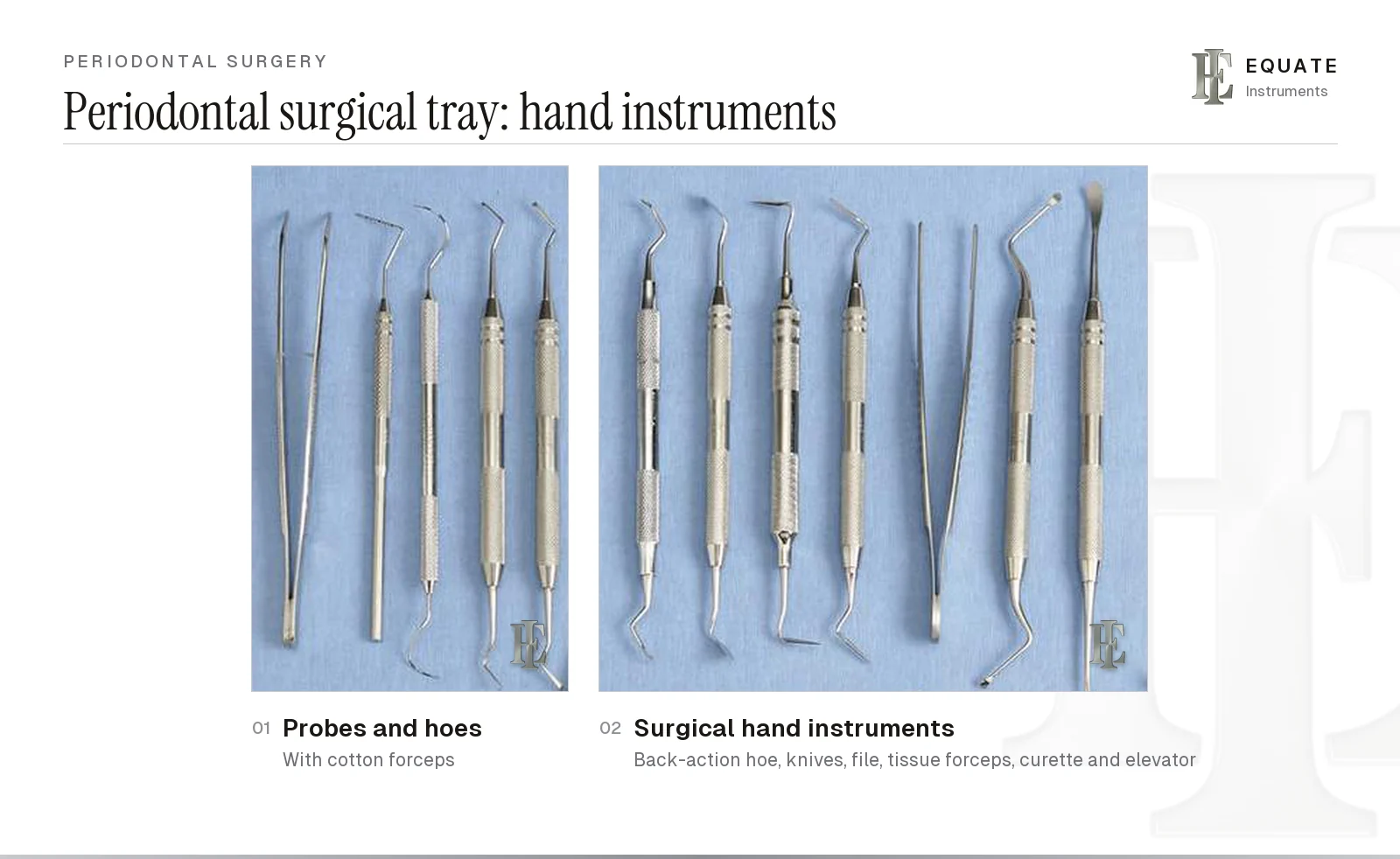
The tray is the universal surgical tray with a periodontal block added between the examination instruments and the closing instruments. Boyd's periodontal surgical tray opens with a mouth mirror, explorer and cotton forceps before the probes, hoes, knives, bone file, tissue forceps, surgical curette and periosteal elevator; the scissors, blade, haemostat, sutures, needle holder, retractor, mouth prop and a disposable surgical suction tip make up a second row. What each instrument is, and how the patterns differ, is set out in the periodontal instruments guide.
| Instrument | What it is for | Guide |
|---|---|---|
| Mouth mirror, explorer, cotton forceps | Examine, retract and carry small items | Dental explorers |
| Periodontal probe and furcation probe | Measure pockets and furcation involvement | Periodontal probes |
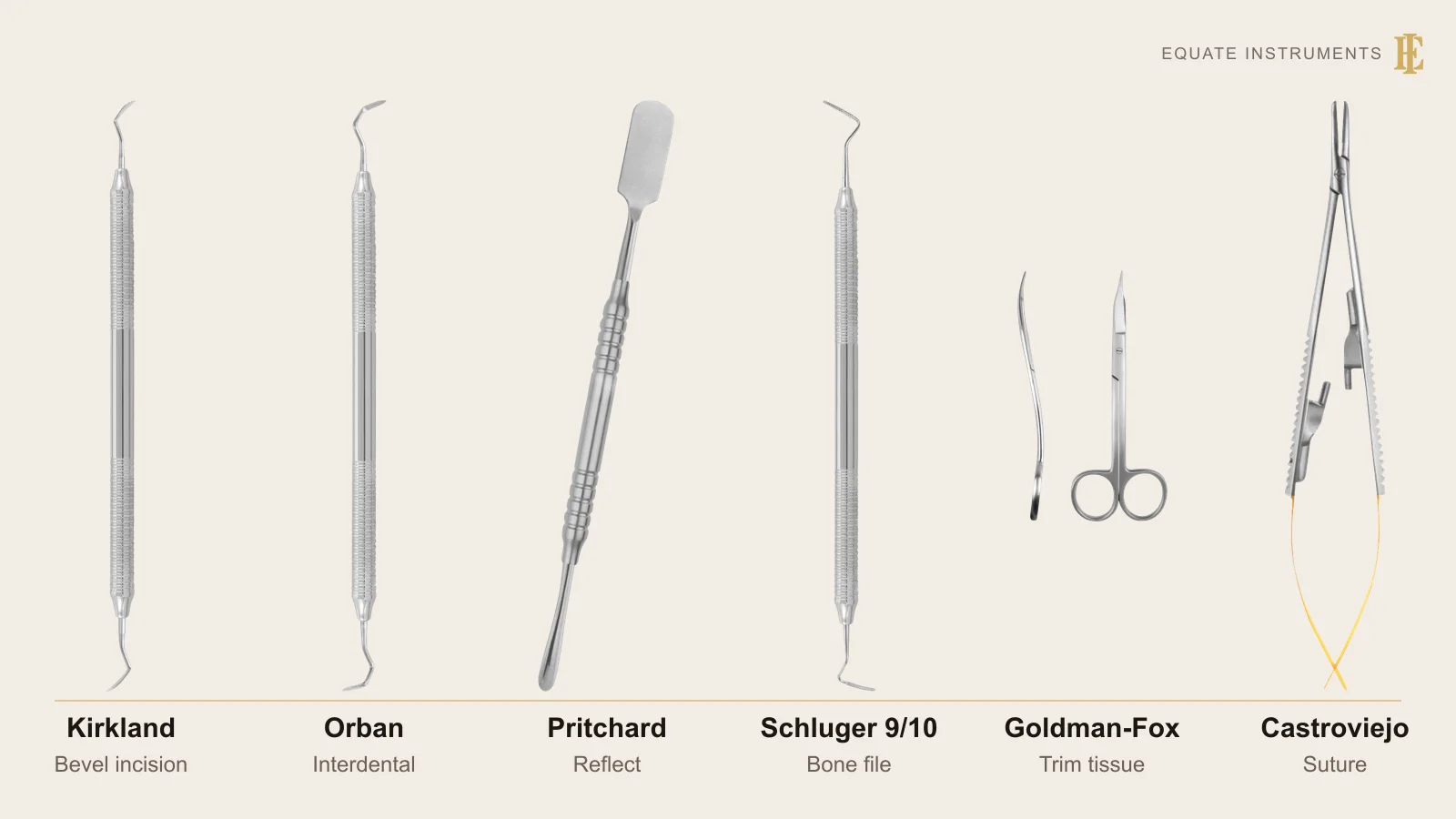
| Kirkland knife | Broad external bevel incision on facial and lingual gingiva | Periodontal knives |
| Orban knife | Cut the interdental tissue | Periodontal knives |
| Scalpel handle and No. 15 or 12 blade | Sulcular and internal bevel incisions | Scalpel handles |
| Periosteal elevator | Reflect the flap | Periosteal elevators |
| Curettes and scalers | Debride roots and remove tissue | Curettes, scalers |
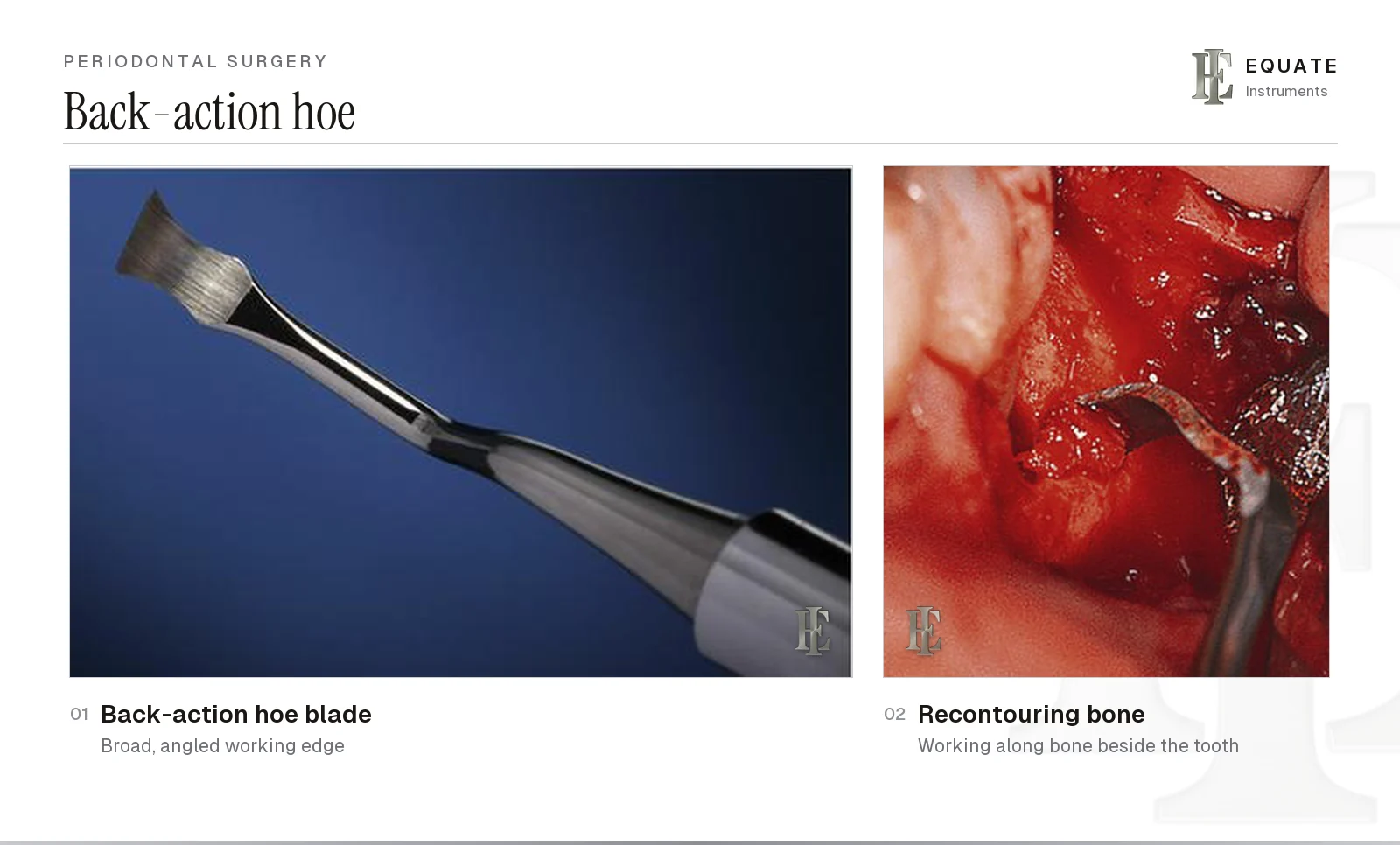
| Mesial/distal and buccal/lingual hoes, back-action hoe | Heavy deposits; fine crestal bone reshaping | Periodontal instruments guide |
| Surgical curette | Remove granulation tissue from defects | Surgical curettes |
| Bone file and rongeur | Smooth and recontour bone | Dental rongeurs and bone files, bone chisels |
| Tissue forceps, tissue scissors, haemostat | Hold and trim soft tissue | Tissue forceps, hemostats |
| Needle holder, sutures, suture scissors | Close the flap | Needle holders |
| Minnesota retractor, mouth prop, disposable surgical suction tip | Access and a clear field | Dental retractors, surgical suction tips |
What is the difference between gingivectomy and flap surgery?
A gingivectomy cuts away excess gingiva; a flap procedure lifts the gingiva to reach the roots and bone and then puts it back. Boehm and Kim's StatPearls overview of periodontal surgery notes that gingivectomy suits pockets formed by thick, fibrous gingiva with no bone defect underneath, as in drug-induced overgrowth or altered passive eruption, and that it does not treat bony defects. Michael Newman and Fermin Carranza's Clinical Periodontology covers the incision designs and instruments for both.
| Gingivectomy | Flap surgery | |
|---|---|---|
| Main aim | Remove excess gingiva and pseudopockets | Access roots and bone, then reposition tissue |
| Key cutting instruments | Kirkland and Orban knives | Scalpel with No. 15 or 12 blade |
| Bone defects | Not treated | Can be treated, with bone files, rongeurs or chisels |
| Closure | Healing by secondary intention, sometimes under a dressing | Sutures |
In what order is the tray laid out?
Boyd's photographed tray groups the instruments by type, in the sequence given in the checklist above. Many clinics instead lay the periodontal block out in the order the operation runs, and that is the layout described here. Choose one and keep it the same for every case, so the assistant can pass instruments without searching. Set out the examination instruments and probes on the left, then the knives and scalpel, the periosteal elevator, the debridement instruments from the finest curette to the hoes, the bone instruments, and the suturing instruments on the right. Keep the knives and curettes in a rack or slotted cassette so the blades don't touch each other; edges that knock together in a tray go blunt quickly.
What else is needed besides the instruments?
- Local anaesthetic on its own tray, with vasoconstrictor if appropriate for the patient.
- Sterile saline or sterile water for irrigation through a sterile syringe. The CDC's 2003 guidelines count any incision, excision or reflection of tissue that exposes normally sterile areas as oral surgery, which covers both gingivectomy and flap surgery, and call for a sterile irrigant and sterile surgeon's gloves.
- Sutures, most often 4-0 or 5-0, and a periodontal dressing if the operator uses one.
- Sterile gauze, sterile surgeon's gloves, mask, eye protection and gown.
- The periodontal chart and radiographs.
How are periodontal surgery instruments reprocessed?
The knives, scalpel, curettes, scalers, elevators and bone instruments enter soft tissue or bone, so the CDC classes them as critical items to be cleaned and then heat-sterilised; the probes go through the same cycle. Clean first, in an ultrasonic cleaner or washer-disinfector, with hinged instruments open. Then inspect the knives, curettes and scalers for sharpness, sharpen if needed, and pack them with a chemical indicator. Sharpen after cleaning, so the stone never touches a contaminated blade. Retire knives and curettes whose blades have become thin or lost their shape. Follow each manufacturer's ISO 17664-1 instructions and, in England, HTM 01-05. Carry the set in an instrument cassette so the edges stay protected; the full routine is in the sterilisation guide.
What are the common mistakes?
- Starting a gingivectomy with a blunt Kirkland knife, which shreds the tissue instead of cutting a clean bevel.
- Choosing gingivectomy where there is a bone defect or too little attached gingiva to remove.
- Leaving tissue tags in the interdental area, where they delay healing.
- Letting knives and curettes rattle together loose in the tray.
- Forgetting the furcation probe, so furcation involvement is missed before the flap is raised.
Build this tray with Equate
Equate's catalogue lists the periodontal knives in its restorative and operative family: 5 Kirkland gingivectomy knives (including 13K/14K and 15K/16K), 3 Orban knives, 11 Goldman-Fox knives, Widman, Towner and Crane-Kaplan knives, and 2 Sanders interdental knives. There are 3 Pritchard and 6 Goldman-Fox periosteal elevators, bone files in Schluger 9/10 and Sugarman patterns alongside bone file rasps, and 7 furcation probes. Closure is covered by 8 gum scissors (Goldman-Fox, La Grange and Dean double-curved) and 16 needle holders in Castroviejo, Boynton and Kalt patterns. Equate does not list a back-action hoe; the nearest equivalent is the Rhodes back-action chisel among its bone chisels.
Instruments are passivated stainless steel, ultrasonically cleaned, shape-, boil- and performance-tested and individually packed, and designed in Finland. Clinics can request samples and a quote.
The Equate difference
Equate lists 91 instruments across the 11 subcategories on this tray, including 5 Kirkland and 3 Orban knives, 11 Goldman-Fox periodontal knives, 2 Sanders interdental knives, 9 Pritchard and Goldman-Fox periosteal elevators, Schluger and Sugarman bone files, 7 furcation probes and 16 needle holders in Castroviejo, Boynton and Kalt patterns.
Equate Periodontal Surgery Tray Setup options

Nabers Furcation Probe - Solid Handle 6mm
EI-0131
Furcation Probe - Double-Ended Hollow Handle
EI-0882
Nabers Probe (Ball-End) - Double-Ended Hollow Handle
EI-0883
Furcation Probe - Double-Ended, Premium Textured Silicone Handle
EI-1102
Nabers Probe (Ball-End) - Double-Ended, Premium Textured Silicone Handle
EI-1103
Furcation Probe - Orange Slim Silicone Handle
EI-1184
Nabers Probe (Ball-End) - Orange Slim Silicone Handle
EI-1185
Kirkland Gingivectomy Knife Fig. 15K/16K - Titanium-Coated Solid Handle
EI-0056
Kirkland 13K/14K Gingivectomy Knife - Hollow Handle
EI-0071
Widman Curved Periodontal Knife
EI-0228
Kirkland 13K-TG Gingivectomy Knife - Solid Handle 6mm
EI-1900
Kirkland Knife - Solid Handle 6mm
EI-1957Browse all restorative & operative instruments Browse all oral surgery instruments Browse all periodontal & hygiene instruments Browse all endodontic instruments
Buying in your market
Frequently asked questions
What instruments go on a periodontal surgery tray?
A mirror, explorer and cotton forceps; periodontal and furcation probes; Kirkland and Orban knives and a scalpel; a periosteal elevator; curettes, scalers and hoes; a bone file and rongeur; tissue forceps and scissors; and a haemostat, needle holder, sutures and suture scissors, with a retractor, mouth prop and surgical suction tip for access.
What is the difference between a Kirkland and an Orban knife?
The Kirkland has a wide, rounded blade with an edge on every side, and it makes the long external bevel cut of a gingivectomy along the facial or lingual gingiva. The Orban has a slim, pointed blade that slips between the teeth to free the interdental tissue. The periodontal knives guide compares the patterns.
Do periodontal knives need sharpening?
Yes. Check each edge after cleaning and before sterilisation, and sharpen or replace any knife that drags. A sharp blade cuts a clean bevel; a blunt one tears the gingiva and leaves ragged margins.
When is a gingivectomy chosen over a flap?
When pockets are caused by thick gingiva with no bone defect beneath them and there is enough attached gingiva to remove some. Bony defects need a flap.
Is a periodontal dressing needed after gingivectomy?
Not always. Baghani and Kadkhodazadeh's 2013 review found no agreement on whether dressings are needed after periodontal surgery and judged them unnecessary over undisplaced flaps that return to their original position, where bleeding and root sensitivity are minimal. When a dressing is placed it usually stays for 3 to 14 days. The review groups dressings into zinc oxide with eugenol, zinc oxide without eugenol, and types with neither, such as cellulose-based dressings.
What sutures are used for periodontal flap surgery?
In a 2019 survey of 136 dentists by Koyuncuoglu and colleagues, about half chose 4-0 or 5-0 sutures for flap surgery, three-quarters chose non-resorbable material, and a 3/8-circle reverse-cutting needle was the most popular. The paper also cites earlier work showing that braided silk provokes more tissue inflammation than monofilament, which is worth weighing because silk is the traditional choice for this tray.
References
- Newman MG, Takei HH, Klokkevold PR, Carranza FA. Newman and Carranza's Clinical Periodontology, 13th edition. Elsevier, 2018
- Boehm TK, Kim CS. Overview of Periodontal Surgical Procedures. StatPearls, StatPearls Publishing, 2024
- Kohn WG, Collins AS, Cleveland JL, Harte JA, Eklund KJ, Malvitz DM. Guidelines for Infection Control in Dental Health-Care Settings, 2003. MMWR Recommendations and Reports 52(RR-17), Centers for Disease Control and Prevention, 2003
- Department of Health. Health Technical Memorandum 01-05: Decontamination in primary care dental practices, 2013 edition (NHS England)
- ISO 17664-1:2021. Processing of health care products — Information to be provided by the medical device manufacturer for the processing of medical devices — Part 1: Critical and semi-critical medical devices
- Boyd LB. Dental Instruments: A Pocket Guide, 7th edition. Saunders/Elsevier, 2020. Chapter 16, Periodontal Instruments and Periodontal Surgical Instruments (photographs used under licence)
- Baghani Z, Kadkhodazadeh M. Periodontal Dressing: A Review Article. J Dent Res Dent Clin Dent Prospects 2013;7(4):183–191
- Koyuncuoglu CZ, Yaman D, Kasnak G, Demirel K. Preference of Suture Specifications in a Selected Periodontal and Implant Surgeries in Turkey. Eur J Dent 2019;13(1):108–113
- British Society of Periodontology. Basic Periodontal Examination (BPE), 2019
I am a…
Related
- Periodontal Instruments Explained: Probes, Hoes, Knives and Files
- Periodontal Knives (Gingivectomy and Interdental Knives)
- Periosteal Elevators: Molt 9, Freer, Buser and Other Patterns
- Dental Curettes
- Periodontal Probes
- Oral Surgery Tray Setup
- Dental Scalers (Hand Scalers)
- Surgical Curettes (Bone Curettes) for Oral Surgery
- Dental Rongeurs and Bone Files
- Bone Chisels and Surgical Mallets in Dentistry