Dental Hand Cutting Instruments: How Hatchets, Hoes, Chisels and Trimmers Differ and How to Use Them
Written by the Equate Instruments Technical Team · Reviewed by the Medical & Dental Board, Equate Instruments · Updated ·
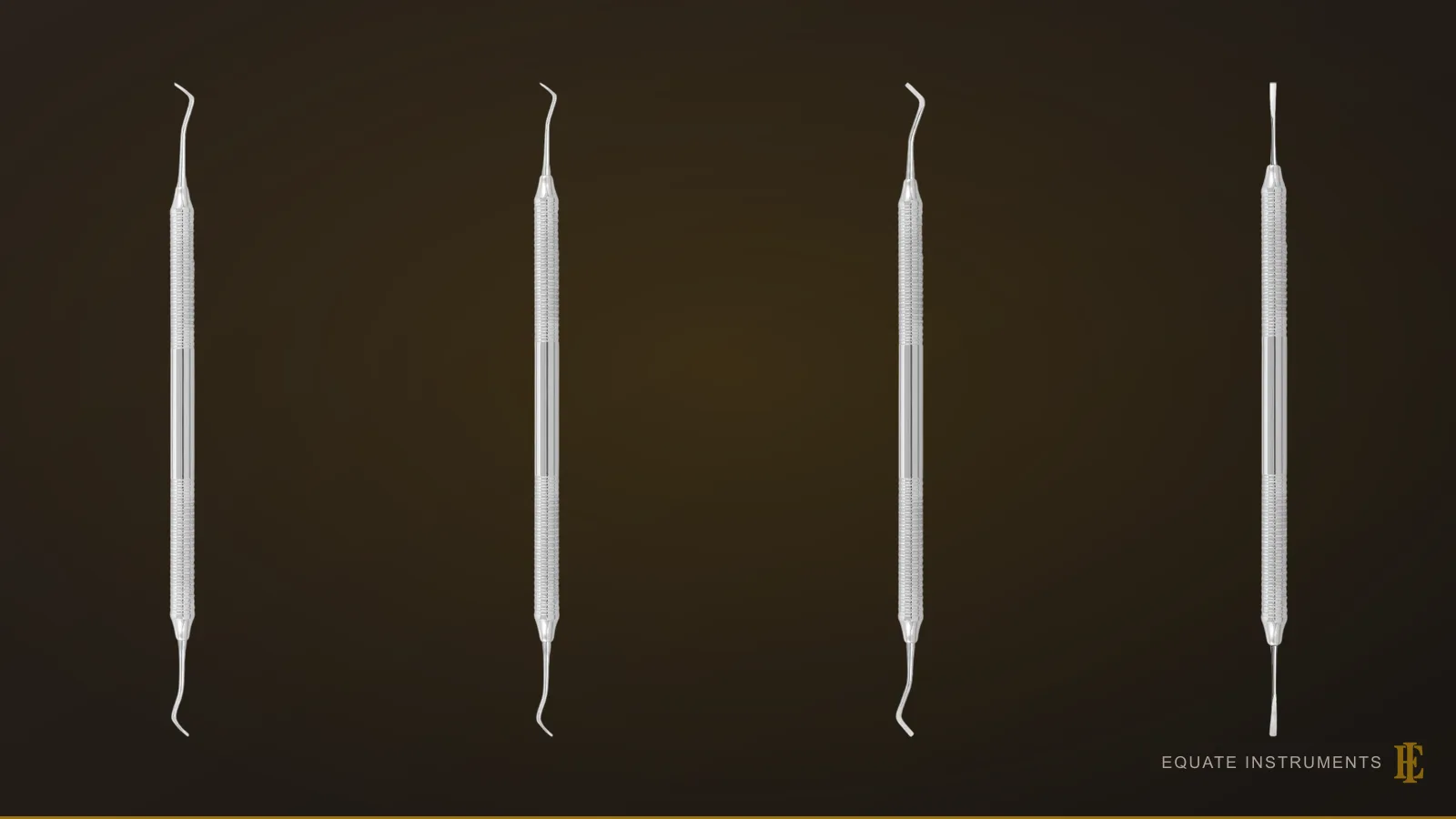
Dental hand cutting instruments are sharp, mostly single-bevelled blades that finish a cavity preparation after the bur. They differ in where the cutting edge faces: a chisel's edge crosses the blade and is pushed, a hoe's is bent towards the operator and pulled, and hatchets and gingival margin trimmers cut sideways along a wall or the gingival margin.
Key points
- A hatchet's cutting edge lies in the same plane as the handle, while a hoe's edge sits across it and is used with a pull stroke.
- Black's formula gives blade width in tenths of a millimetre, blade length in millimetres and angles in centigrades, or hundredths of a circle, though some quick-reference guides give the angles in degrees.
- Gingival margin trimmers come in pairs: a cutting-edge angle of 90 to 100 marks the distal pair and 75 to 85 the mesial pair.
What are hand cutting instruments used for in dentistry?
Hand cutting instruments finish a cavity preparation once the bur has done the bulk work: they split away enamel that has lost its dentine support, plane the walls smooth, sharpen line and point angles and bevel the gingival margin of a Class II box. Enamel breaks along the direction of its rods, so a sharp blade pushed along that direction cleaves off a loose lip of enamel cleanly, with no heat and no vibration.
Farhad Hadavi's teaching notes on instrumentation for cavity preparation, published by Columbia University, point out that hand cutters remove undermined enamel readily but cut sound enamel poorly, which makes them self-limiting and precise near the pulp, the gingiva and the adjacent tooth. They sit on the amalgam and composite trays next to the spoon excavator, which removes soft dentine, and the dental explorer, which checks the margins. The restorative instruments hub covers the filling instruments that follow them.
These are tooth instruments. Surgical chisels for bone, used with a mallet, are a different design and are covered on the bone chisels and mallets page.
What types of hand cutting instrument are there?
There are seven classic designs, grouped by the shape of the blade and the direction in which its cutting edge faces. Columbia University's operative dentistry notes sort them into two families: in the chisel family the edge runs across the plane of the instrument, and in the hatchet family it lies along it. The spoon excavator, a curved-blade relative of the hatchet used for caries removal, has its own spoon excavators page.
| Instrument | Cutting edge | Main use | Stroke | Family |
|---|---|---|---|---|
| Enamel hatchet | In the same plane as the handle; made in right and left pairs | Cleaving enamel on proximal walls and refining box walls | Push and lateral | Hatchet |
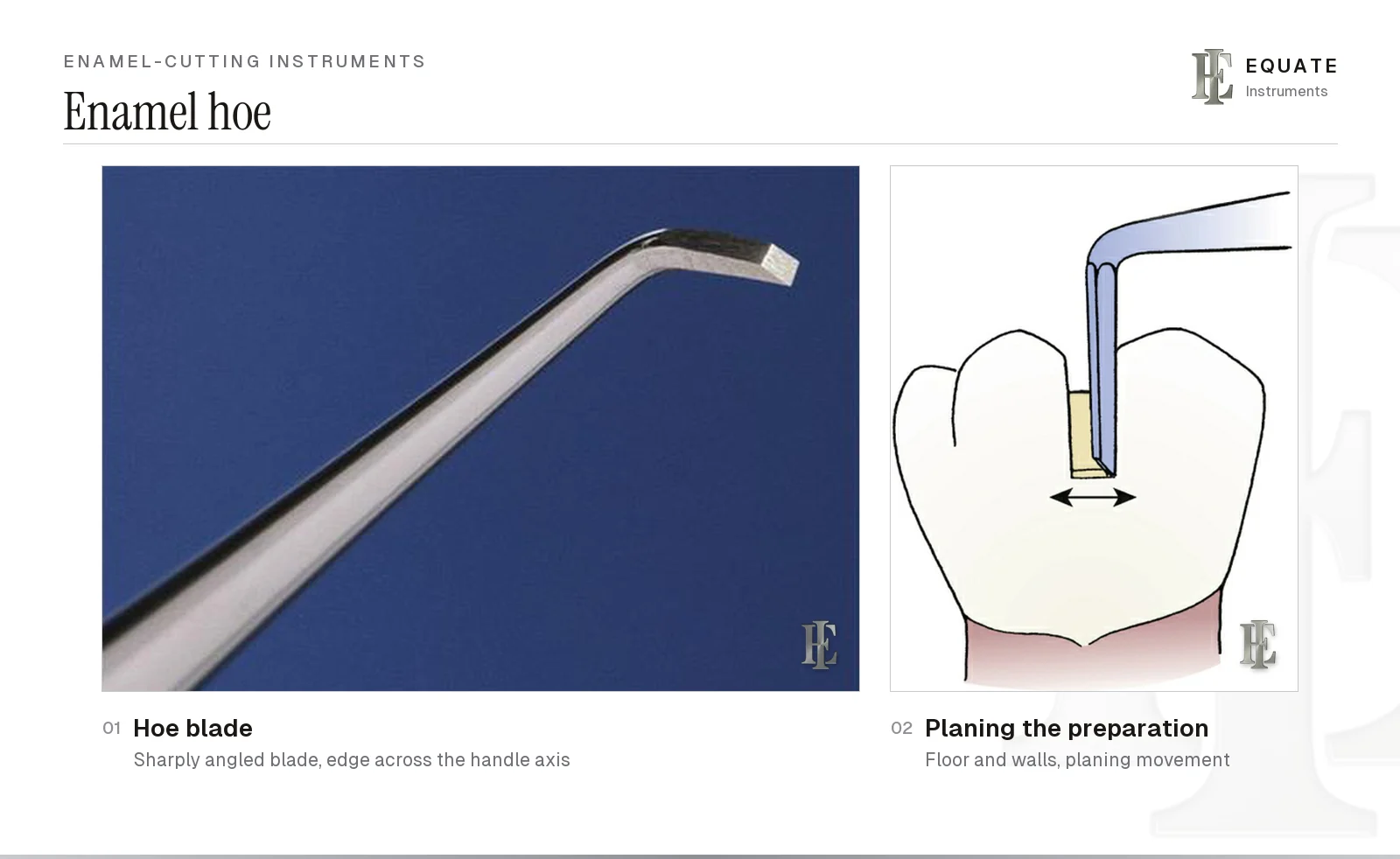
| Enamel hoe | Across the line of the handle, with the blade angled sharply | Planing floors and walls, especially in Class III and V forms | Pull | Chisel |
| Straight chisel | Roughly square to a straight shank and blade | Planing and cleaving enamel on accessible walls | Push | Chisel |
| Wedelstaedt chisel | Square to a gently curved shank and blade | Cleaving enamel where a straight chisel can't reach | Push | Chisel |
| Binangle chisel | Square to the blade, with two bends in the shank | Planing enamel in posterior teeth | Push | Chisel |
| Angle former | Ground at an angle to the blade, giving three cutting edges | Sharpening line and point angles and placing retention | Lateral scraping | Chisel |
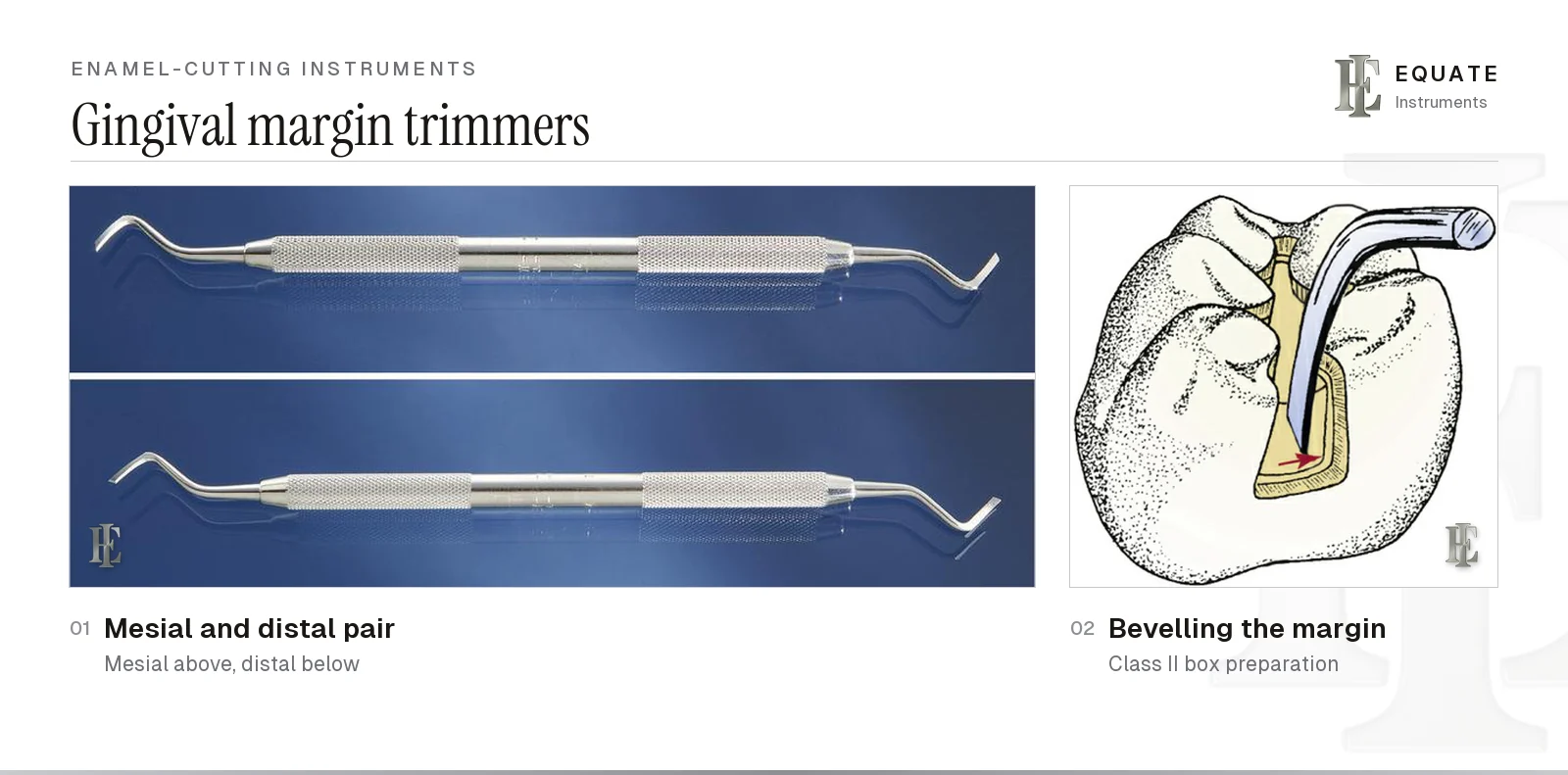
| Gingival margin trimmer | Angled edge on a curved blade; mesial and distal pairs | Bevelling the gingival margin of a proximal box | Lateral scraping | Hatchet |
What is the difference between a hatchet, a hoe and a chisel?
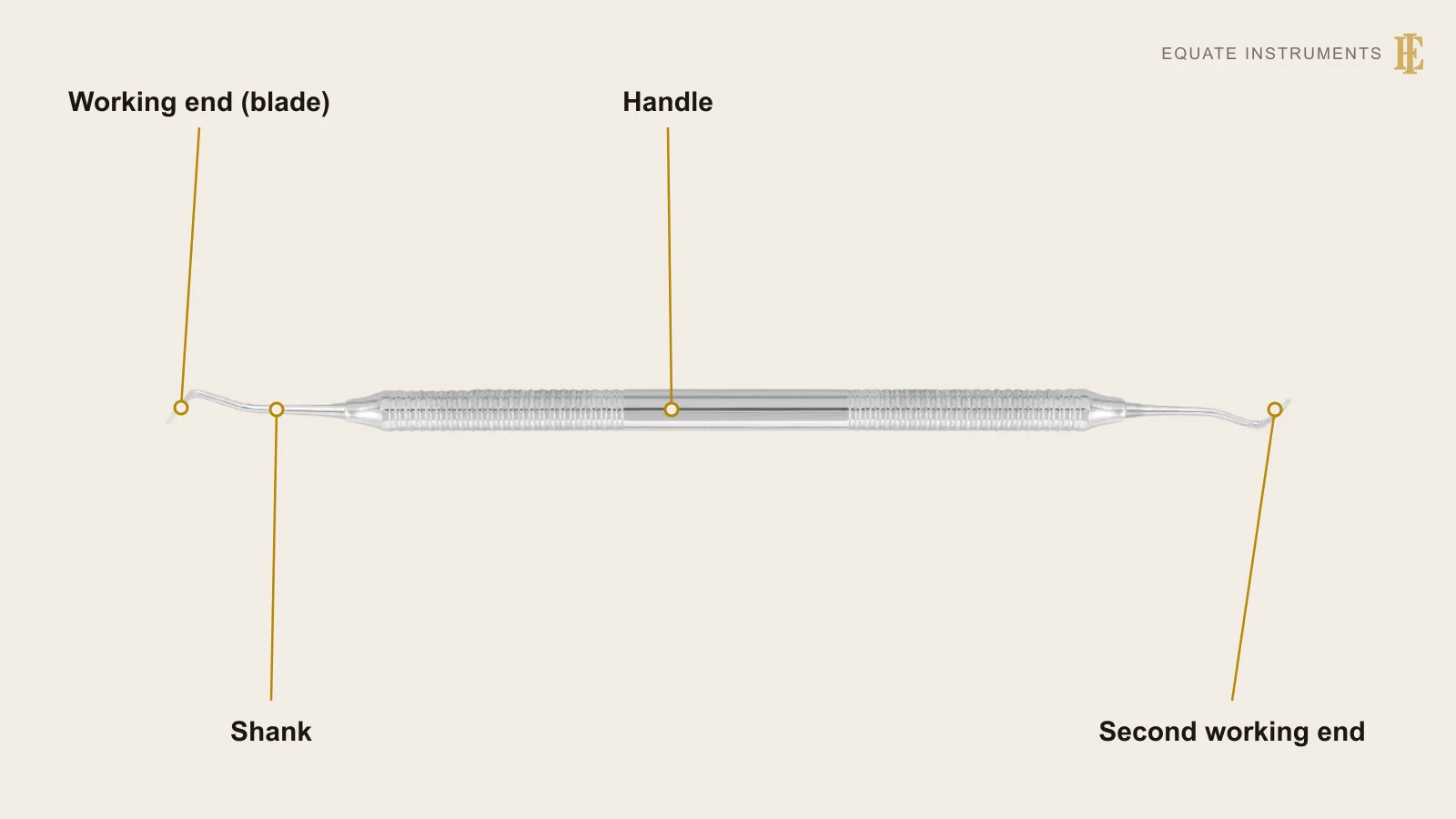
The difference is the direction the cutting edge faces relative to the handle. A chisel's edge is roughly at right angles to its blade, so it's driven forward like a carpenter's chisel. A hatchet's edge lies in the same plane as the handle, like an axe, so it cuts towards the side, which suits the proximal walls of a box. A hoe is a chisel whose blade is bent sharply, at an angle approaching a right angle to the handle, and it's pulled towards the operator rather than pushed.
Hadavi describes the angle former as a modified chisel and the gingival margin trimmer as a modified hatchet whose curved blade makes it a lateral cutter for the gingival margin.
How does G. V. Black's instrument formula work?
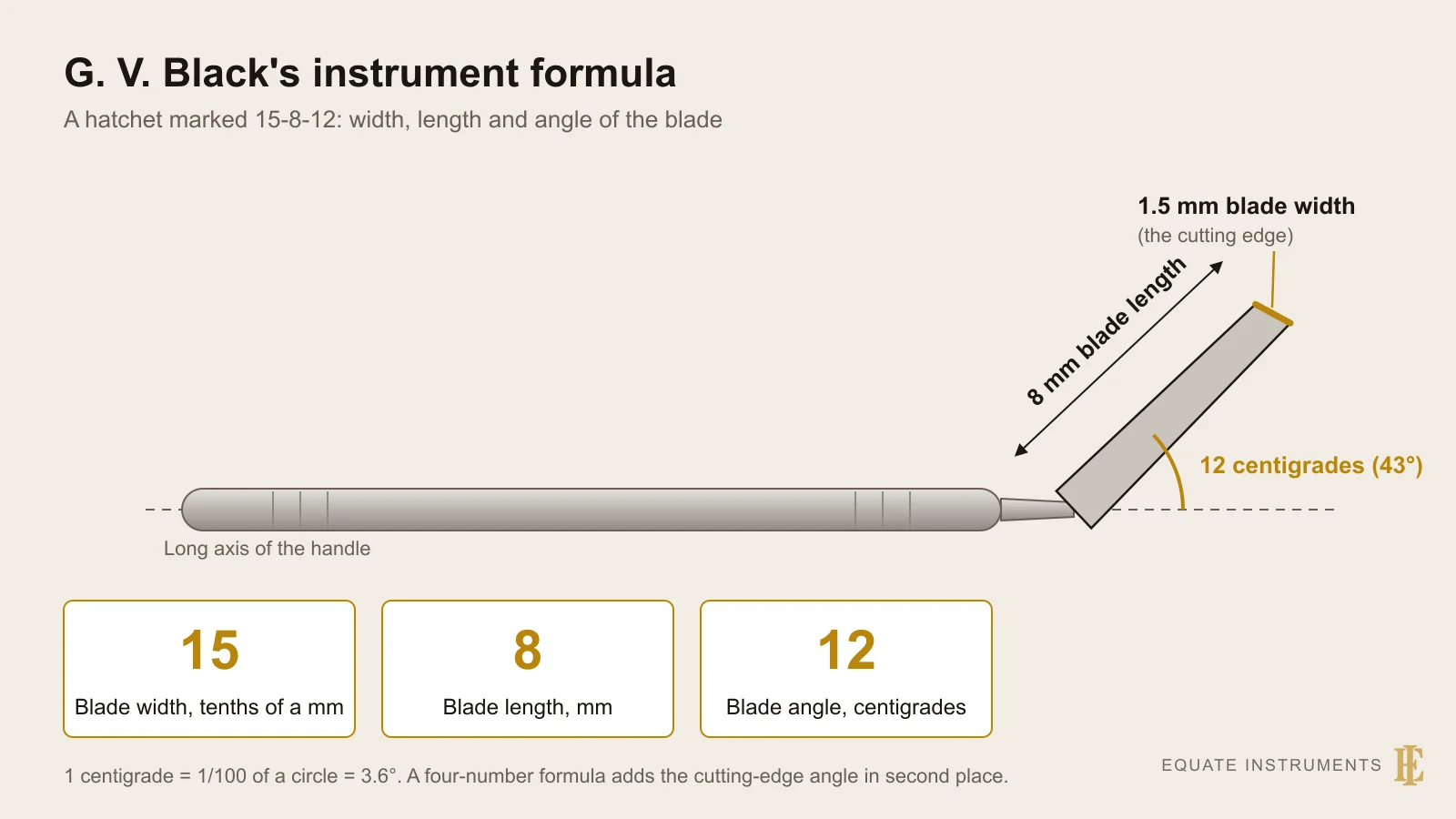
Black's formula describes the blade in three or four numbers: width in tenths of a millimetre, length in millimetres and the blade's angle to the long axis of the handle, so a 15-8-12 hatchet has a 1.5 mm wide, 8 mm long blade turned 12 units from the handle. Sturdevant and Hadavi give the angles in centigrades, hundredths of a circle worth 3.6 degrees each; some quick-reference guides, including Boyd's pocket guide, simplify this to degrees. Greene Vardiman Black (1836–1915) set out the formula in A Work on Operative Dentistry, along with a name of up to four parts for every instrument (order, suborder, class and subclass), which is why a binangle chisel is named for both its shank and its blade. Book photographs of each blade and its formula are in the enamel-cutting instruments guide.
When the cutting edge isn't at right angles to the blade, a fourth number for the edge angle goes in second place, which is why angle formers and gingival margin trimmers carry four numbers. Hadavi's notes give 15-95-8-14 as a typical distal trimmer and 15-80-8-14 as a mesial one. Sturdevant's rule is 90 to 100 in second place for a distal pair and 75 to 85 for a mesial pair, with 90 and 85 pairs for the gentle gingival bevel of an amalgam box and 100 and 75 pairs for the steeper bevels of inlays and onlays.
| Position | Three-number formula | Four-number formula | Unit |
|---|---|---|---|
| 1st | Blade width | Blade width | Tenths of a millimetre |
| 2nd | Blade length | Cutting-edge angle to the handle | Millimetres / centigrades |
| 3rd | Blade angle to the handle | Blade length | Centigrades / millimetres |
| 4th | None | Blade angle to the handle | Centigrades |
What do the bevels on a hand cutting instrument tell you?
The bevel tells you which way the instrument cuts and which member of a pair you're holding. Most hand cutters are single-bevelled: one bevel forms the primary cutting edge at the end of the blade, and the sides of the blade form two secondary edges. Instruments used in pairs, such as hatchets, spoon excavators and gingival margin trimmers, are made as right and left versions. Sturdevant's test is to hold the instrument with the primary edge down and pointing away from you: if the bevel is on the right, it's the right-hand instrument. Wedelstaedt and binangle chisels are instead described as mesial-bevel or distal-bevel, according to which side of the blade carries the bevel; the enamel-cutting instruments guide shows how to tell the two apart.
For lateral scraping, the stroke runs from the bevelled side of the blade towards the unbevelled side, so the edge bites rather than skates.
How do you hold and use hand cutting instruments safely?
Use a modified pen grasp with a firm finger rest on a tooth in the same arch, as close to the working site as you can. The closer and harder the rest, the more force you can apply safely, because a sharp blade that slips can cut the tongue, cheek or gingiva in a moment; working under rubber dam, placed with the rubber dam instruments, protects the soft tissue.
Keep the blade parallel to the wall you're planing, so it shaves off unsupported enamel rods rather than gouging the wall. Push chisels and hatchets, pull hoes, and use trimmers and angle formers with a lateral scraping stroke. Common mistakes are using the wrong member of a pair, so the bevel faces the wrong way; using a mesial trimmer on a distal margin; levering with the blade, which chips the edge; and carrying on with a dull edge, which crushes enamel instead of cleaving it. Sturdevant's textbook accepts four grasps for these instruments:
- Modified pen grasp: the usual choice, with the tip of the ring finger, or the ring and little fingers, resting on a nearby tooth in the same arch.
- Inverted pen grasp: used mostly for preparations reached from the lingual side of anterior teeth.
- Palm-and-thumb and modified palm-and-thumb grasps: the other two grasps the textbook accepts.
- Conventional pen grasp: not an acceptable grasp for these instruments, according to the same textbook.
What does the Equate range include?
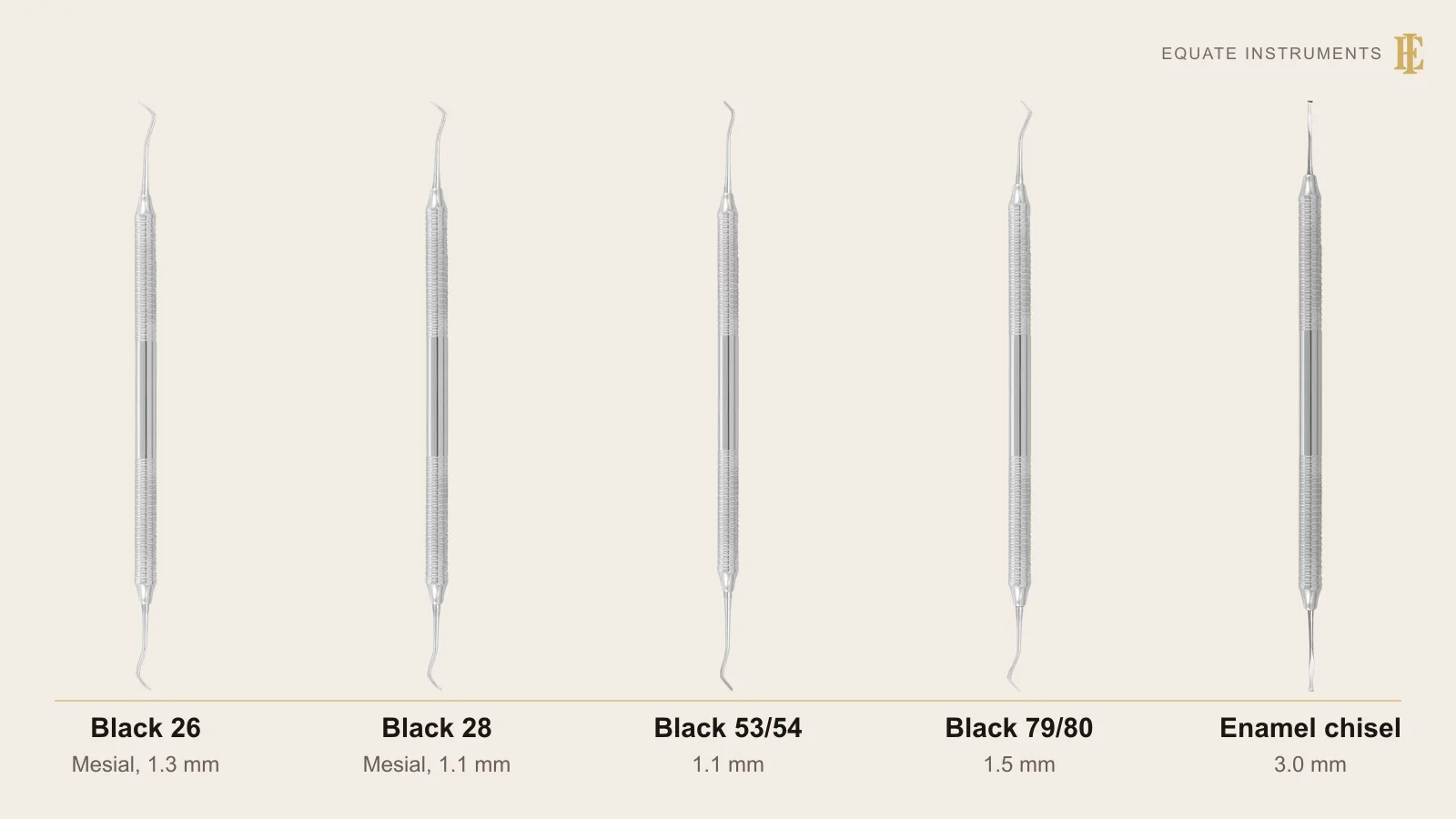
Equate's hand cutting range is built around G. V. Black-pattern double-ended instruments: figures 26, 27, 28 and 29 with 1.1 to 1.3 mm blades, and figures 51/52, 53/54, 77/78 and 79/80 with 1.1 to 1.5 mm blades, all on knurled 6 mm solid handles. Beside them are a mesial and a distal gingival margin trimmer with 1.2 mm blades and two double-ended 3.0 mm enamel chisels on 6 mm solid handles. Wedelstaedt-pattern instruments in 1.3, 1.6 and 2.1 mm are listed with the interproximal instruments on the dental carvers page.
The current catalogue doesn't list enamel hoes, binangle chisels or angle formers; they're illustrated in the enamel-cutting instruments guide. Periodontal hoe scalers, which remove calculus rather than enamel, are on the dental scalers page. Every instrument is passivated stainless steel, ultrasonically cleaned, shape-, boil- and performance-tested and individually packed, and clinics can request samples and a quote.
When you replace an instrument, match the Black formula on the handle to the one you already use, so the new blade behaves the same way, and keep the restorative set together in one cassette so mesial and distal pairs and right and left blades stay complete.
How do you sharpen, clean and sterilise hand cutting instruments?
Hand cutters need sharpening more than any other restorative instrument. Sharpen on a fine flat stone, holding the blade so the stone follows the original bevel exactly, then test the edge. Vyprynyuk and Chitlall, in Dimensions of Dental Hygiene, describe two sharpness checks for periodontal instruments: a sterile plastic test stick, kept in every setup, that a sharp curette edge should bite into, and a bright light, under which a dull edge shows a line of reflected light. Both checks carry over to an enamel chisel or hatchet: drawn across an acrylic test stick, a sharp edge catches while a dull one slides, and the light test is the one we suggest before each use. Each sharpening shortens the blade, so replace the instrument when the blade is visibly shorter or the edge won't hold.
Clean and sterilise the instruments in line with the manufacturer's instructions, which ISO 17664-1 requires to cover cleaning, inspection, packaging and sterilisation, and with the CDC's Guidelines for Infection Control in Dental Health-Care Settings or, in UK practices, HTM 01-05. Process them in a cassette or tray so the edges don't knock against other instruments; the amalgam restoration tray setup and the composite restoration tray setup show where they sit. In outline: clean, inspect and dry, pack with an indicator inside and outside, steam sterilise, check both indicators and treat any wet or torn pack as non-sterile; the enamel-cutting instruments guide sets out each step.
The Equate difference
Equate lists 12 hand cutting instrument references: eight double-ended G. V. Black-pattern instruments (figures 26, 27, 28, 29, 51/52, 53/54, 77/78 and 79/80, with 1.1 to 1.5 mm blades on 6 mm solid handles), a mesial and a distal 1.2 mm gingival margin trimmer, and two double-ended 3.0 mm enamel chisels on 6 mm solid handles.
Equate Dental Hand Cutting Instruments: How Hatchets, Hoes, Chisels and Trimmers Differ and How to Use Them options

Gingival Margin Trimmer 1.2 mm (Mesial)
EI-0929
Gingival Margin Trimmer 1.2 mm (Distal)
EI-0942
Fig.1 Black/26 Mesial 1.3mm Solid Handle 6mm
EI-2131
Fig.2 Black/27 Mesial 1.3mm Solid Handle 6mm
EI-2132
Fig.3 Black/28 Mesial 1.1mm Solid Handle 6mm
EI-2133
Fig.4 Black/29 Mesial 1.1mm Solid Handle 6mm
EI-2134
Fig.77/78 Black Mesial 1.5mm Solid Handle 6mm
EI-2135
Fig.79/80 Black Mesial 1.5mm Solid Handle 6mm
EI-2136
Fig.1 Black/53-54 1.1mm Solid Handle 6mm
EI-2137
Fig.1 Black/51-52 1.5mm Solid Handle 6mm
EI-2138
Enamel Chisel 3.0 mm, Solid Handle 6 mm
EI-1901
Enamel Chisel 3.0 mm, Solid Handle 6 mm
EI-1902Browse all restorative & operative instruments Browse all oral surgery instruments
Buying in your market
Frequently asked questions
What is a hatchet used for in dentistry?
An enamel hatchet cleaves and planes enamel on the walls of a cavity preparation, especially the proximal walls of a Class II box. Its cutting edge lies in the same plane as the handle, so it cuts to the side, and it's made in right and left pairs.
What is a hoe instrument in dentistry?
An enamel hoe is a chisel-type hand cutter whose blade is bent at a steep angle to the handle, so its edge faces across the handle. It's used with a pull stroke to plane the floor and walls of a preparation.
What is the difference between a dental chisel and a hatchet?
A chisel's cutting edge is roughly at right angles to its blade and it's pushed forward. A hatchet's edge lies in the plane of the handle, like an axe, so it cuts laterally against a wall.
How do you tell a mesial from a distal gingival margin trimmer?
Read the second number of the four-number formula. A value of 90 to 100 marks the distal pair and 75 to 85 the mesial pair, so 15-95-8-14 is distal and 15-80-8-14 is mesial.
Is a dental enamel chisel the same as a bone chisel?
No. An enamel chisel is a fine hand instrument for planing tooth enamel. A bone chisel is a heavier surgical instrument for cutting bone, often struck with a mallet.
What is the difference between an enamel hatchet and a gingival margin trimmer?
A gingival margin trimmer is a modified hatchet. Its blade is curved, which strengthens its sideways scraping action, and its cutting edge is set at an angle to the blade, so it carries a four-number formula. Trimmers come as a mesial and a distal pair for the gingival margins of a Class II box.
Where are mesial and distal trimmers used in a Class II box?
Each trimmer planes the gingival margin of its own box and rounds the axiopulpal line angle there. Columbia University's teaching notes add that each can also deepen the retention groove at the axiogingival line angle of the opposite box, so the distal trimmer does that job in a mesial box.
References
- Hadavi F. Instruments and general instrumentation for cavity preparation. Teaching notes published by Columbia University
- Black GV. A Work on Operative Dentistry. Chicago: Medico-Dental Publishing, 1908 (instrument nomenclature and formula)
- Ritter AV, Boushell LW, Walter R (eds). Sturdevant's Art and Science of Operative Dentistry, 7th edition. Elsevier, 2019 (ch. 14, Instruments and Equipment for Tooth Preparation, online)
- Donovan TE, Eidson RS. Instruments and equipment for tooth preparation. In: Heymann HO, Swift EJ, Ritter AV (eds). Sturdevant's Art and Science of Operative Dentistry, 6th ed. Elsevier, 2013
- Kohn WG, et al. Guidelines for Infection Control in Dental Health-Care Settings, 2003. MMWR 52(RR-17), Centers for Disease Control and Prevention
- ISO 17664-1:2021 Processing of health care products: information to be provided by the medical device manufacturer for the processing of medical devices, Part 1: critical and semi-critical medical devices
- Department of Health (England). Health Technical Memorandum 01-05: Decontamination in primary care dental practices, 2013 edition
- Boyd LB. Dental Instruments: A Pocket Guide, 7th edition. Saunders/Elsevier, 2020. Chapter 2, Enamel-Cutting Instruments (photographs used under licence)
- Columbia University. Operative Dentistry: Hand Instruments. Teaching notes, 2007
- Vyprynyuk K, Chitlall A. Maintain the sharp cutting edge of periodontal instruments. Dimensions of Dental Hygiene, February 2022
I am a…
Related
- Restorative Dental Hand Instruments
- Spoon Excavators (Dental Excavators)
- Dental Explorers
- Bone Chisels and Surgical Mallets in Dentistry
- Dental Carvers: Types of Carvers in Dentistry and the Lab
- Amalgam Restoration Tray Setup
- Enamel-Cutting Instruments and G.V. Black's Instrument Formula
- Amalgam Restorative Instruments: What Each One Does
- Dental Burs and Rotary Instruments: Types, Shanks and Uses
- Composite Restoration Tray Setup (Class I to V)
- Dental Instrument Cassettes, Trays and Boxes