Periodontal Instruments Explained: Probes, Hoes, Knives and Files
Written by the Equate Instruments Technical Team · Reviewed by the Medical & Dental Board, Equate Instruments · Updated ·
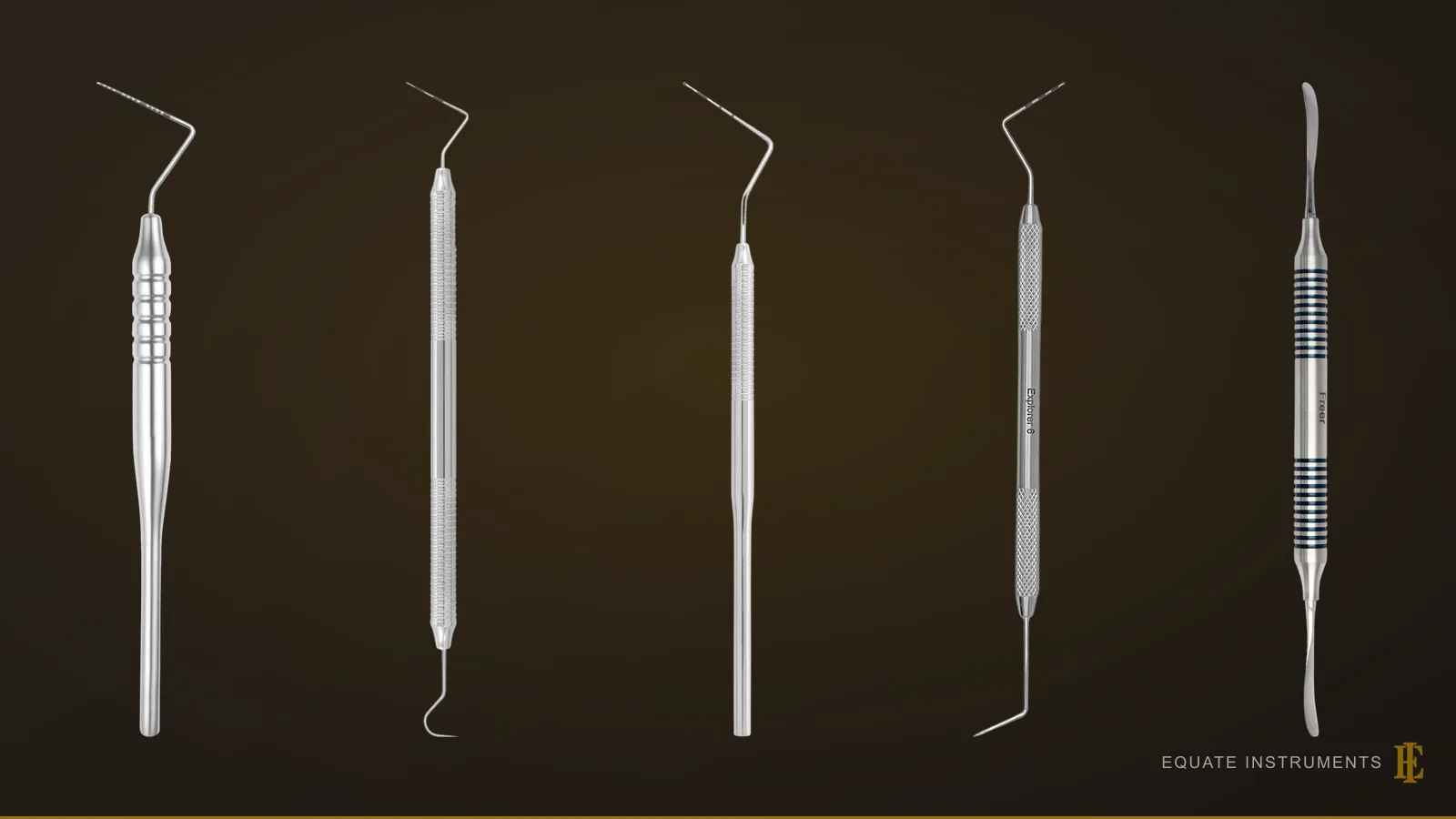
Periodontal instruments are the hand instruments used to assess and treat the gums, bone and root surfaces around teeth. They fall into two groups: diagnostic instruments such as periodontal and furcation probes, and treatment or surgical instruments such as hoe scalers, back-action hoes, kidney-shaped gingivectomy knives, spear-point interdental knives and interdental files.
Key points
- Probes come first: a millimetre-marked probe records pocket depth, and a curved furcation probe checks the bone between the roots of molars and upper premolars.
- Hoes and files remove heavy deposits, while kidney-shaped and spear-point knives shape and release gingival tissue during gingivectomy and flap procedures.
- Every reusable instrument on a periodontal tray is cleaned, packed with a process indicator and steam sterilised after each patient; blades, sutures and surgical suction tips are single-use.
What are periodontal instruments?
Periodontics deals with the tissues that hold a tooth in place: the gingiva, the periodontal ligament, the cementum on the root and the alveolar bone. The instruments in Linda Bartolomucci Boyd's Dental Instruments: A Pocket Guide (Elsevier) chapter on periodontics cover two jobs. Probes measure and map disease, and a small group of hoes, knives and files remove deposits, cut gingiva and smooth bone when non-surgical care is not enough.
Most of these instruments sit on top of a basic setup of mirror, explorer and cotton forceps. Scalers and curettes used for routine debridement are covered in the dental hygiene instruments guide, and general surgical items such as scalpels, needle holders and scissors in the universal surgical instruments guide.
| Instrument | What it is used for | Typical patterns |
|---|---|---|
| Periodontal probe | Recording pocket depth, recession, bleeding and attachment loss | Williams, UNC 15, CP-12, WHO ball-ended, plastic probes for implants |
| Furcation probe | Detecting and grading bone loss between the roots of multirooted teeth | Nabers, single or double-ended, colour-banded |
| Hoe scaler | Pull-stroke removal of heavy, ledge-like calculus | Mesial/distal and buccal/lingual pairs; anterior and posterior shanks |
| Back-action hoe | Fine reshaping of crestal bone next to teeth during periodontal surgery | Double-ended, several blade widths |
| Kidney-shaped knife | External bevel incision in gingivectomy and reshaping in gingivoplasty | Kirkland, Goldman-Fox, Buck, Solt |
| Interdental knife | Releasing and removing tissue between teeth | Orban, Goldman-Fox, Buck, Sanders |
| Interdental file | Crushing tenacious deposits; smoothing interdental bone in surgery | Sugarman, Schluger, Hirschfeld, Buck |
Periodontal probes: measuring pocket depth
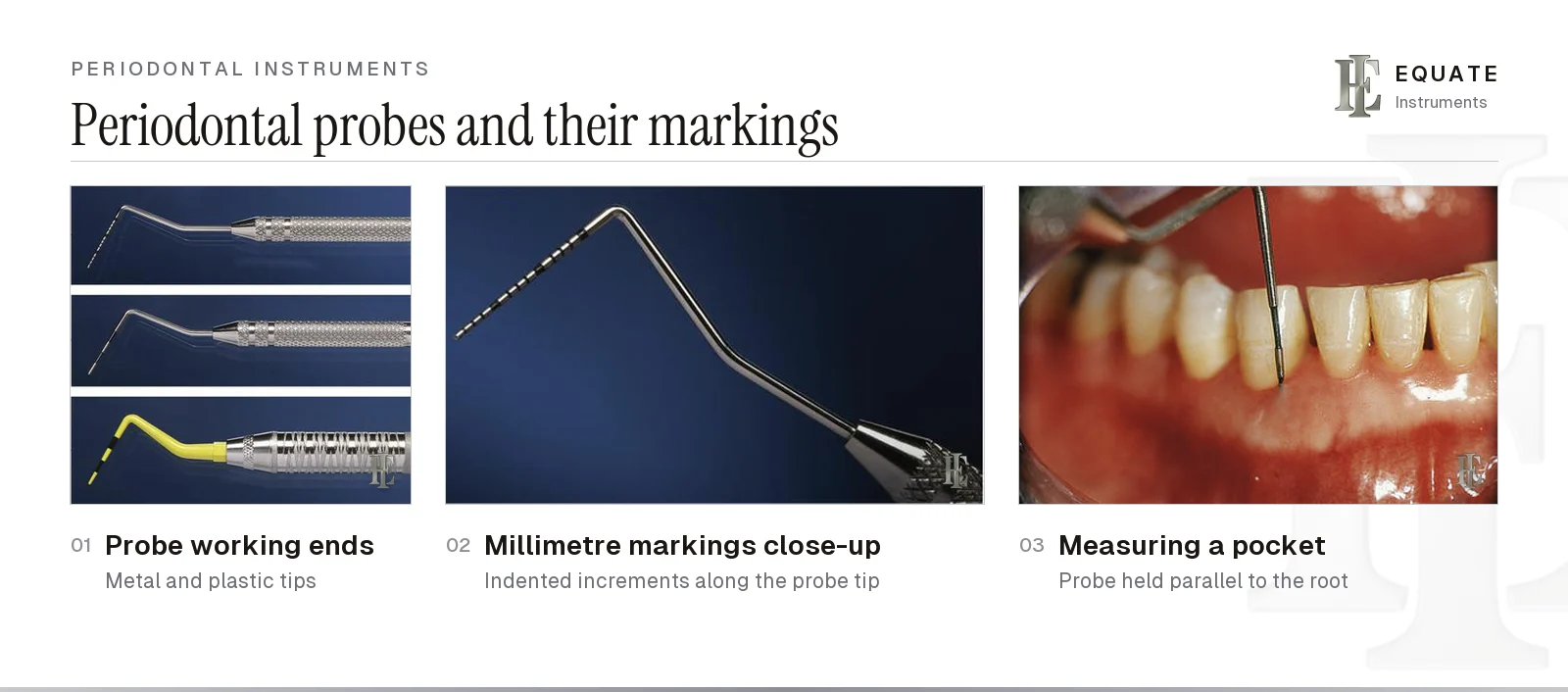
A periodontal probe is a slim, blunt, round or flat-sided working end marked in millimetres. Walked gently around each tooth, it shows how far the tip slips below the gingival margin before it meets resistance. Those readings, together with recession, bleeding on probing and mobility, make up the periodontal chart that the 2017 World Workshop classification (Caton and colleagues, 2018) relies on to stage and grade periodontitis.
The markings are what separate one probe from another. A Williams probe has bands at 1, 2, 3, 5, 7, 8, 9 and 10 mm, with gaps at 4 and 6 mm that make readings quick to place. A UNC 15 probe is marked at every millimetre to 15 mm, with darker bands at 5, 10 and 15 mm, which suits detailed charting. CP-12 style probes carry colour bands at 3-mm steps. Some probes use notches cut into the metal instead of printed bands, and some have replaceable coloured plastic tips that are gentler on implant surfaces and restorations.
For screening, the British Society of Periodontology's Basic Periodontal Examination uses a WHO probe with a 0.5 mm ball end and a black band from 3.5 to 5.5 mm. The ball reduces the risk of over-penetration and makes it easier to feel subgingival calculus. Scottish Dental Clinical Effectiveness Programme guidance describes a light probing force of about 20–25 g. Probes appear on basic, hygiene and periodontal trays; double-ended versions pair a probe with an explorer, and electronic probes that record a controlled force exist for research and charting. Compare patterns in the periodontal probes guide; for measuring tissue thickness and implant sites rather than pockets, see the periodontal depth gauge.
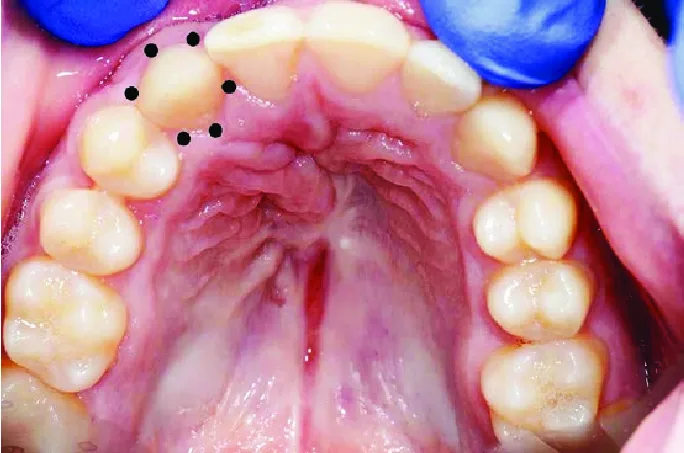
The BPE only screens. When a sextant scores code 3, the BSP asks for a 6-point pocket chart of that sextant after initial therapy, and a code 4 in any sextant means a 6-point chart of the whole dentition. Six sites are probed on every tooth, three from the cheek side and three from the tongue side, though only readings of 4 mm and over need to be written down, with bleeding on probing recorded alongside.
Furcation probes: Nabers and multirooted teeth
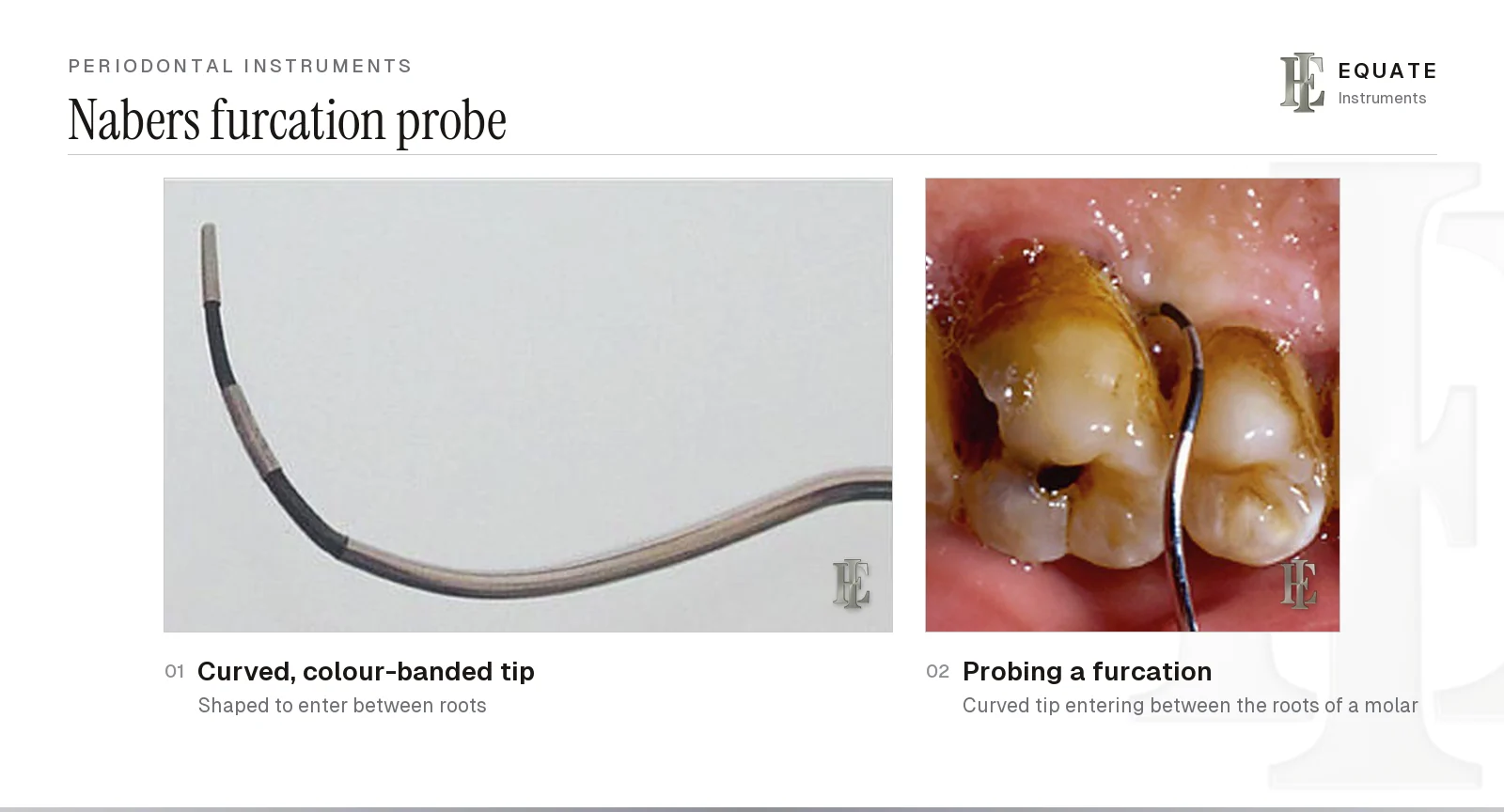
Where bone is lost between the roots of a molar or an upper first premolar, a straight probe cannot follow the anatomy. A furcation probe such as the Nabers has a curved, blunt working end that hooks horizontally into the furcation entrance from the buccal, lingual or proximal side. The clinician notes whether the tip only catches at the entrance, passes partway under the root trunk or goes right through to the other side, and charts the furcation involvement accordingly. Boyd gives the probe a vertical job too: it gauges how deep the defect runs as well as how far it reaches under the roots.
Nabers probes are usually colour-banded at 3-mm intervals, so they give an approximate horizontal measurement as well as a yes-or-no answer. Double-ended versions carry a left and right curve, or a mirror-image pair, so that both sides of a tooth can be reached without changing grip. As Newman and Carranza's Clinical Periodontology sets out, upper molars have three furcation entrances: one buccal, one mesial (best reached from the palatal side) and one distal (reached from buccal or palatal). Lower molars have buccal and lingual entrances; radiographs from the imaging and diagnostic guide support but do not replace furcation probing.
Furcation findings are commonly graded with Hamp's classes, which are measured horizontally with a Nabers probe, as in Farook and colleagues' 2020 reliability study of lower molars. That study also found that periapical radiographs missed many of the furcations probing picked up, so the two are best used together. On a BPE grid, the British Society of Periodontology asks for an asterisk beside the sextant score whenever a furcation is found: 3* means a pocket of 3.5–5.5 mm plus a furcation involvement in that sextant.
| Hamp class | Horizontal loss measured with the probe | What the probe tip does |
|---|---|---|
| Class I | 3 mm or less | Catches just inside the furcation entrance |
| Class II | More than 3 mm, but not through to the other side | Passes partway under the root trunk |
| Class III | Through-and-through loss | Can be seen at the opposite furcation entrance |
Periodontal hoe scalers
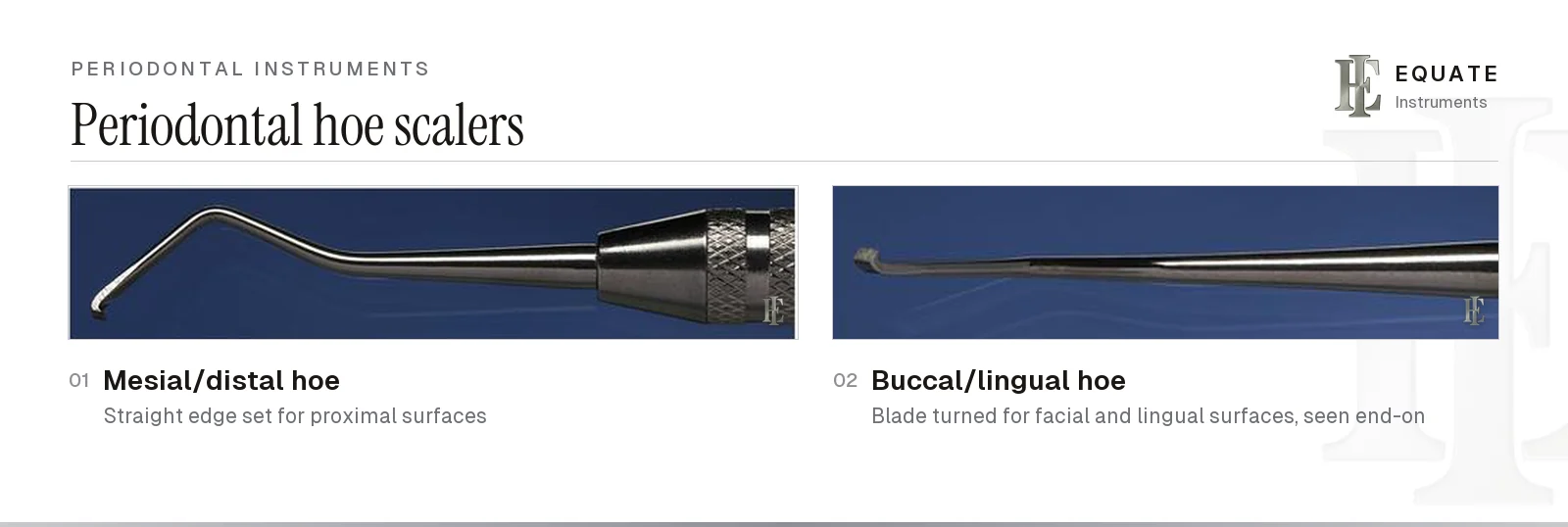
A periodontal hoe has a short, straight cutting edge set at roughly a right angle to the end of the shank, like a garden hoe. It is used with a firm pull stroke towards the crown, with the shank kept in contact with the tooth so that the blade and shank touch at two points and the edge cannot gouge the root. Its job is to fracture and lift heavy, ledge-like calculus before finer instruments finish the surface.
Hoes come in pairs or sets so that each surface can be approached squarely: a mesial/distal hoe and a buccal/lingual hoe, or a set of four. Anterior hoes have short, straighter shanks; posterior hoes have longer, more angled shanks to reach molars. Because the blade is wide and straight, a hoe adapts poorly to curved root surfaces and narrow, deep pockets, which is why ultrasonic instruments and curettes have taken over much of its work. Boyd lists hoes for hygiene as well as periodontal trays, depending on the procedure. See how hoes compare with sickles and Jacquette scalers in the dental scalers guide.
Back-action hoes and bone recontouring
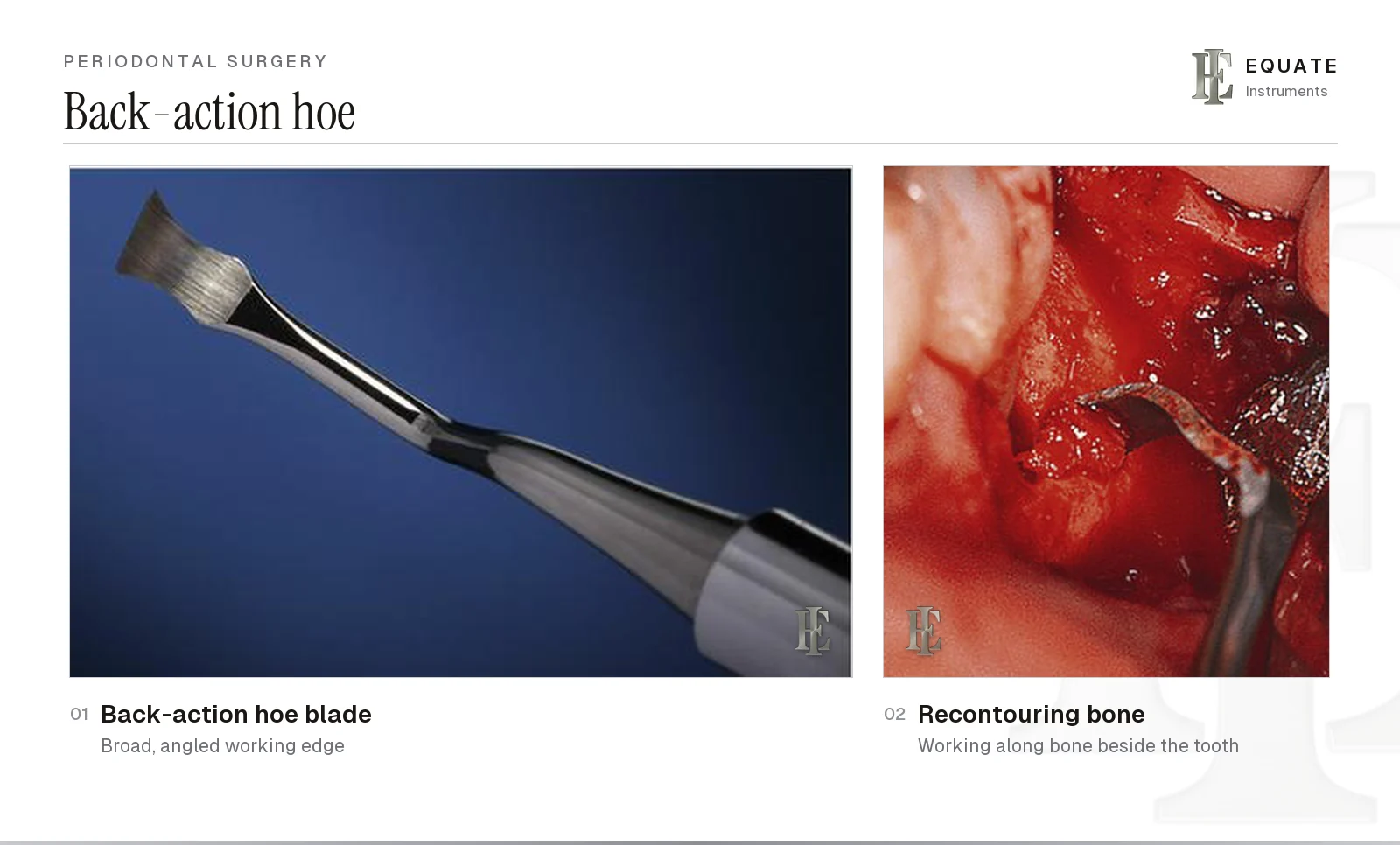
The back-action hoe has a broad, angled blade and is used mainly in periodontal surgery: once a flap is raised, it allows fine reshaping of the bone at the crest where a bur could catch the root surface. Boyd lists it chiefly for periodontal trays, though, depending on the procedure, it can also appear on a hygiene tray.
It is double-ended and made in several blade widths. In practice it shares this role with back-action and Ochsenbein chisels, rotary burs under irrigation (see the burs and rotary instruments guide) and bone files; the choice depends on access and how much bone needs to be removed. Equate lists bone chisels, including a Rhodes back-action chisel, within its oral surgery range, described in the oral surgery and extraction instruments guide.
Kidney-shaped periodontal knives for gingivectomy
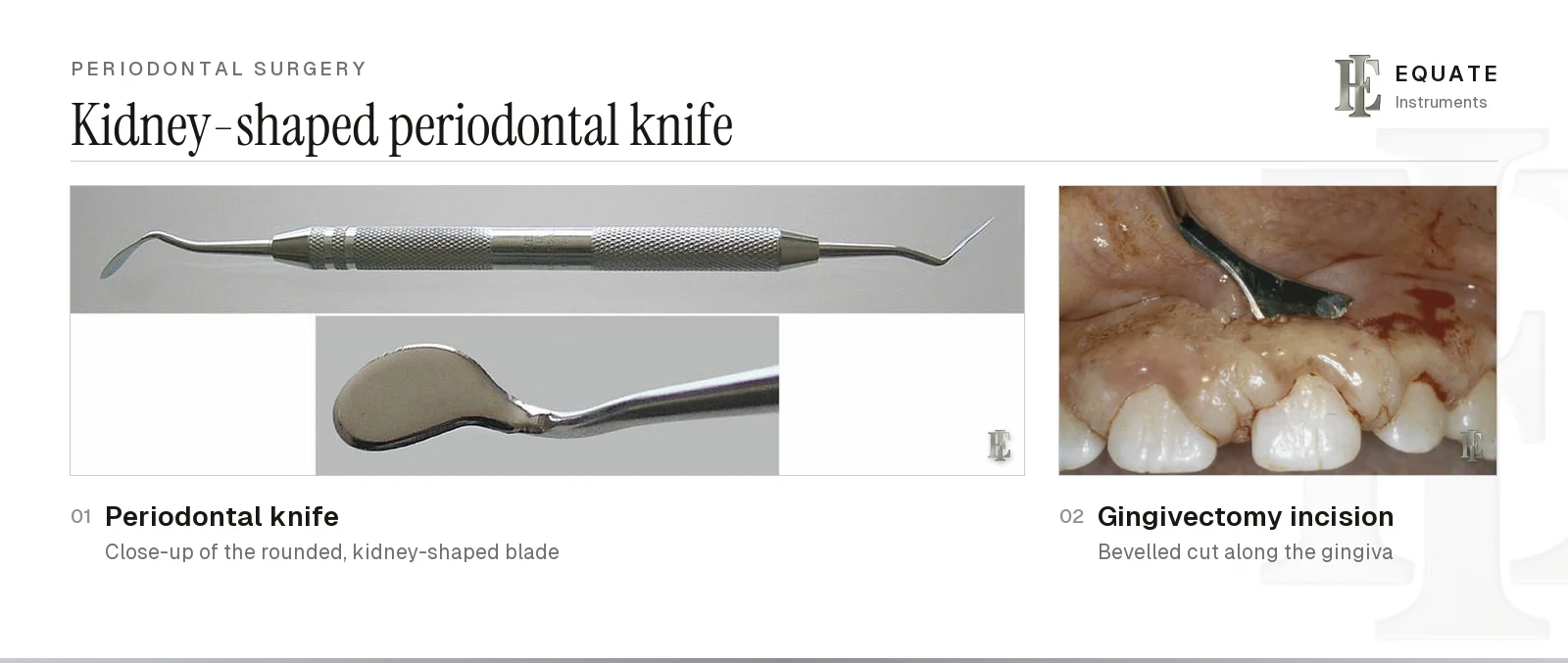
Gingivectomy removes the soft-tissue wall of a pocket or excess gingival tissue, and gingivoplasty reshapes the gingiva to a more natural contour. The kidney-shaped periodontal knife is designed for the first, long cut: a rounded blade sharpened around its edge, set on an angled shank so that it can make a continuous bevelled incision along the facial or lingual gingiva of several teeth.
Different designers give their names to the common patterns, among them the Kirkland, Goldman-Fox, Buck and Solt knives, which differ in blade size, curvature and shank angle. Kirkland knives such as the 15K/16K are double-ended, with mirror-image blades so both sides of an arch can be reached. These knives belong on periodontal surgical trays only, and their edges must be kept sharp: a dull knife tears tissue instead of cutting it cleanly. Laser and electrosurgical units are alternatives for some gingival procedures, but they do not replace a well-kept knife set. How the incision is marked, angled and completed is covered in the periodontal knives guide.
Interdental knives and files
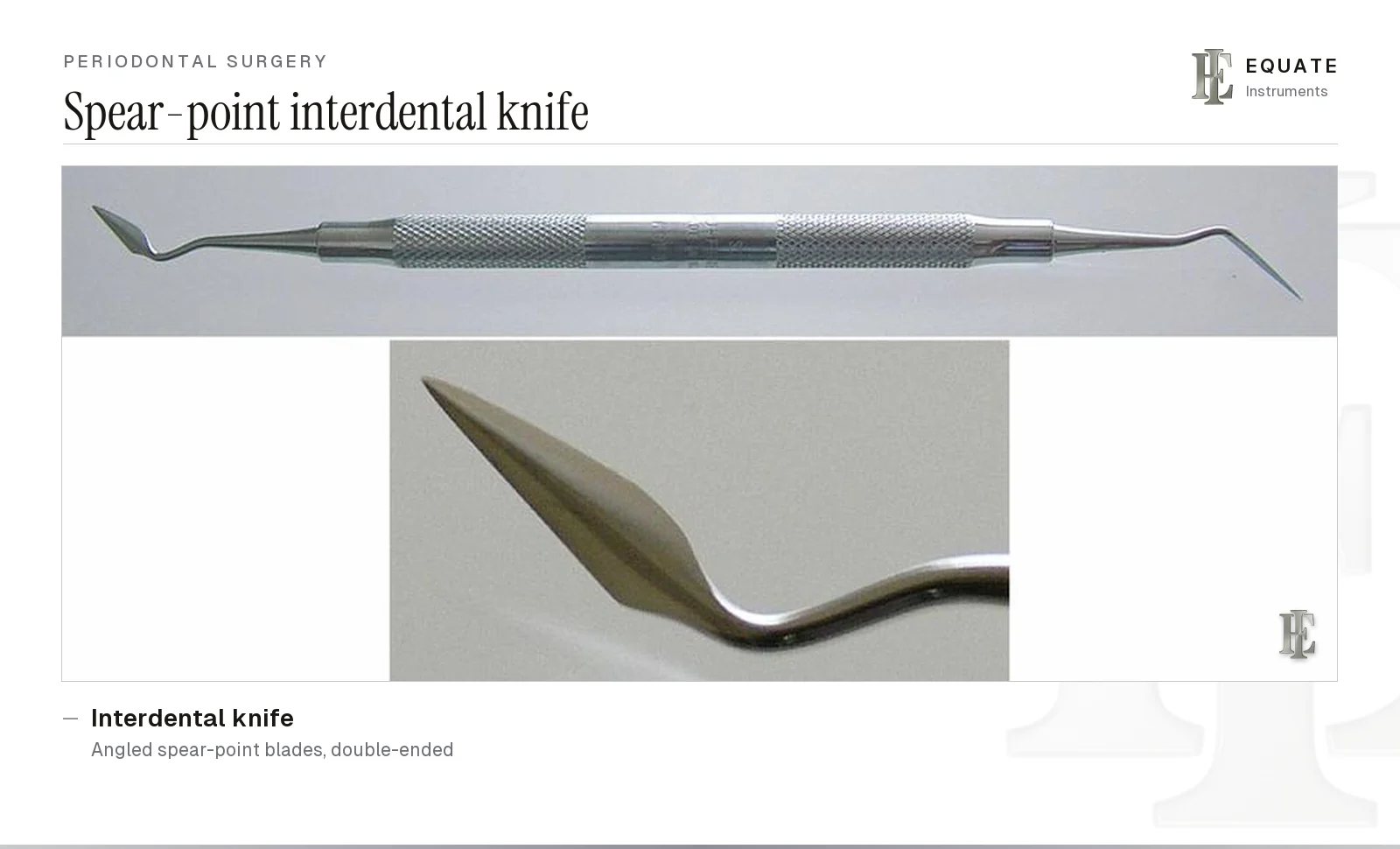
Once the main incision is made, the tissue between the teeth still has to be released. A spear-point interdental knife has a narrow, pointed, two-edged blade on an angled shank, so it can be slipped into the interproximal area to complete the cut and free the papilla. Orban, Goldman-Fox, Buck and Sanders patterns are the familiar ones; the Buck 5/6 is a widely used double-ended example. They come single or double-ended and in a range of blade sizes.
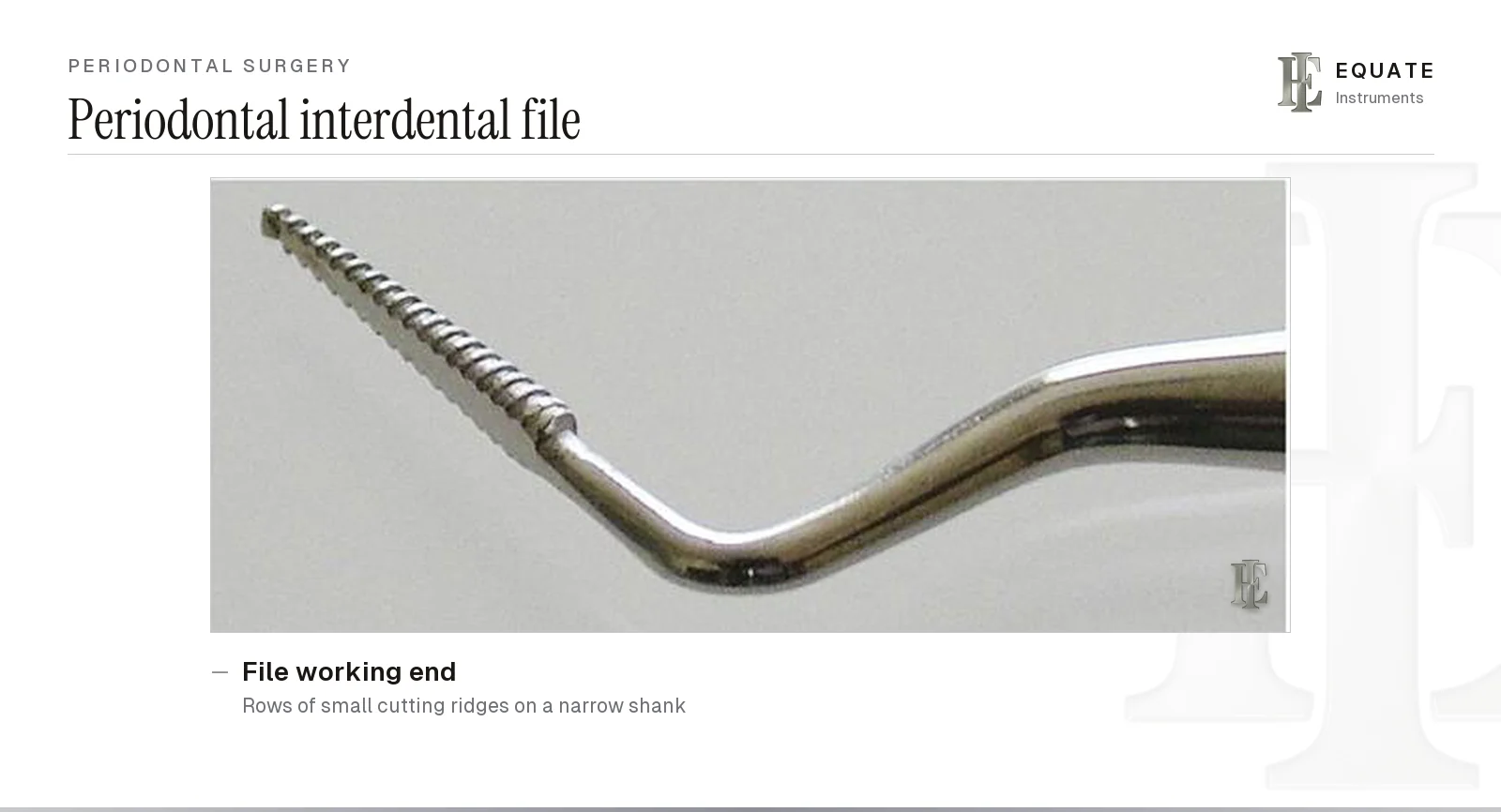
An interdental file has a series of small cutting ridges on a narrow working end and is used with short push or pull strokes. Its first job is to fracture heavy, tenacious calculus in proximal areas, and Hirschfeld-type files are kept mainly for that. Sugarman and Schluger files are also used during flap surgery to smooth and recontour interdental bone, as Newman and Carranza describe. Files come in curved, straight, mesial/distal and buccal/lingual angles. They are blunted by use and are hard to resharpen precisely, so worn ones are usually replaced rather than reground.
The periodontal surgical tray setup
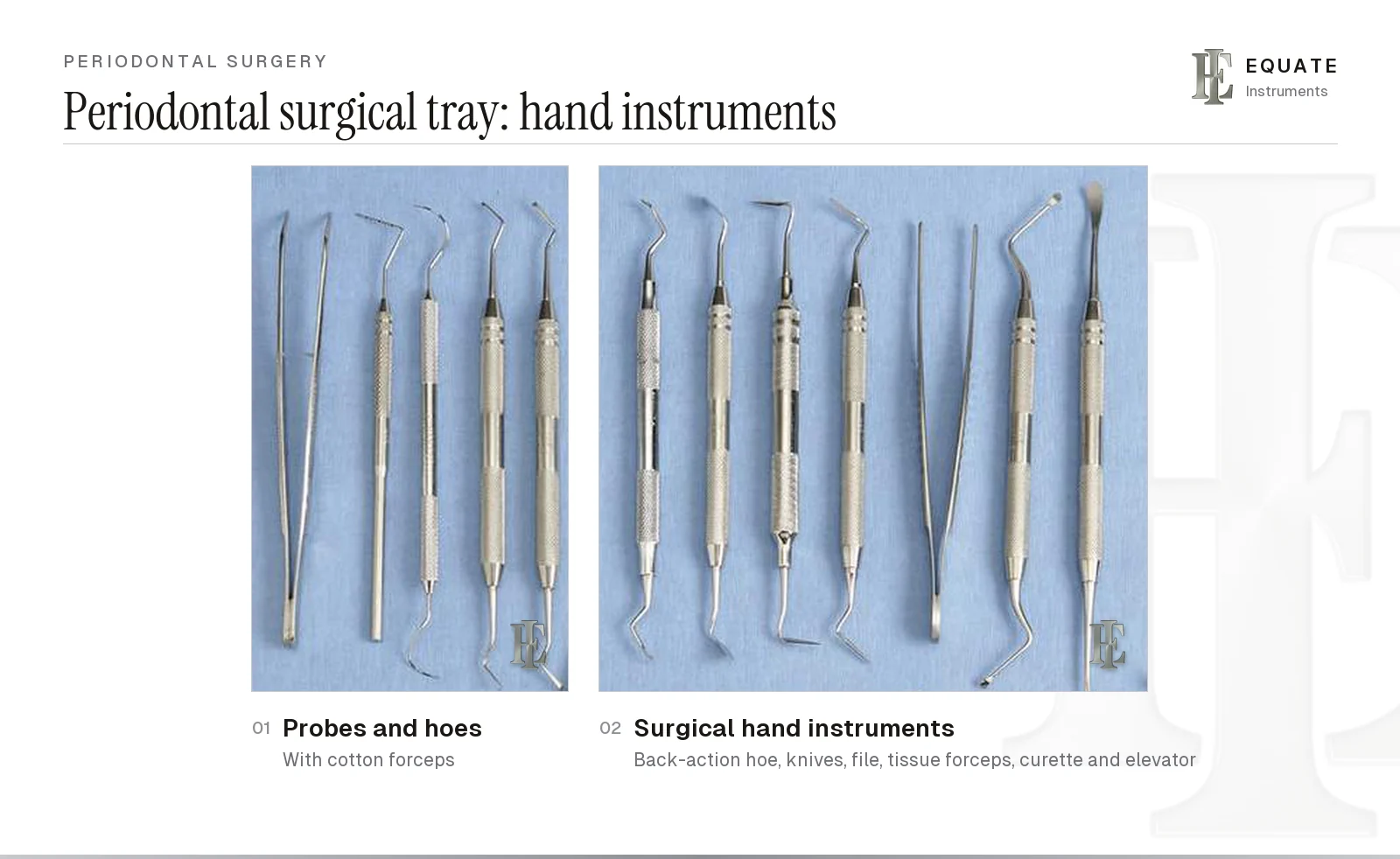
This is a summary; the step-by-step workflow, the left-to-right layout and a full checklist are on the periodontal surgery tray setup page. A gingivectomy relies mainly on the knives, while a flap procedure relies on the scalpel and the periosteal elevator.
A periodontal surgical tray is laid out in the order the procedure runs, from examination through incision and debridement to suturing. Boyd's setup combines the instruments in this guide with general surgical items; quantities and exact choices vary by operator and procedure.
- Examination: mouth mirror, explorer, cotton forceps, a periodontal probe and a furcation probe.
- Deposit and bone removal: mesial/distal and buccal/lingual hoes, a back-action hoe, a bone file and a surgical curette (compare patterns in the dental curettes guide).
- Incision and flap: a kidney-shaped knife, an interdental knife, a scalpel handle with a No. 12 blade, tissue forceps, tissue scissors and a periosteal elevator.
- Retraction and access: a Minnesota-style cheek and tongue retractor and a mouth prop, both covered in the dental retractors guide, and a disposable surgical high-volume evacuation tip (see surgical suction tips) from the evacuation systems guide.
- Haemostasis and closure: a haemostat, sutures with needle, a needle holder and suture scissors.
- Anaesthesia: the local anaesthetic syringe and cartridges are set up separately, as described in the local anaesthetic equipment guide.
Cleaning, sharpening and sterilising periodontal instruments
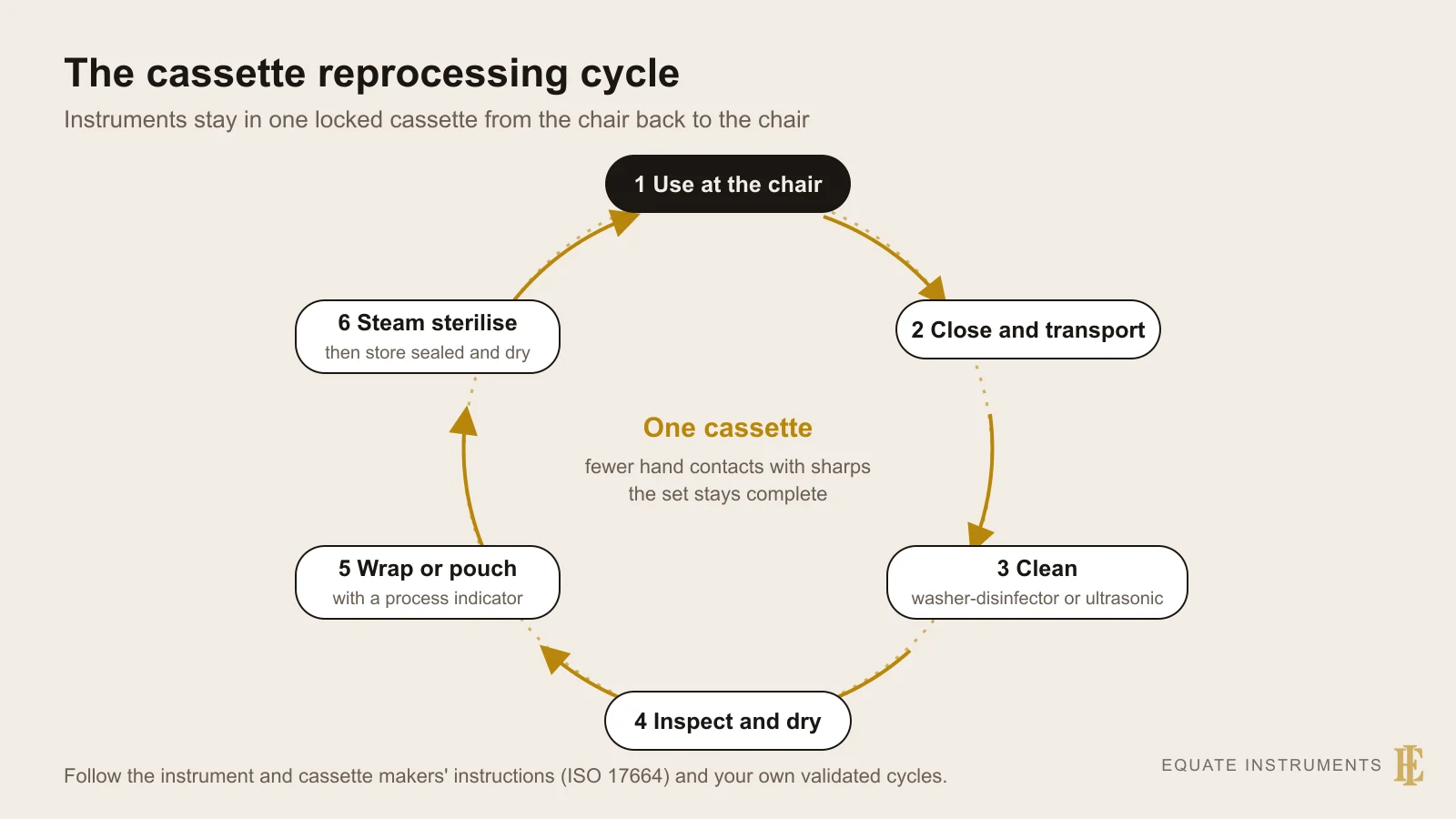
Under the Spaulding classification used in the US Centers for Disease Control and Prevention guidelines (Kohn and colleagues, 2003), knives, hoes and files are critical items because they cut soft tissue or touch bone. Manual probes are not classed on their own: the only probe the guidelines name is the electronic periodontal probe, listed among semicritical devices that touch mucous membrane. Either way probes are cleaned and heat sterilised before each use, because the CDC asks the same of heat-tolerant semicritical items. The Department of Health's HTM 01-05 for dental practices in England likewise expects cleaning followed by heat sterilisation between patients, and in Europe steam sterilisation processes are developed and validated to EN ISO 17665. Follow the manufacturer's reprocessing instructions and your national regulations.
- Clean promptly: blood and tissue dry quickly on fine knife edges and file ridges, so keep instruments moist and clean them in an ultrasonic bath or washer-disinfector, then inspect under magnification.
- Protect the edges: knife and hoe edges are fragile, so carry them in a cassette or with tip protectors and never loose in a tray.
- Sharpen after cleaning and before sterilising: knives and hoes are sharpened on a clean, sterilised stone and then reprocessed; check each edge against a test stick or under light for a bright, rounded line that shows dullness.
- Check probe markings: worn or faded bands give wrong readings, and a bent probe tip should be replaced, not straightened.
- Pack and sterilise: seal each instrument or cassette in a pouch or wrap with an internal process indicator, steam sterilise, and check both external and internal indicators before use.
- Store and record: keep packs dry and intact, and log cycles as your national rules require. More detail is in the sterilisation and protective equipment guide.
Buying periodontal instruments: what to check
- Probe markings: choose one marking system for the whole practice so charts from different clinicians are comparable; mixing marking systems makes readings easy to misplace.
- Tip diameter and finish: a slim, blunt tip that enters a tight pocket without catching, with markings that stay legible after hundreds of cycles.
- Furcation probes: a curve deep enough to reach under the root trunk of a large molar, and colour bands that can be read in a bloody field.
- Knife pairs: buy kidney-shaped and interdental knives as left and right pairs or double-ended patterns so every surface can be reached.
- Steel and edges: hardened stainless steel that takes and keeps an edge, with blades ground evenly and free of burrs; some patterns have titanium-nitride-coated working ends.
- Handles: a diameter, weight and knurl that give control with light pressure, the same principle described for instrument handles.
- Kits and cassettes: a complete periodontal kit in a cassette keeps the surgical set together through cleaning, sterilisation and storage.
The Equate difference
Equate's catalogue lists 55 periodontal probes (14 Williams-pattern, 22 colour-coded, 10 WHO CPI, 2 UNC 15 and 7 Nabers and furcation probes) plus 32 explorer–probe combinations, 4 hoe scalers, 5 Kirkland and 11 Goldman-Fox periodontal knives plus Widman, Crane-Kaplan and USC Towner periodontal knives, 3 Orban, 4 Buck and 2 Sanders knives, 7 periodontal files (Hirschfeld, Sugarman, Schluger and a back file) and 3 complete periodontal kits. Equate does not list a back-action hoe; its nearest surgical equivalent is a Rhodes back-action chisel.
Equate Periodontal Instruments Explained: Probes, Hoes, Knives and Files options

UNC Periodontal Probe CP 15 - Hollow Handle
EI-0040
Nabers Furcation Probe - Solid Handle 6mm
EI-0131
Furcation Probe - Double-Ended Hollow Handle
EI-0882
Nabers Probe (Ball-End) - Double-Ended Hollow Handle
EI-0883
Hoe Scaler (Anterior)
EI-1005
Hoe Scaler (Lateral)
EI-1006
Hoe Scaler (Posterior)
EI-1007
North Carolina UNC-15 Periodontal Probe
EI-1020
All-Round Periodontal Kit
EI-1086
Special Perio Diagnostic Set
EI-1090
Furcation Probe - Double-Ended, Premium Textured Silicone Handle
EI-1102
Nabers Probe (Ball-End) - Double-Ended, Premium Textured Silicone Handle
EI-1103Browse all periodontal & hygiene instruments Browse all restorative & operative instruments
Buying in your market
Frequently asked questions
What instruments are used in periodontal surgery?
A periodontal surgical tray usually holds a mirror, explorer and cotton forceps, periodontal and furcation probes, hoes and a back-action hoe, kidney-shaped and interdental knives, a scalpel, files and curettes, a periosteal elevator, tissue forceps and scissors, retractors, and suturing instruments.
What is the difference between a Williams probe and a UNC 15 probe?
A Williams probe is banded at 1, 2, 3, 5, 7, 8, 9 and 10 mm, leaving gaps at 4 and 6 mm. A UNC 15 probe is marked at every millimetre to 15 mm with darker bands at 5, 10 and 15 mm, so it reads deeper pockets in finer steps.
What is a Nabers probe used for?
A Nabers probe is a curved furcation probe. Its blunt, hooked tip enters the furcation between the roots of molars and upper first premolars so the clinician can detect and grade horizontal bone loss there.
Which knife is used for a gingivectomy?
A kidney-shaped knife such as a Kirkland makes the main bevelled cut and a spear-point interdental knife such as an Orban frees the papillae; the periodontal knives guide compares the patterns step by step.
Are hoe scalers still used?
Less than before. Hoes remove heavy, ledge-like calculus with a pull stroke, but their straight, wide blade adapts poorly to curved roots and deep pockets, so ultrasonic scalers and curettes now do most of that work. Many clinicians keep a set for tenacious deposits.
What is a back-action hoe used for?
It is a double-ended surgical instrument with a broad, angled blade, used once a flap is raised to trim and reshape the bone at the crest beside the teeth more gently than a bur. Equate does not list one; its closest equivalent is the Rhodes back-action chisel.
What does an asterisk mean on a BPE chart?
It means a furcation involvement was found in that sextant. The British Society of Periodontology asks for the asterisk to be written beside the sextant's code, so 3* records a probing depth of 3.5–5.5 mm plus a furcation.
References
- Boyd LB. Dental Instruments: A Pocket Guide, 7th edition. Saunders/Elsevier, 2020 (photographs used under licence)
- Caton JG, Armitage G, Berglundh T, et al. A new classification scheme for periodontal and peri-implant diseases and conditions: introduction and key changes from the 1999 classification. J Clin Periodontol 2018;45(Suppl 20):S1–S8
- British Society of Periodontology. Basic Periodontal Examination (BPE), 2019
- Scottish Dental Clinical Effectiveness Programme. Prevention and Treatment of Periodontal Diseases in Primary Care: periodontal probing
- Newman MG, Takei HH, Klokkevold PR, Carranza FA. Newman and Carranza's Clinical Periodontology, 13th edition. Elsevier, 2018
- Kohn WG, et al. Guidelines for Infection Control in Dental Health-Care Settings, 2003. MMWR 52(RR-17), Centers for Disease Control and Prevention
- Department of Health. Health Technical Memorandum 01-05: Decontamination in primary care dental practices, 2013 edition (NHS England)
- ISO 17665:2024. Sterilization of health care products — Moist heat — Requirements for the development, validation and routine control of a sterilization process for medical devices (adopted in Europe as EN ISO 17665:2024)
- Farook FF, Alnasyan B, Almohammadi D, et al. Reliability Assessment of the Clinical and Radiographic Diagnosis of Furcation Involvement. Open Dent J 2020;14:403
I am a…
Related
- Periodontal Knives (Gingivectomy and Interdental Knives)
- Periodontal Surgery Tray Setup
- Periodontal Probes
- Dental Scalers (Hand Scalers)
- Dental Curettes
- Dental Hygiene Instruments: Curettes, Sickle Scalers, Ultrasonic Inserts and Sharpening
- Universal Surgical Instruments for Oral and Periodontal Surgery
- Dental Sterilisation and Protective Equipment
- Oral Surgery and Extraction Instruments
- Dental Imaging and Diagnostic Equipment
- Periosteal Elevators: Molt 9, Freer, Buser and Other Patterns
- Dental Rongeurs and Bone Files
- Bone Chisels and Surgical Mallets in Dentistry