Surgical Suction Tips for Oral Surgery
Written by the Equate Instruments Technical Team · Reviewed by the Medical & Dental Board, Equate Instruments · Updated ·
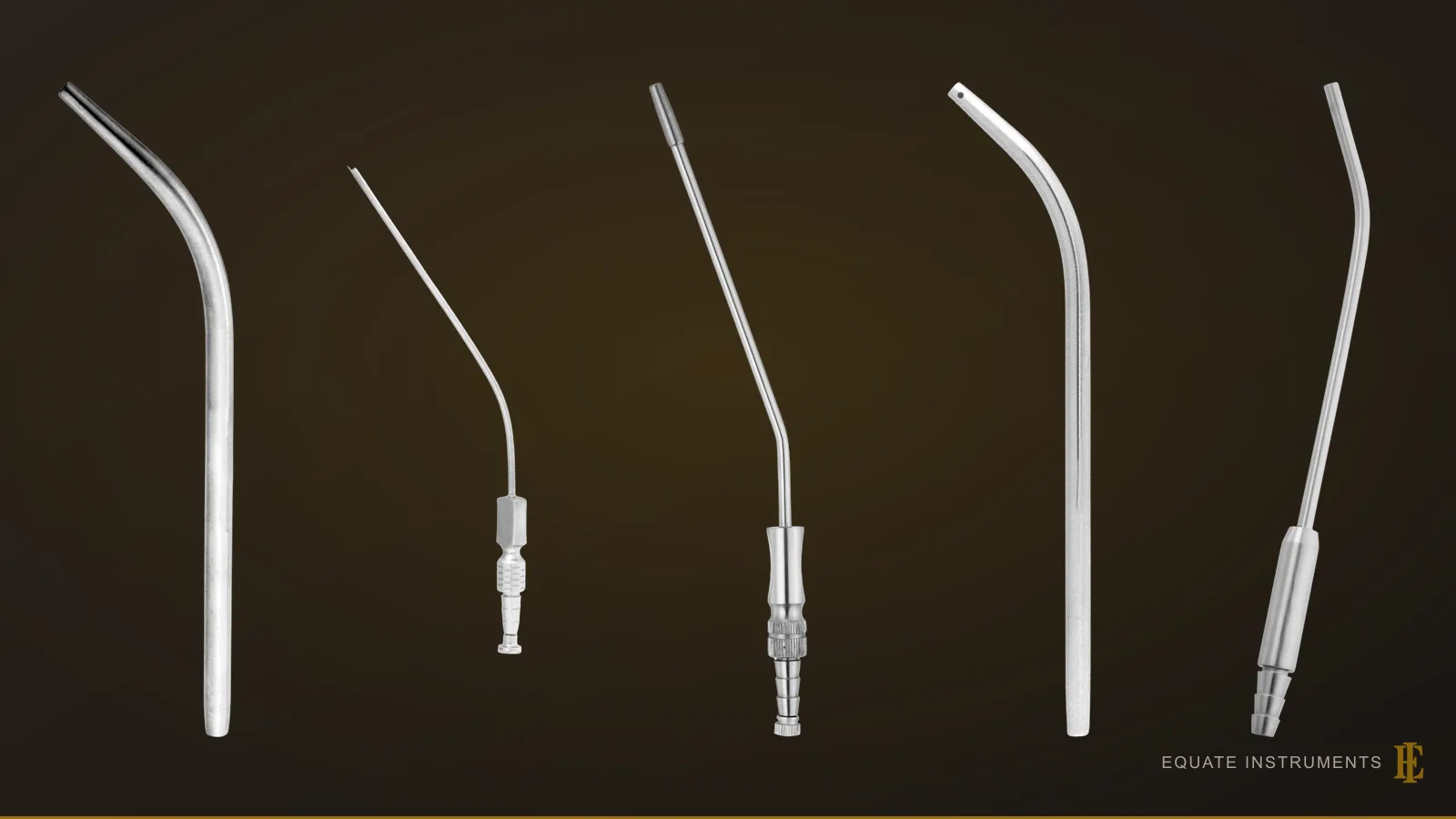
A surgical suction tip is a narrow tube, usually reusable stainless steel or titanium or single-use plastic, that connects to the dental unit's high-volume suction and clears blood, saliva, irrigant and debris from a surgical site. Its 1.5 to 5 mm bore reaches into sockets and under flaps where a wide restorative tip can't. Frazier-type tips are angled, with a finger port that varies suction strength.
Key points
- A clear field is what lets the surgeon see bone, roots and nerves; the suction tip works beside the bur and irrigation throughout the procedure.
- Pick the bore to the site: 1.5 to 2 mm for implant osteotomies and microsurgery, around 3 mm for flaps, 4 to 5 mm for extractions and bone removal.
- Lumened tips need brushing and flushing right through the bore before sterilisation, or the inside stays dirty.
What is a surgical suction tip used for?
Surgical suction keeps the operating field visible. During an extraction, implant placement or periodontal flap surgery it removes blood, saliva, the irrigating saline that cools the bur and the bone and tooth debris the bur produces. The CDC's 2003 guidelines call for sterile solutions, such as sterile saline or sterile water, as the coolant and irrigant in oral surgery, so the suction tip has to keep up with a steady flow. CDC's dental unit water guidance adds that the irrigant has to arrive by a sterile delivery device, such as a sterile bulb syringe, sterile tubing that bypasses the unit's waterlines or a sterile single-use device, so the tip works against a separate supply rather than the unit's own water (see the dental evacuation guide).
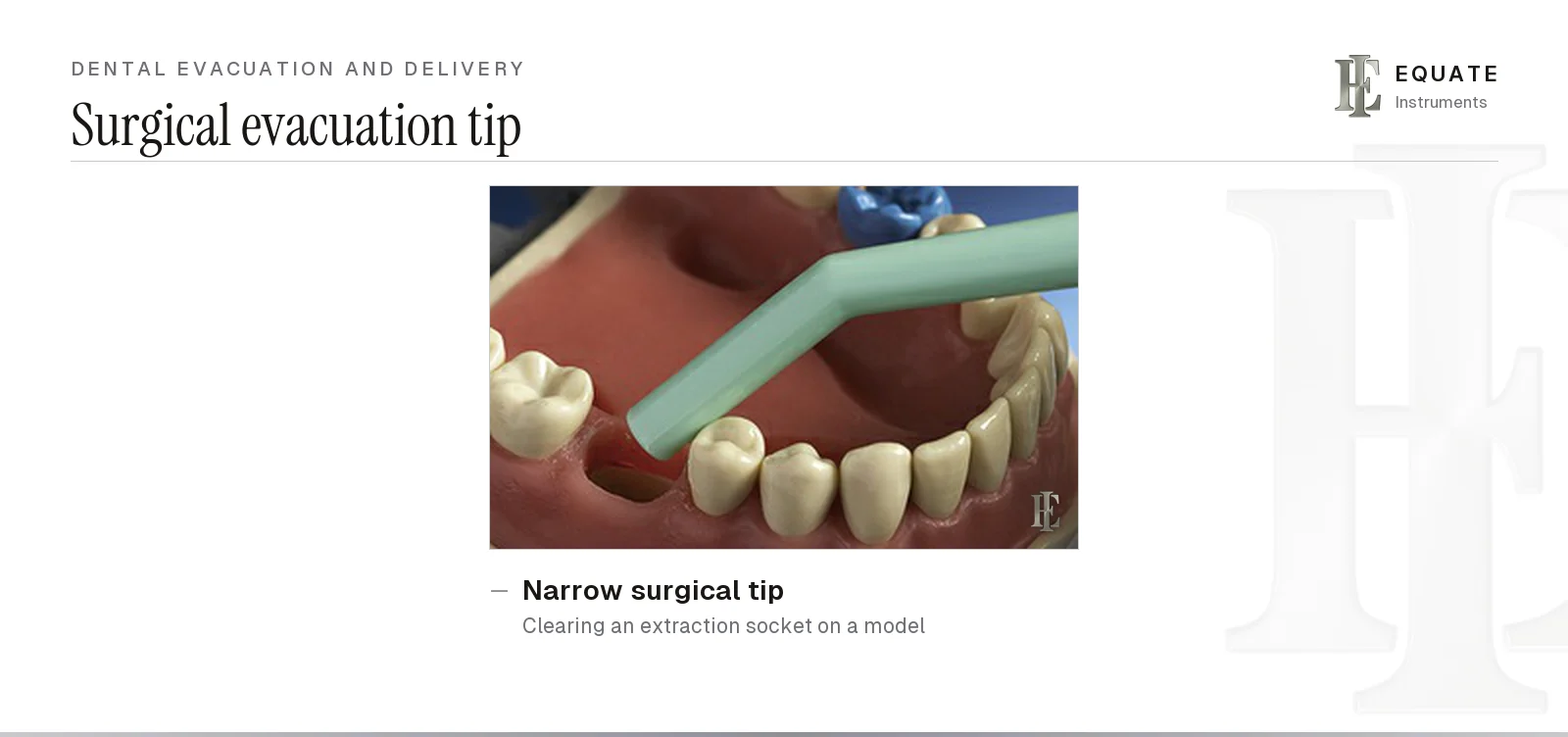
In Contemporary Oral and Maxillofacial Surgery, Hupp, Tucker and Ellis note that surgical suction tips have a smaller opening than the tips used in general dentistry, so they clear blood from the surgical site quickly and can reach into it. The tip sits on the oral surgery tray beside the retractors, periosteal elevators and extraction instruments.
What is the difference between a surgical tip and an HVE tip?
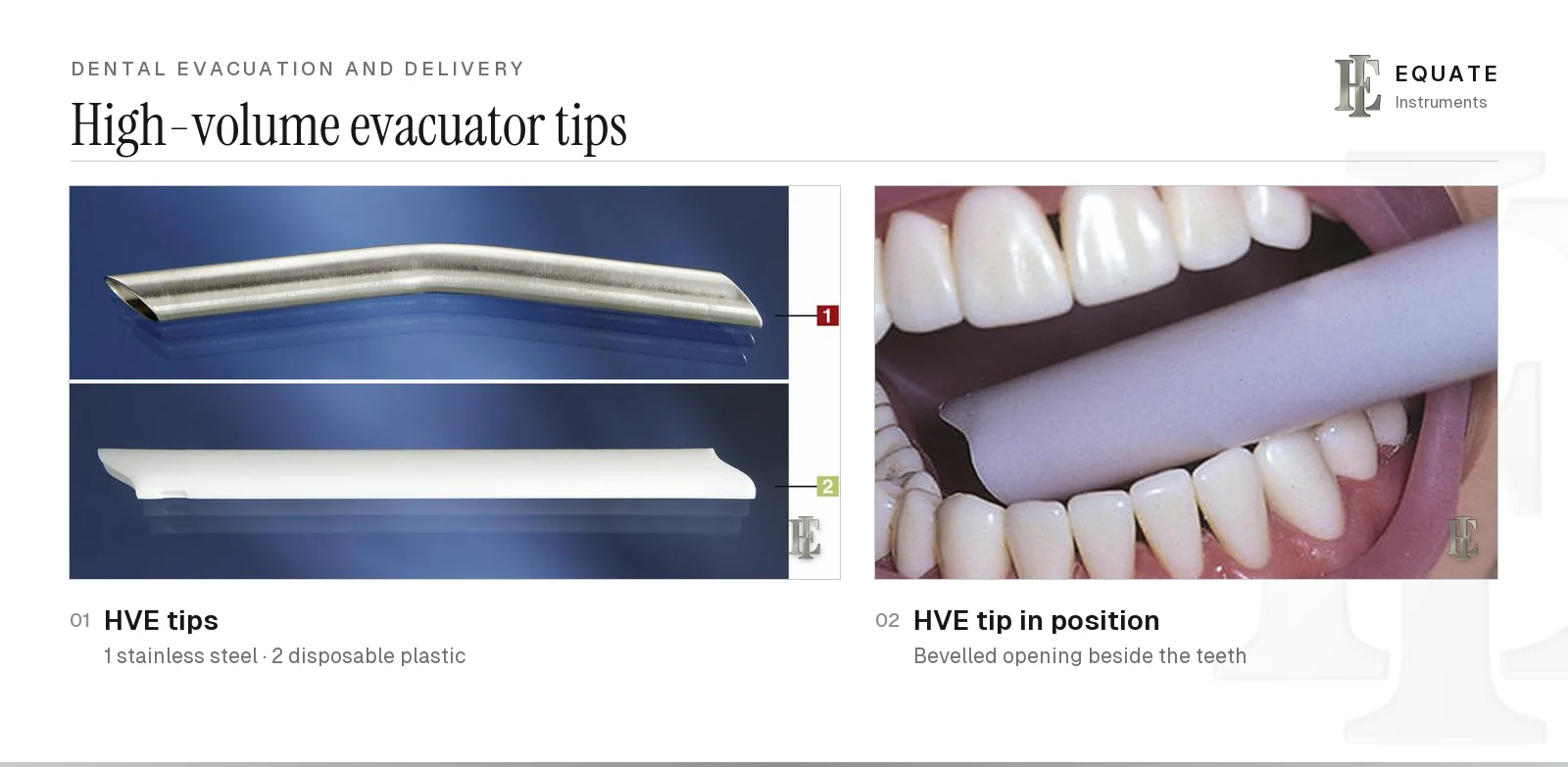
A standard high-volume evacuation (HVE) tip has a wide bore for moving large volumes of water, spray and debris during restorative work and scaling, and it is held near the tooth, not in a wound. A surgical tip has a much narrower bore, often a tapered or angled end, and connects to the same high-volume line through tubing or an adaptor. The narrow tip can be placed into a socket, under a reflected flap or into an osteotomy, and it is reprocessed as a surgical instrument.
Check the fit before ordering. Some stainless steel surgical tips taper where the tubing pushes on, so an extra length of connecting tubing is needed to join them to the unit's high-volume hose.
| Feature | Standard HVE tip | Surgical suction tip |
|---|---|---|
| Bore | Wide | Narrow, about 1.5–5 mm |
| Where it works | Beside the tooth and in the vestibule | In the socket, under the flap and at the bur |
| Suction control | Valve on the hose | Hose valve plus, on Frazier types, a finger port |
| Main job | Removing water spray and aerosol at source | Clearing blood and irrigant from a surgical field |
| Material | Stainless steel or plastic, reusable or single-use | Stainless steel or titanium, reusable, or single-use plastic |
What types of surgical suction tip are there?
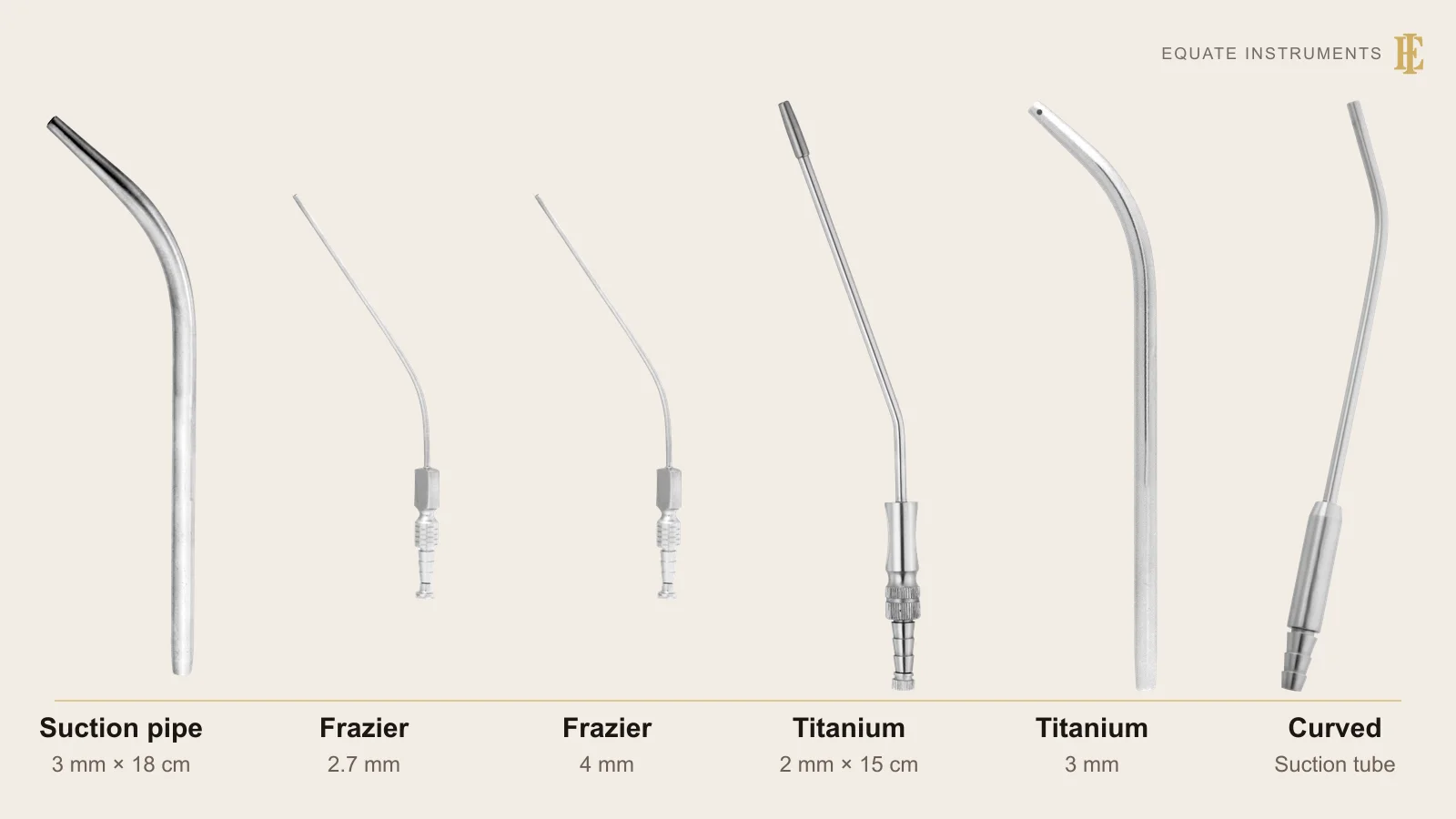
- Frazier-type tips: an angled tube on a handle with a finger port; covering the port raises suction and uncovering it lowers suction, so tissue isn't drawn into the tip.
- Straight-bore suction pipes: plain stainless tubes in 3 to 5 mm bores, often bent near the tip, for extractions and general surgery.
- Fine titanium tubes: light, narrow 1.5 to 3 mm tubes for implant osteotomies, sinus work and microsurgery.
- Curved tubes: a curved shaft that reaches posterior and palatal sites with the hand clear of the view.
- Single-use plastic surgical tips: disposable alternatives, discarded after one patient.
- Bone collector in line: a mesh-filter trap fitted between tube and hose to save drilling debris for grafting; see bone graft instruments.
How do you choose the bore size?
| Bore | Typical use | Trade-off |
|---|---|---|
| 1.5–2 mm | Implant osteotomies, sinus membrane work, microsurgery | Precise and gentle, but blocks more easily with bone chips |
| 2.7–3.3 mm | Flap surgery, periodontal surgery, apicectomy | A good balance of flow and control |
| 4–5 mm | Surgical extractions, third molars, heavy bleeding or irrigation | High flow, but too bulky for fine sites |
How do surgical suction tips help control aerosols?
Surgical handpieces, ultrasonic devices and air-water sprays produce spatter and aerosol that carry bacteria and blood. The CDC's 2003 guidelines describe aerosols as particles of respirable size, under 10 µm, that can stay in the air for long periods, and list dental dam and high-velocity evacuation among the measures that reduce them. In a 2004 review in the Journal of the American Dental Association, Stephen Harrel and John Molinari recommended routine preprocedural rinses and high-volume evacuation, layered with other infection-control precautions.
A narrow surgical tip clears the wound but moves far less air than a wide HVE tip, so in procedures that generate a lot of spray the assistant may run both: the surgical tip in the field and a wide tip near the handpiece. Keep that wide cannula close to the tooth: Koch and Graetz's 2021 manikin study in PLOS ONE found far fewer spray particles escaped with it near the tooth than with it several centimetres away, and higher flow helped further. Low-volume saliva ejectors are no substitute: CDC warns that they can let fluid flow back into the mouth when the patient's lips seal around the tip.
How do you position the suction tip during surgery?
Hold the tip in a pen or thumb-to-nose grasp and keep it just ahead of the bur or irrigation, close to the fluid but not resting on soft tissue. Once the tooth is out, it's sensible to keep the tip out of the depth of the fresh socket and let the socket fill with blood, so the clot isn't disturbed, and don't hold it against the floor of the mouth, the flap margin or the sinus membrane, which it can catch and bruise. On Frazier-type tips, uncover the finger port when working near soft tissue and cover it for bulk fluid.
If the tip blocks with bone chips, clear it by flushing sterile saline through it rather than poking it with an instrument. At the end of the procedure, suction a little clean water through the tip and line before it goes for reprocessing.
What does the Equate range include?
Equate's ten surgical suction tips are reusable metal tubes: straight-bore suction pipes in 3, 4 and 5 mm at 18 cm; Frazier suction tubes in 2.7, 3.3 and 4 mm bores; titanium suction tubes in 1.5, 2 and 3 mm, the 2 mm tube at 15 cm; and a curved suction tube. They suit the surgical extraction tray and implant and sinus lift procedures. For implant and grafting work, the range also has a bone collector with a suction tube adapter (EI-2727) that sits in line between the tube and the hose.
Browse the accessories range and request samples and a quote. Designed in Finland.
How do you clean and sterilise surgical suction tips?
Lumened instruments are among the hardest to clean, because blood and bone dust dry inside the bore where you can't see them. Flush the tip with water straight after use, then brush the lumen with a soft brush of the right diameter that passes all the way through and out of the other end, and flush again. Clean the finger port and any adaptor separately. An ultrasonic bath or a washer-disinfector with lumen connectors improves cleaning; the CDC notes that automated cleaning is generally more efficient and safer than manual scrubbing. The World Health Organization's 2016 manual on decontaminating and reprocessing medical devices covers cleaning and inspection of lumened items.
Inspect each tip by looking through it against a light; any visible residue means it goes back for cleaning. Then sterilise it in line with the CDC guidelines or, in UK practices, HTM 01-05, following the manufacturer's instructions under ISO 17664-1. Use a stylet or cleaning wire for fine tubes where the manufacturer's instructions call for one, and retire tips that are dented, kinked or corroded inside, which can't be cleaned reliably. Single-use plastic tips are discarded after each patient. Equate tubes are passivated stainless steel or titanium and autoclavable, and are supplied non-sterile, so clean and sterilise every new tip before its first use.
The Equate difference
Equate lists 10 surgical suction tips: three straight-bore suction pipes (3, 4 and 5 mm × 18 cm), three Frazier tubes (2.7, 3.3 and 4 mm), three titanium suction tubes (1.5, 2 and 3 mm, the 2 mm at 15 cm) and a curved suction tube.
Equate Surgical Suction Tips for Oral Surgery options

Surgical Suction Pipe 3 mm x 18 cm
EI-1488
Surgical Suction Pipe 4 mm x 18 cm
EI-1489
Surgical Suction Pipe 5 mm x 18 cm
EI-1490
Titanium Surgical Suction Tube 2 mm x 15 cm
EI-1491
Frazier Surgical Suction Tube 4 mm
EI-1492
Frazier Surgical Suction Tube 3.3 mm
EI-1493
Frazier Surgical Suction Tube 2.7 mm
EI-1494
Titanium Surgical Suction Tube 1.5mm
EI-3083
Titanium Surgical Suction Tube 3mm
EI-3084
Surgical Suction Tube - Curved
EI-3097Browse all accessories & supplies instruments
Buying in your market
Frequently asked questions
What is a Frazier suction tip?
A Frazier tip is an angled, narrow surgical suction tube with a finger port on the handle. Covering the port increases suction; uncovering it reduces suction so soft tissue isn't drawn in.
What size surgical suction tip should I use?
Use 1.5 to 2 mm for implant and microsurgery, around 3 mm for flap and periodontal surgery, and 4 to 5 mm for surgical extractions with heavy bleeding or irrigation.
Can a surgical suction tip replace the HVE tip?
Not for aerosol control. A narrow surgical tip clears the wound, but a wide high-volume tip removes far more spray, so many surgical procedures use both.
How do you clean the inside of a suction tip?
Flush it immediately, brush the lumen with a correctly sized brush that passes right through, flush again, clean it ultrasonically or in a washer-disinfector, and check it against a light before sterilising.
Should you suction inside an extraction socket?
Mainly during the procedure. Once the tooth is out and bleeding is under control, it's good practice to keep the tip away from the socket base and let the socket fill with blood so a clot can form.
Can I use dental unit water to irrigate during surgery?
No. CDC calls for sterile saline or sterile water in surgery, delivered by a sterile device such as a sterile bulb syringe, sterile tubing that bypasses the dental unit waterlines or a sterile single-use device. The suction tip then has to keep pace with that separate sterile supply.
References
- Hupp JR, Tucker MR, Ellis E. Contemporary Oral and Maxillofacial Surgery, 7th edition. Elsevier, 2018 (instrumentation for basic oral surgery: suction)
- Kohn WG, et al. Guidelines for Infection Control in Dental Health-Care Settings, 2003. MMWR 52(RR-17), Centers for Disease Control and Prevention
- Harrel SK, Molinari J. Aerosols and splatter in dentistry: a brief review of the literature and infection control implications. Journal of the American Dental Association 2004;135(4):429–437
- Centers for Disease Control and Prevention. Best Practices for Sterilization in Dental Settings (Dental Infection Prevention and Control)
- World Health Organization. Decontamination and reprocessing of medical devices for health-care facilities. Geneva: WHO, 2016
- Department of Health. Health Technical Memorandum 01-05: Decontamination in primary care dental practices, 2013 edition (NHS England)
- Boyd LB. Dental Instruments: A Pocket Guide, 7th edition. Saunders/Elsevier, 2020. Chapter 4, Evacuation Devices, Air/Water Syringe Tip, and Dental Unit (photographs used under licence)
- Centers for Disease Control and Prevention. Dental Unit Water Quality: Dental Infection Prevention and Control
- Koch M, Graetz C. Spray mist reduction by means of a high-volume evacuation system: results of an experimental study. PLOS ONE 2021;16(9):e0257137
I am a…
Related
- Dental Evacuation Devices, the Air/Water Syringe and the Dental Unit
- Dental and Oral Surgery Retractors
- Tooth Extraction Instruments
- Sinus Lift Instruments
- Oral Surgery Tray Setup
- Surgical Extraction Tray Setup
- Bone Graft Instruments
- Periodontal Surgery Tray Setup
- Oral Surgery and Extraction Instruments