Dental Handpieces: Types, Attachments and Reprocessing
Written by the Equate Instruments Technical Team · Reviewed by the Medical & Dental Board, Equate Instruments · Updated ·
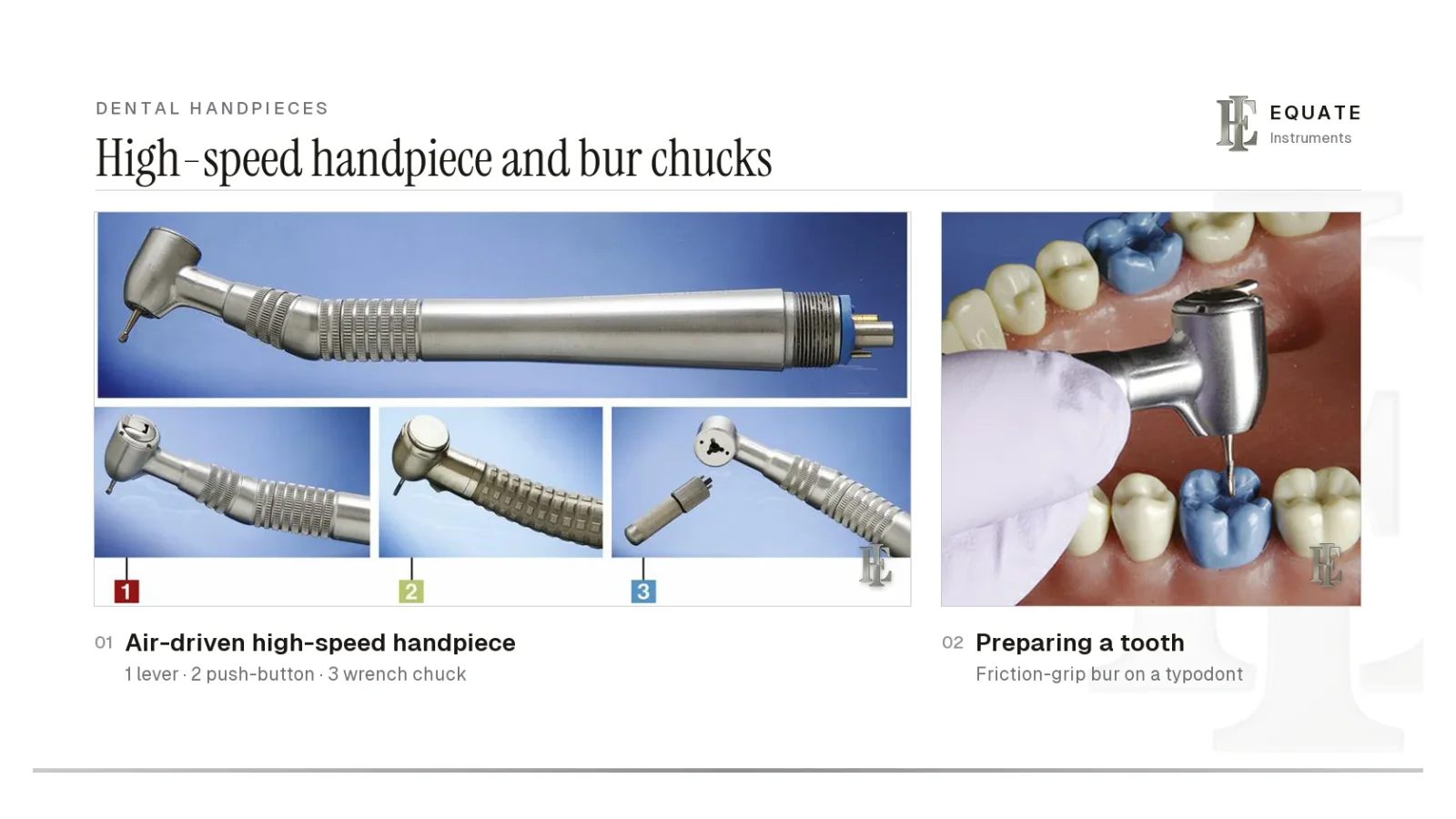
Dental handpieces are the powered, hand-held devices that turn a bur, polishing cup or other rotary instrument. The main families are the air-driven high-speed turbine for cutting enamel and removing restorations, the slow-speed motor with straight or contra-angle attachments for caries removal, finishing and polishing, prophy handpieces for coronal polishing, and electric and surgical motors with programmable speed and torque.
Key points
- High-speed turbines cut fast with a water spray to protect the pulp; slow-speed motors give control and torque for caries removal, finishing, polishing and laboratory work.
- The attachment decides which bur fits: friction-grip shanks for turbines and some contra-angles, latch-type shanks for latch contra-angles, long straight shanks for straight handpieces.
- Handpieces, motors and reusable prophy angles are cleaned, lubricated and heat sterilised after every patient; disposable prophy angles are used once and discarded.
What are dental handpieces?
A handpiece is the motorised part of the rotary system: it holds a bur, disc, polishing cup or file and spins it at a controlled speed. Boyd's Dental Instruments: A Pocket Guide (Elsevier) gives handpieces a chapter of their own because almost every restorative, prosthodontic, hygiene and surgical tray depends on one. The burs and points they drive are covered in the dental burs and rotary instruments guide.
Handpieces fall into a few families that differ in how they are powered, how fast they turn and what they are used for. Air-driven units run from the compressed air in the dental unit's tubing; electric units have a motor in the handpiece line and a control box that sets speed and torque. The table below sums up the main types.
| Type | Typical speed | Bur or attachment | Main uses |
|---|---|---|---|
| High-speed air turbine | Very high, up to about 450,000 rpm free-running | Friction-grip (FG) burs | Cutting enamel and dentine, crown preparations, removing old restorations, sectioning crowns |
| Slow-speed motor with straight attachment | Low, up to about 30,000 rpm | Long-shank straight (HP) burs and mandrels | Adjusting dentures, provisionals and appliances, mostly outside the mouth |
| Slow-speed motor with contra-angle | Low, with forward and reverse | Latch-type (RA) burs, or FG burs in push-button heads | Caries removal, refining preparations, finishing and polishing restorations |
| Prophy handpiece and prophy angle | Low | Snap-on or screw-in cups and brushes, or disposable angles | Coronal polishing, cleaning before sealants |
| Electric motor and attachments | Set by the control unit; speed-increasing heads reach turbine-like speeds | FG, RA and HP depending on the attachment | Restorative work, endodontic rotary files, trimming crowns and bridges |
| Surgical (implant) motor | Up to about 40,000 rpm at the motor, with lower speeds, in the tens of rpm, for implant work | Implant drills and surgical burs | Implant site preparation and oral surgery under sterile irrigation |
High-speed handpieces (air turbines)
The high-speed handpiece is the instrument most patients call the dental drill. Air from the unit drives a small turbine in the head, so the bur turns extremely fast with little torque. That makes it efficient for cutting enamel, preparing cavities and crowns on the composite and crown and bridge trays, removing amalgam or composite, sectioning failed crowns and making fine adjustments to a fixed restoration before cementation. Boyd lists bone cutting among its uses, but where a flap is raised or a socket is open, air reaching the wound, whether turbine exhaust or air mixed into the coolant spray, can be forced into the tissues and cause surgical emphysema. An electric motor alone does not remove that risk: Chiou and colleagues (Journal of Dental Sciences, 2021) reported subcutaneous emphysema after an extraction done with an electric motor-driven handpiece. For surgery, choose a surgical handpiece that does not blow air into the field and run it on sterile irrigant only.
Cutting at these speeds produces a lot of frictional heat. Every high-speed handpiece therefore has ports in the head that direct a water spray, or air alone when water is unwanted, onto the bur. The spray protects the pulp and keeps the cutting surface clear; cutting without coolant quickly overheats the tooth and risks pulpal damage. Laboratory work puts numbers on this. A review by Lau and colleagues (Clinical Oral Investigations, 2023) treats a rise of more than 5.5 °C inside the pulp as potentially harmful. Chua and colleagues (Heliyon, 2019) found that dry cuts with a turbine warmed the pulp chamber by roughly 3 to 5 °C, while water spray cooled it whether the head had one, three or four ports; more ports cooled slightly faster, but the difference was not significant. In a separate study of a 1:5 electric contra-angle, Lempel and Szalma (2022) ran the coolant as a water jet with the spray air switched off and recorded a pulp rise of about 6 °C at 15 mL/min against about 2.2 °C at 30 mL/min; with the spray air on, giving a fine mist, the rise was about 3.3 °C at 15 mL/min and 3.0 °C at 30 mL/min. Good isolation, for example with a dental dam, keeps the spray and debris under control while the turbine is running.
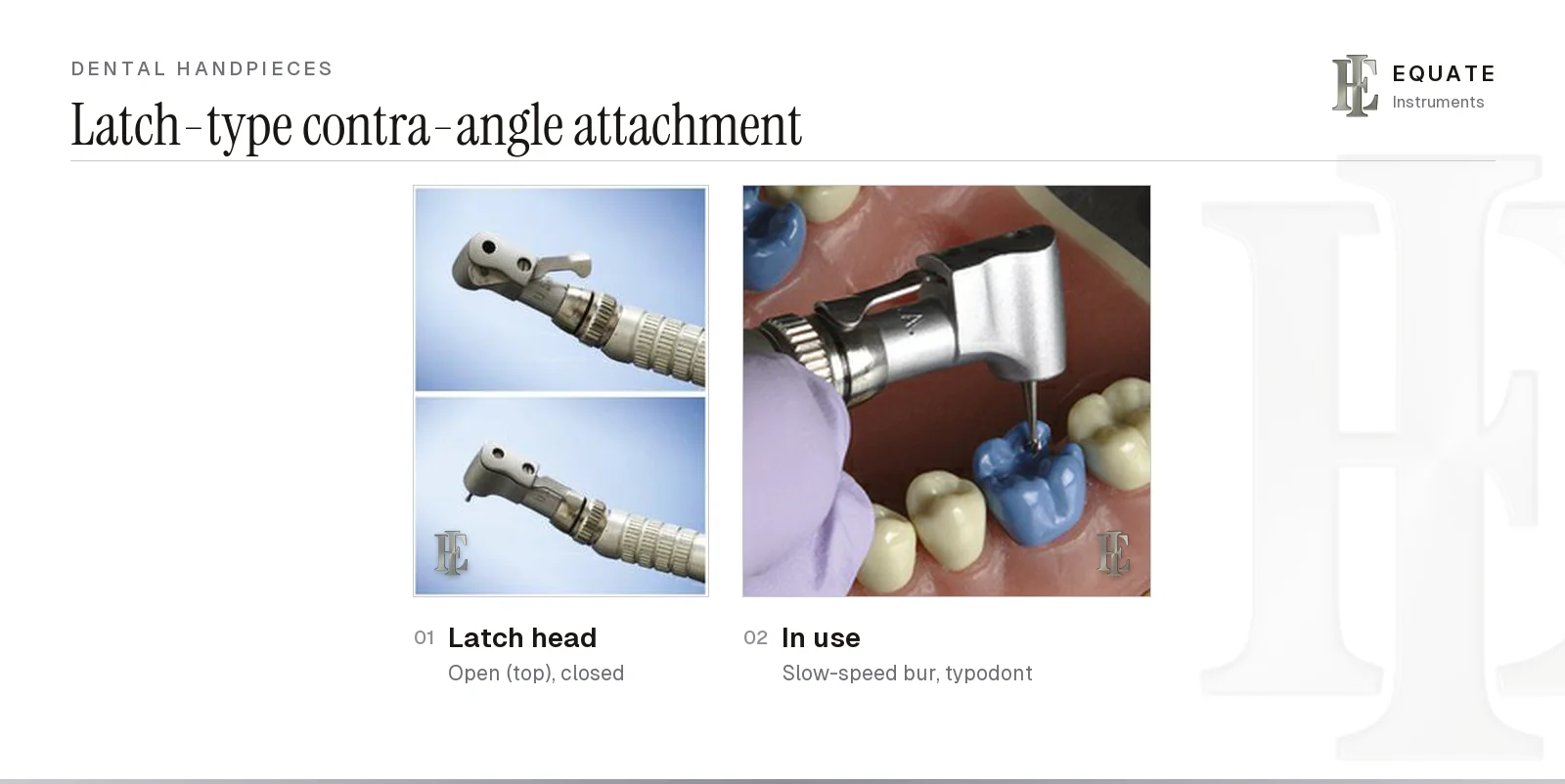
Turbines differ mainly in how the bur is held. A lever chuck has a small flip-up lever on the back of the head; a push-button chuck releases the bur when the cap is pressed; an older conventional chuck needs a small bur tool (wrench) to tighten and loosen the bur. Push-button heads are widely used because they let the clinician change burs quickly without a separate tool. Whatever the design, the bur must be pushed fully home before the handpiece is run, and the button should never be pressed while the turbine is turning.
The design is younger than many people assume. A team at the Dominion Physical Laboratory in Wellington, New Zealand, led by John Patrick Walsh, filed a provisional patent for an air-driven handpiece in October 1949. A separate design developed in the United States, credited to John Borden, went into commercial production in 1957.
Fibre-optic handpieces: light at the bur
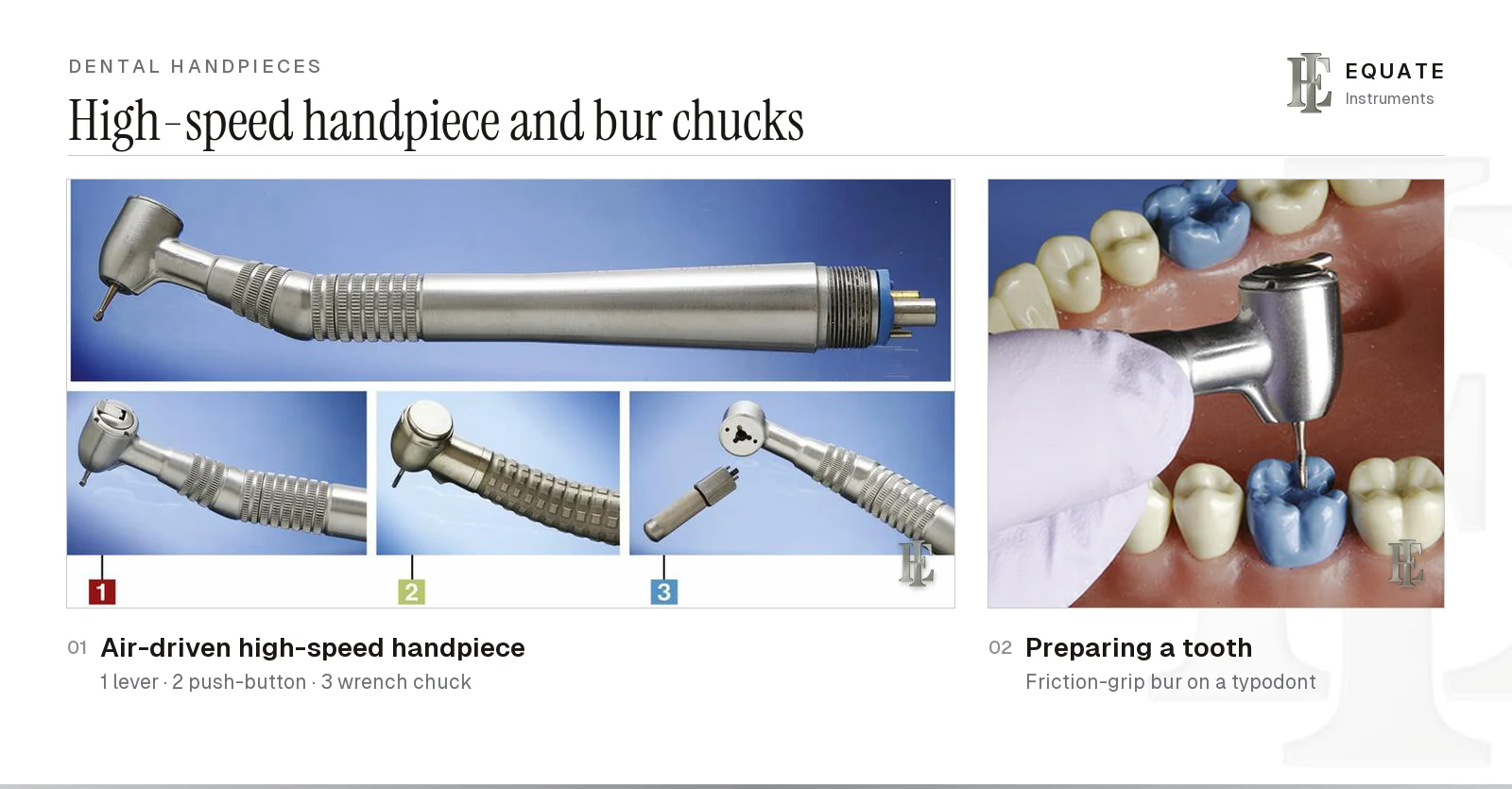
A fibre-optic or LED handpiece has one or more light outputs on the neck of the head, aimed at the bur tip. The light travels with the instrument, so the working area stays lit as the handpiece moves, without shadows from the operator's hand or head. It is particularly useful for posterior teeth, deep preparations and lingual or distal surfaces.
Apart from the light, fibre-optic turbines behave like any other high-speed handpiece. The difference is at the connection: the dental unit's tubing needs a coupling that carries power or light to the head, so a lit handpiece will only light up on a line built for it. Check the coupling standard of your unit before buying, and keep the light window clean, because dried debris or lubricant on it dims the output.
Slow-speed motors, straight and contra-angle attachments
The slow-speed handpiece is really a motor with interchangeable attachments. It complements the turbine rather than replacing it: lower speed and more torque give better tactile control when removing soft caries, refining a preparation, finishing and polishing restorations (including an amalgam restoration at its return visit) or adjusting an occlusal contact. Most slow-speed motors run in forward and reverse, selected with a ring or switch on the motor.
A straight attachment holds long-shank (HP) burs and mandrels in line with the motor. It is used mainly outside the mouth, at the chairside or in the laboratory, for trimming dentures, partial dentures, provisional crowns and orthodontic appliances.
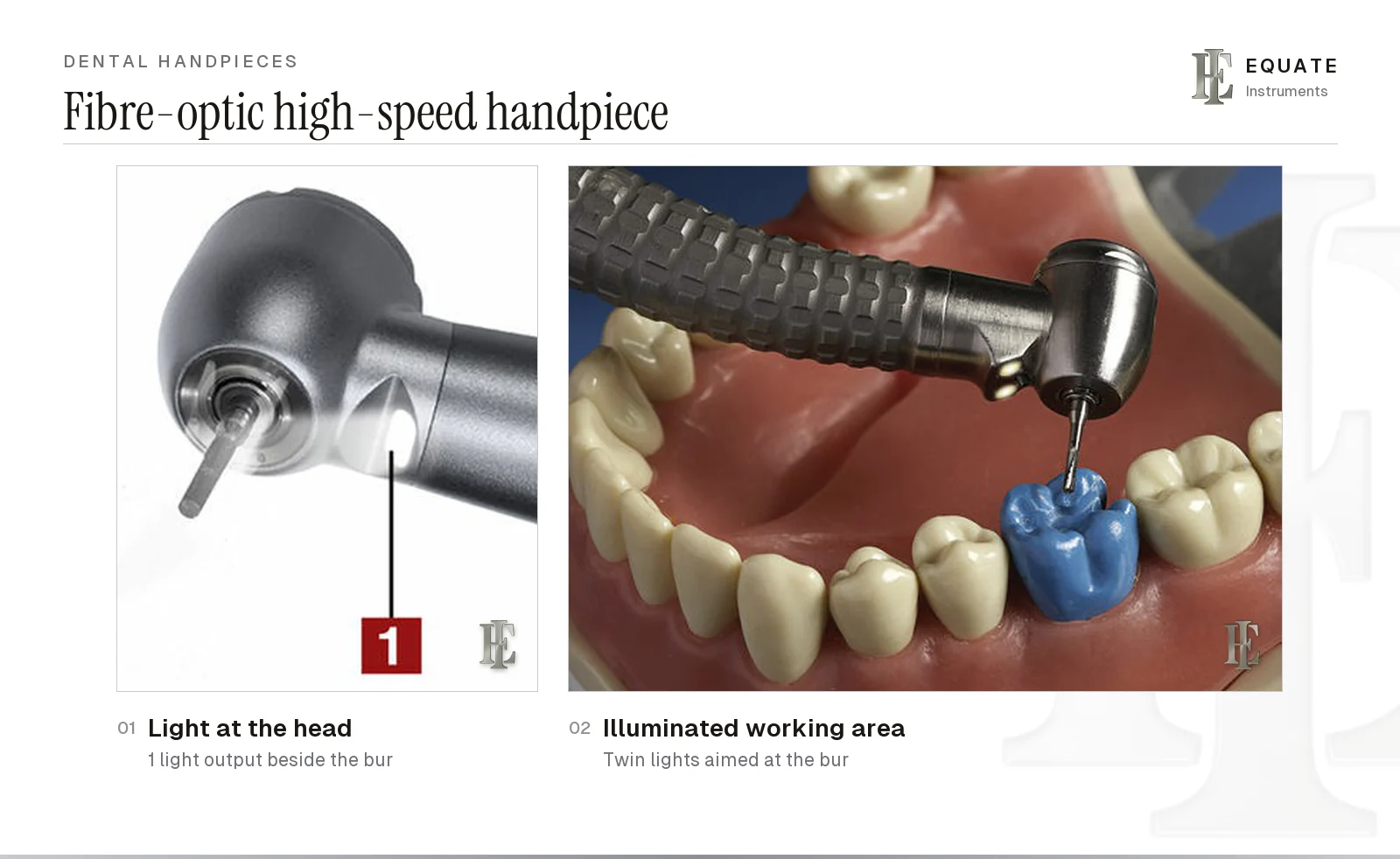
A contra-angle attachment bends the head away from the long axis so the bur can reach posterior teeth. Latch-type contra-angles take burs with a notched RA shank, held by a latch that swings across the back of the head. Friction-grip contra-angles take FG burs and release them with a push-button, like a turbine. Prophy cups and brushes for latch heads also fit here. Matching the bur shank to the head is the single most important check: an FG bur will not lock in a latch head and an RA bur will not seat in a friction-grip chuck. ISO 1797 standardises these shank types.
Prophy handpieces, prophy angles, cups and brushes
Coronal polishing after scaling, the polishing stage of a hygiene tray setup, and cleaning enamel before a fissure sealant, is done with a slow-speed prophy handpiece. In many hygiene surgeries the hygienist uses a dedicated motor, light and contoured so that a full session of polishing is less tiring for the hand; cordless rechargeable versions with a wireless foot control are also used for prophylaxis and sealant setups.
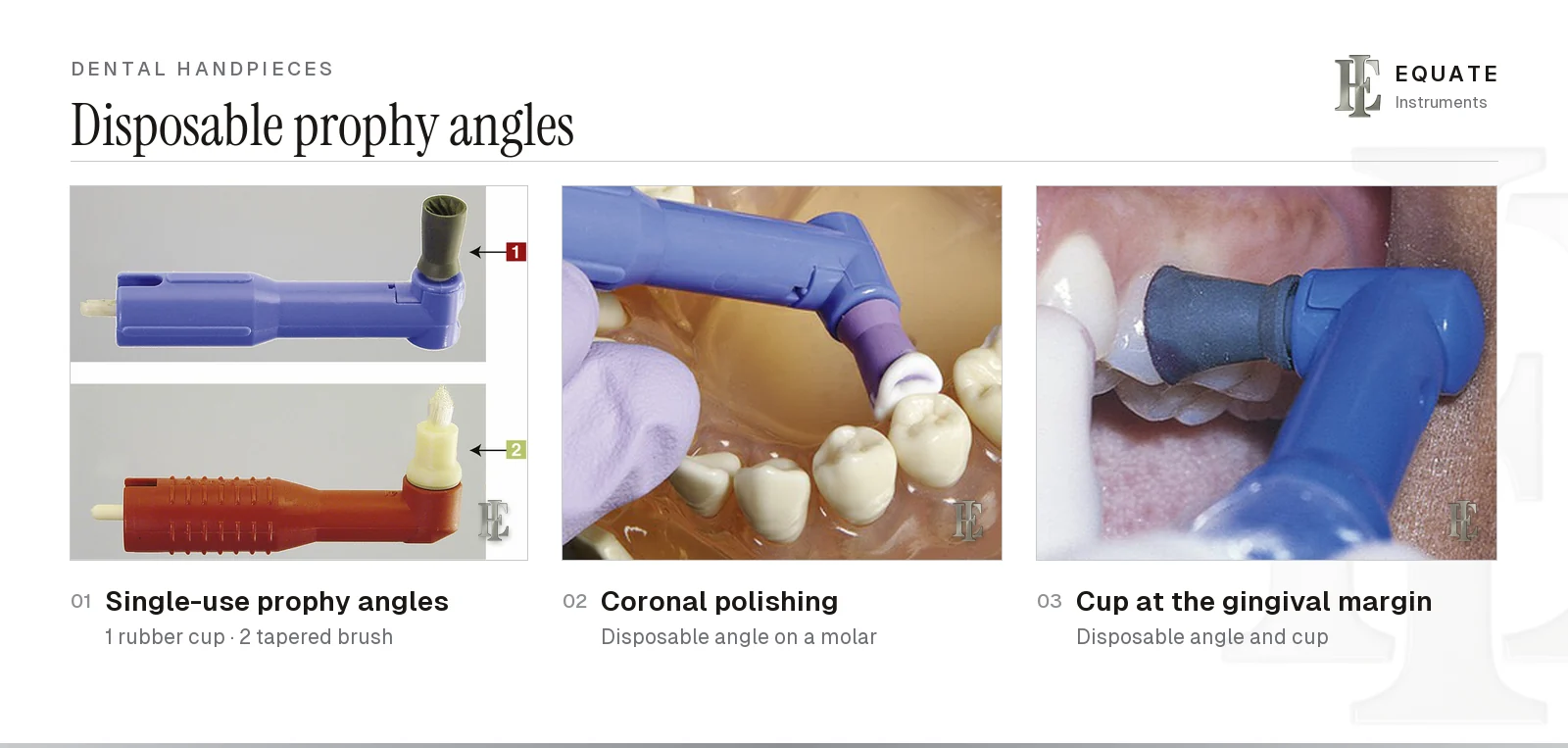
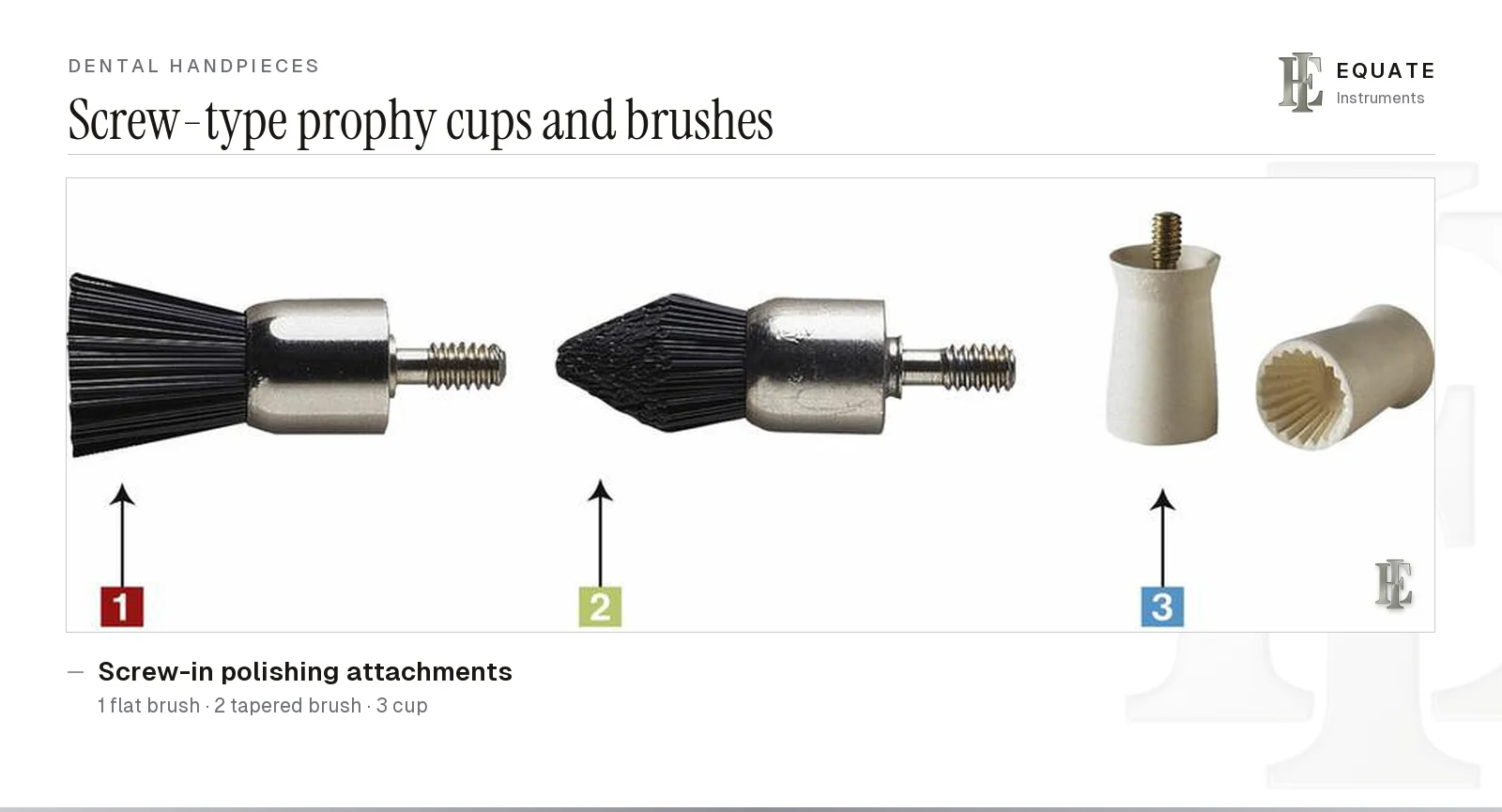
The working end is a prophy angle. Disposable prophy angles are moulded in plastic with the cup or brush already attached, snap onto the handpiece, and go in the clinical waste after one patient. Reusable metal prophy angles take screw-in or snap-on cups and brushes, which are themselves single-use, and the angle is reprocessed like any handpiece.
Rubber cups come in different stiffnesses and inner designs (webbed, ribbed or plain) to hold prophy paste and flare over smooth surfaces and just under the gingival margin. Use a brush where a cup cannot follow the anatomy, such as deep fissures or the cingulum pits of incisors, and avoid brushes on exposed root surfaces; a tapered brush reaches further into a fissure than a flat one. Use light, intermittent pressure and low speed with plenty of paste: pressing hard or polishing dry generates heat and can abrade restorations and exposed root surfaces.
Electric and surgical handpiece systems
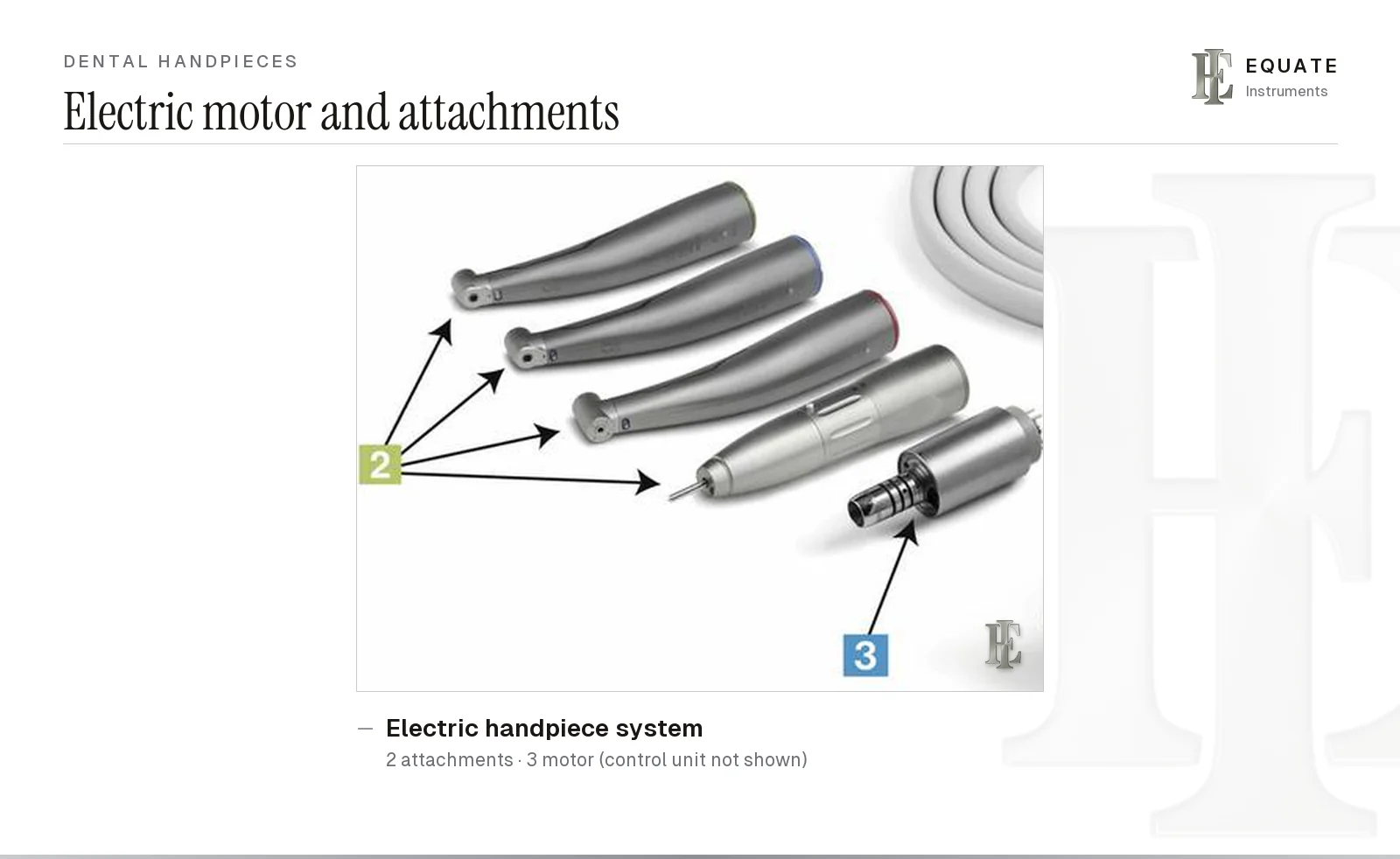
An electric handpiece system has a control unit, an electric motor (usually brushless) and a set of attachments. Instead of depending on air pressure, the motor holds a selected speed under load, which gives consistent cutting and lets the same motor drive a restorative bur, an endodontic nickel-titanium rotary file (the endodontic tray setup allows hand or rotary files for shaping the canal) or a laboratory adjustment simply by changing the attachment and the programme. Electric contra-angles also cut without air in the spray: in a phantom-head study, Vernon and colleagues (Journal of Dental Research, 2023) found that 1:5 contra-angles run without air coolant at up to 200,000 rpm released very little bioaerosol, but pulp temperature limits were exceeded more often as the remaining dentine got thinner.
Attachments are rated by gear ratio, and a widely used colour convention helps tell them apart: a red ring marks a speed-increasing head (for example 1:5, for cutting at turbine-like speeds), blue a direct 1:1 head, and green a reduction head for endodontics or controlled low-speed work, where rotary files take over from the stainless steel endodontic hand instruments. Always check the marking on the attachment itself and the manufacturer's instructions, because using the wrong ratio with an endodontic programme changes the file speed and torque.
Surgical motors are electric systems built for implant and oral surgery. Boyd gives a maximum of about 40,000 rpm for the surgical unit, with far lower settings for implant work; drill speed and applied force are among the main causes of heat in bone during an osteotomy, as Mishra and Chowdhary's 2014 review sets out, so drilling is done at reduced speed with a sterile irrigant pumped through external tubing to cool the bone. CDC guidance calls for sterile saline or sterile water as the coolant for surgical procedures, delivered through a system that bypasses the dental unit (such as single-use or sterilisable tubing, or a sterile bulb syringe), because a conventional dental unit cannot reliably deliver sterile water. Surgical motors share the tray with tooth extraction instruments and sit on the surgical extraction tray for impacted molars, where a surgical bur under sterile saline cuts the buccal gutter and sections the tooth; the assistant clears irrigant and bone debris with a surgical suction tip in the wound, adding a wide high-volume tip near the handpiece when spray is heavy. See the dental evacuation and delivery systems guide for the unit side of the set-up.
Air abrasion, air polishing, lasers and the dental unit
Several other powered devices are grouped with handpieces because they connect to the unit or run from a foot control. Air abrasion units blast a fine stream of aluminium oxide particles to remove caries or prepare pits and fissures for sealants and small restorations; they cut with little vibration or heat, so many small preparations need little or no local anaesthetic. High-volume suction and eye protection for everyone in the room are essential.
Air polishers direct a jet of air, water and a mild powder such as sodium bicarbonate at the tooth to remove stain and biofilm, as an alternative to cup-and-paste polishing. Soft-tissue diode lasers, which commonly work in the near-infrared at roughly 800 to 980 nm (the unit Boyd illustrates uses 980 nm), suit small soft-tissue procedures because the beam seals small vessels as it cuts, so the field stays relatively dry; the laser area needs controlled access and wavelength-specific protective eyewear under national laser-safety rules.
All of these are delivered from the dental unit, which supplies the tubings for high-speed and slow-speed handpieces, the air/water syringe and often an intraoral camera and the chair controls. Units are built with front, rear or side delivery. The dental evacuation and delivery systems guide covers delivery layouts, suction and the air/water syringe.
Cleaning, lubricating and sterilising handpieces
Handpieces have internal channels and moving parts that can draw in saliva, blood and debris, so they cannot be made safe by wiping the outside. The US Centers for Disease Control and Prevention (CDC) recommends heat sterilising high-speed, low-speed, electric, endodontic and surgical handpieces and all their attachments, such as prophy angles, between patients, and says surface disinfection or immersion in a chemical is not acceptable. A removable electric motor is sterilised only if its manufacturer validates this; otherwise it is barrier-covered and disinfected. In England, HTM 01-05 expects handpieces to be cleaned and lubricated according to the manufacturer's instructions and then steam sterilised; it notes that a vacuum (type B or S) cycle is better suited to hollow instruments. Always follow the reprocessing instructions the manufacturer gives under ISO 17664-1 and your national rules.
- At the chair: wipe off visible debris and run the handpiece with water and air for 20 to 30 seconds after each patient to flush the lines, as CDC guidance recommends, then remove the bur.
- Clean: HTM 01-05 asks you to confirm with the handpiece manufacturer that a washer-disinfector may be used, and says handpieces should not go in an ultrasonic cleaner unless the manufacturer confirms they are compatible. Where a washer-disinfector is not recommended, a dedicated handpiece-cleaning machine can be considered; it flushes and lubricates under pressure but, unlike a washer-disinfector, does not disinfect.
- Lubricate: oil the handpiece with the manufacturer's spray and nozzle, or use an automated maintenance unit, which oils and cleans a handpiece in a closed, filtered chamber in well under a minute so that the oil mist does not spread into the room. A washer-disinfector cycle can strip the lubricant, so re-oil before sterilising. HTM 01-05 also asks for separate, labelled lubricant canisters for handpieces before and after washer-disinfector cleaning, plus a third for oiling after sterilisation if the manufacturer calls for it, and warns that too little oil damages the internal mechanism. Follow the handpiece instructions on when to oil, because some designs are oiled before and some after cleaning.
- Expel excess oil by running the handpiece briefly before packing, since oil left in the head hinders steam penetration and can be thrown out at the next patient.
- If you pouch or wrap the handpiece before sterilising, use a vacuum (type B or S) cycle validated for hollow loads, with an internal process indicator in the pack. A non-vacuum (type N) steriliser is for unwrapped instruments only, and those are wrapped aseptically afterwards if they are to be stored. HTM 01-05 is frank that handpieces are hard to clean and sterilise and that the lubricant inside makes true sterility unlikely in any steriliser, which is why validated cleaning and correct oiling come first.
- Check the external indicator when the load comes out and the internal indicator when the pouch is opened at the chair, and record the cycle as your national rules require.
- Dispose of single-use prophy angles, cups and brushes after one patient. Cover motors, cords and control units that cannot be sterilised with barriers, or disinfect them as the manufacturer directs.
Choosing a handpiece: what to check
- Coupling: the handpiece must match the tubing and couplings on your dental unit, including the connection for light where a fibre-optic model is chosen.
- Chuck and bur shank: friction-grip for turbines, latch-type or friction-grip for contra-angles, long HP shanks for straight attachments. Standardise across the surgery to avoid wrong-bur errors.
- Head size and access: smaller heads give better access and visibility for children and posterior teeth; larger heads usually give more power.
- Water spray and light: in one turbine study more spray ports cooled slightly faster, though not significantly, so check that the spray reaches the bur tip and set the coolant flow the manufacturer recommends; a light at the head reduces shadowing.
- Noise, weight and balance: a lighter, balanced handpiece and a swivel coupling reduce wrist strain over a long clinic. Noise matters too: Theodoroff and Folmer (General Dentistry, 2015) found poorer hearing in clinicians who regularly used high-speed handpieces than in comparison groups.
- Reprocessing: check that the manufacturer states the handpiece can be steam sterilised and gives validated cleaning and lubrication instructions, and budget for maintenance and turbine replacement.
- Organisation: keep burs in a bur holder or block matched to the handpieces on each tray, and reprocess the hand instruments used alongside them in closed instrument cassettes; the handpieces themselves are cleaned, oiled and pouched separately. Equate's restorative instruments page and basic dental instruments guide cover the hand instruments on the same trays.
The Equate difference
Equate does not make or sell handpieces, motors or prophy angles. For the handpiece area of the surgery it supplies 3 stainless steel bur holders (for 4, 8 and 12 burs), silicone bur-holder inserts in 4 colours (20 pieces per pack), 8 sterilisation cassettes, 19 instrument cassettes and 18 procedure trays for organising and reprocessing the instruments used alongside them.
Equate Dental Handpieces: Types, Attachments and Reprocessing options

Sterilization Cassette for 5 Instruments - 182 x 72 x 34 mm
EI-0229
Medium Sterilization Cassette with Removable Top - 10 Instruments, 192 x 144 x 34 mm
EI-0230
Sterilization Cassette for 20 Instruments - 288 x 182 x 34 mm
EI-0231
Sterilization Cassette for 5 Instruments
EI-0232
Sterilization Cassette for 7 Instruments
EI-0233
Sterilization Cassette for 10 Instruments
EI-0234
Sterilization Cassette for 20 Instruments
EI-0235
Multi-Instrument Sterilization Tray with Clips - Small
EI-0236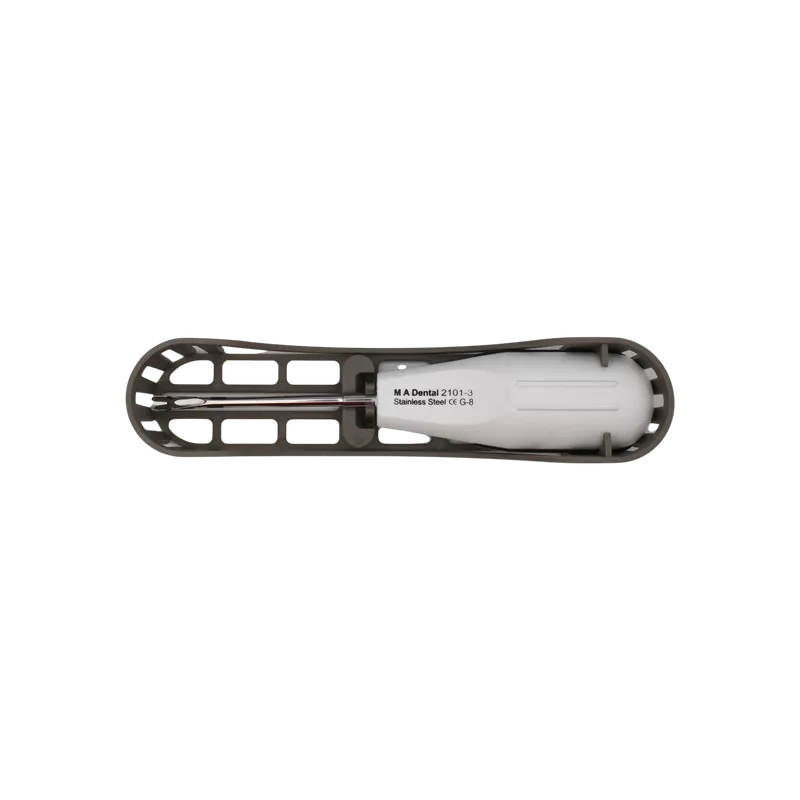
Autoclavable Plastic Tray for Luxating Elevators
EI-0266
Kidney Tray 20 cm
EI-0513
Instrument Tray with Lid 23 x 15 x 5 cm
EI-0514
Solid Base Sterilisation Tray
EI-0517Browse all restorative & operative instruments Browse all sterilization & organization instruments
Buying in your market
Frequently asked questions
What is the difference between a high-speed and a slow-speed dental handpiece?
A high-speed handpiece is an air turbine that spins a friction-grip bur very fast with little torque, used with water spray for cutting enamel and preparing teeth. A slow-speed handpiece is a motor with straight or contra-angle attachments that turns more slowly with more torque, for caries removal, finishing, polishing and laboratory adjustments.
How fast does a dental handpiece spin?
Air-driven high-speed turbines run at up to about 450,000 rpm free-running. Slow-speed motors turn at up to about 30,000 rpm and electric motors at up to about 40,000 rpm, with speed-increasing or reduction heads changing the speed at the bur. Surgical motors reach about 40,000 rpm, with lower speeds, in the tens of rpm, used for implant work under sterile irrigation.
What is the difference between friction-grip and latch-type burs?
Friction-grip (FG) burs have a smooth, thin shank held by friction in a turbine or push-button contra-angle. Latch-type (RA) burs have a notched shank that a latch on the back of a contra-angle head locks into. The two are not interchangeable, so the bur must match the attachment.
What do the coloured rings on contra-angle handpieces mean?
They show the gear ratio under a widely used convention: red for speed-increasing heads such as 1:5, blue for direct 1:1 drive and green for speed-reducing heads used in endodontics and low-speed work. Always confirm the ratio printed on the attachment.
Do dental handpieces need to be sterilised after every patient?
Yes. CDC guidance says handpieces and their attachments, including reusable prophy angles, should be heat sterilised between patients, and UK guidance in HTM 01-05 also expects cleaning, lubrication and steam sterilisation. Wiping or chemical immersion is not enough because the internal parts can be contaminated.
Why do dental handpieces need oiling?
The bearings and gears in the head need lubricant to run smoothly and cool, and reprocessing washes it out. Oiling with the manufacturer's lubricant, then expelling the excess before sterilisation, extends the life of the turbine and reduces noise and overheating.
Can dental handpieces go in an ultrasonic cleaner or washer-disinfector?
Only if the handpiece manufacturer confirms it. HTM 01-05 says handpieces should not be cleaned ultrasonically without that confirmation, and that washer-disinfector use should be checked with the manufacturer first. A washer-disinfector may strip the lubricant, so re-oil before sterilising. A dedicated handpiece-cleaning machine cleans and lubricates but does not disinfect.
Why are handpieces run for 20 to 30 seconds between patients?
CDC guidance says devices connected to the waterline that enter the mouth, including handpieces, should discharge water and air for at least 20 to 30 seconds after each patient. High-speed handpieces can draw oral fluids into their internal parts, which could be expelled at the next patient. Anti-retraction valves help, and HTM 01-05 expects them to be fitted and maintained where backflow protection is needed, but flushing is still advised.
Who invented the high-speed dental drill?
The air-turbine handpiece came from New Zealand. John Patrick Walsh and colleagues at the Dominion Physical Laboratory in Wellington filed a provisional patent for an air-driven handpiece in October 1949. In the United States a separately developed turbine, credited to John Borden, went into commercial production in 1957.
References
- Boyd LB. Dental Instruments: A Pocket Guide, 7th edition. Saunders/Elsevier, 2020 (photographs used under licence)
- Centers for Disease Control and Prevention. Best Practices for Dental Handpieces. Dental Infection Prevention and Control
- Kohn WG, et al. Guidelines for Infection Control in Dental Health-Care Settings, 2003. MMWR 52(RR-17), Centers for Disease Control and Prevention
- Department of Health. Health Technical Memorandum 01-05: Decontamination in primary care dental practices, 2013 edition
- ISO 14457:2017 Dentistry: handpieces and motors
- ISO 1797:2017 Dentistry: shanks for rotary and oscillating instruments
- ISO 17664-1:2021 Processing of health care products: information to be provided by the medical device manufacturer for the processing of medical devices. Part 1: Critical and semi-critical medical devices
- Chiou BJ, Chou SJ, Ho DC, Fang CY. Extraction with an electric motor-driven handpiece may still cause subcutaneous emphysema: a case report. J Dent Sci 2021;16(3):1033-1034
- Chua H, Choi JJE, Ramani RS, Ganjigatti R, Waddell JN. The cooling efficiency of different dental high-speed handpiece coolant port designs. Heliyon 2019;5(8):e02185
- Lempel E, Szalma J. Effect of spray air settings of speed-increasing contra-angle handpieces on intrapulpal temperatures, drilling times, and coolant spray pattern. Clin Oral Investig 2022;26(1):523-533
- Lau XE, Liu X, Chua H, Wang WJ, Dias M, Choi JJE. Heat generated during dental treatments affecting intrapulpal temperature: a review. Clin Oral Investig 2023;27(5):2277-2297
- Vernon JJ, Lancaster PE, Black EVI, et al. Increased handpiece speeds without air coolant: aerosols and thermal impact. J Dent Res 2023;102(1):53-60
- Mishra SK, Chowdhary R. Heat generated by dental implant drills during osteotomy: a review. J Indian Prosthodont Soc 2014;14(2):131-143
- Theodoroff SM, Folmer RL. Hearing loss associated with long-term exposure to high-speed dental handpieces. Gen Dent 2015;63(3):71-76
- Wikipedia. Dental drill (history of the air-turbine handpiece)
- Ring ME. The true discoverer of the dental air turbine handpiece, Sir John Walsh of New Zealand. Bull Hist Dent 1987;35(2):106-109
I am a…
Related
- Dental Burs and Rotary Instruments: Types, Shanks and Uses
- Dental Evacuation Devices, the Air/Water Syringe and the Dental Unit
- Enamel-Cutting Instruments and G.V. Black's Instrument Formula
- Amalgam Restorative Instruments: What Each One Does
- Restorative Dental Hand Instruments
- Basic Dental Instruments: Mirror, Explorer, Cotton Forceps and Handles
- Dental Dam Instruments Explained, from Sheet to Frame
- Endodontic Instruments for Root Canal Treatment
- Dental Sterilisation and Protective Equipment
- Dental Hygiene Tray Setup: Scaling, Root Planing and Polishing
- Surgical Extraction Tray Setup
- Endodontic Tray Setup: Opening and Sealing a Tooth
- Dental Instrument Cassettes, Trays and Boxes