Preventive, Sealant and Whitening Tray Instruments
Written by the Equate Instruments Technical Team · Reviewed by the Medical & Dental Board, Equate Instruments · Updated ·
Preventive and sealant instruments are the items used to clean, isolate, protect and lighten teeth: cotton rolls, dry aids and bite blocks to keep the field dry, disposable fluoride trays, caries detection aids, the prophylaxis and sealant tray setups, and for whitening, a vacuum former, thermoplastic sheet and short-blade scissors to make custom-fitted trays.
Key points
- Most items on preventive trays are single-use disposables; the reusable core is the mirror, explorer, cotton forceps, short-blade tray scissors and the slow-speed handpiece.
- A sealant only lasts if the enamel stays dry from etching to curing, so isolation is the part of the setup that most often decides success.
- Whitening trays are made in the practice on a vacuum former, then trimmed with fine scissors so the edge stays clear of the gum.
What are preventive and sealant instruments?
Preventive dentistry has its own small set of trays. Linda Bartolomucci Boyd's Dental Instruments: A Pocket Guide (Elsevier) groups them in one chapter: the disposables that keep teeth dry, fluoride trays, caries detection aids, the prophylaxis polishing and sealant setups, and the equipment for making custom whitening trays. What links them is that they protect or improve sound tooth structure rather than repair it.
Compared with restorative or surgical trays, very little here is reusable steel. The basic setup of mirror, explorer and cotton forceps still sits on every tray, laid out as in the basic tray setup, and the slow-speed handpiece and evacuation tips come from the dental handpieces and evacuation families. The rest is mostly single-use material and a few pieces of equipment.
| Item | What it's for | Reusable or single use |
|---|---|---|
| Cotton rolls, dry aids, gauze, bite block | Absorbing saliva and holding the mouth open so the field stays dry | Single use |
| Fluoride trays | Holding fluoride gel or foam against both arches at once | Single use |
| Caries detection aids | Flagging hidden or early decay before a fissure is sealed | Unit reused under a barrier; tips and spacers per the manufacturer |
| Prophy angle with cup or brush | Cleaning and polishing enamel before sealing or after scaling | Usually single use, on a reusable slow-speed handpiece |
| Microbrushes, etchant and sealant syringes | Applying etch and sealant to the fissures | Single use |
| Vacuum former | Moulding heated thermoplastic sheet over a stone model | Benchtop equipment, disinfected |
| Short-blade scissors | Trimming formed trays to a clean outline | Reusable, steam sterilised |
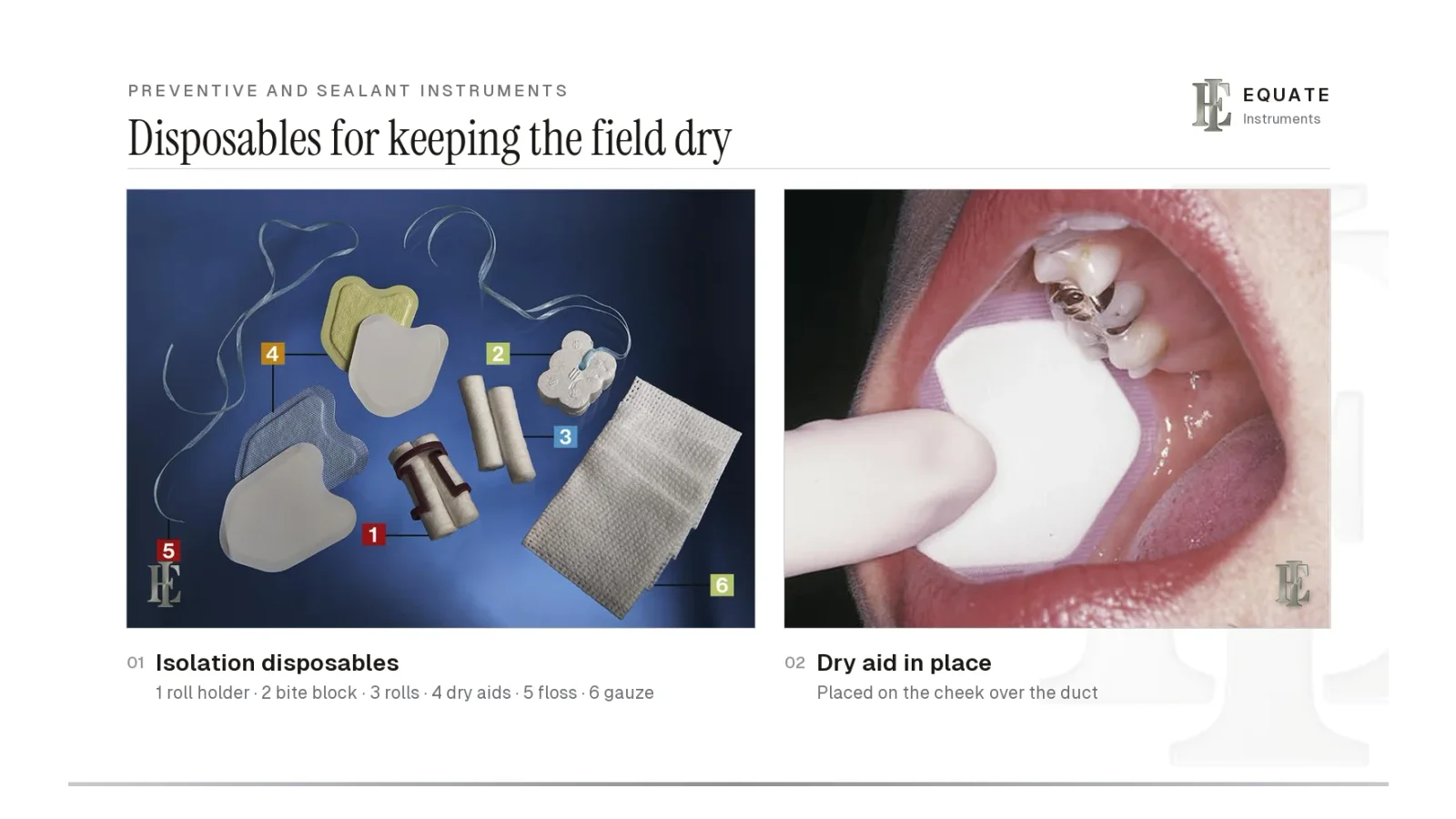
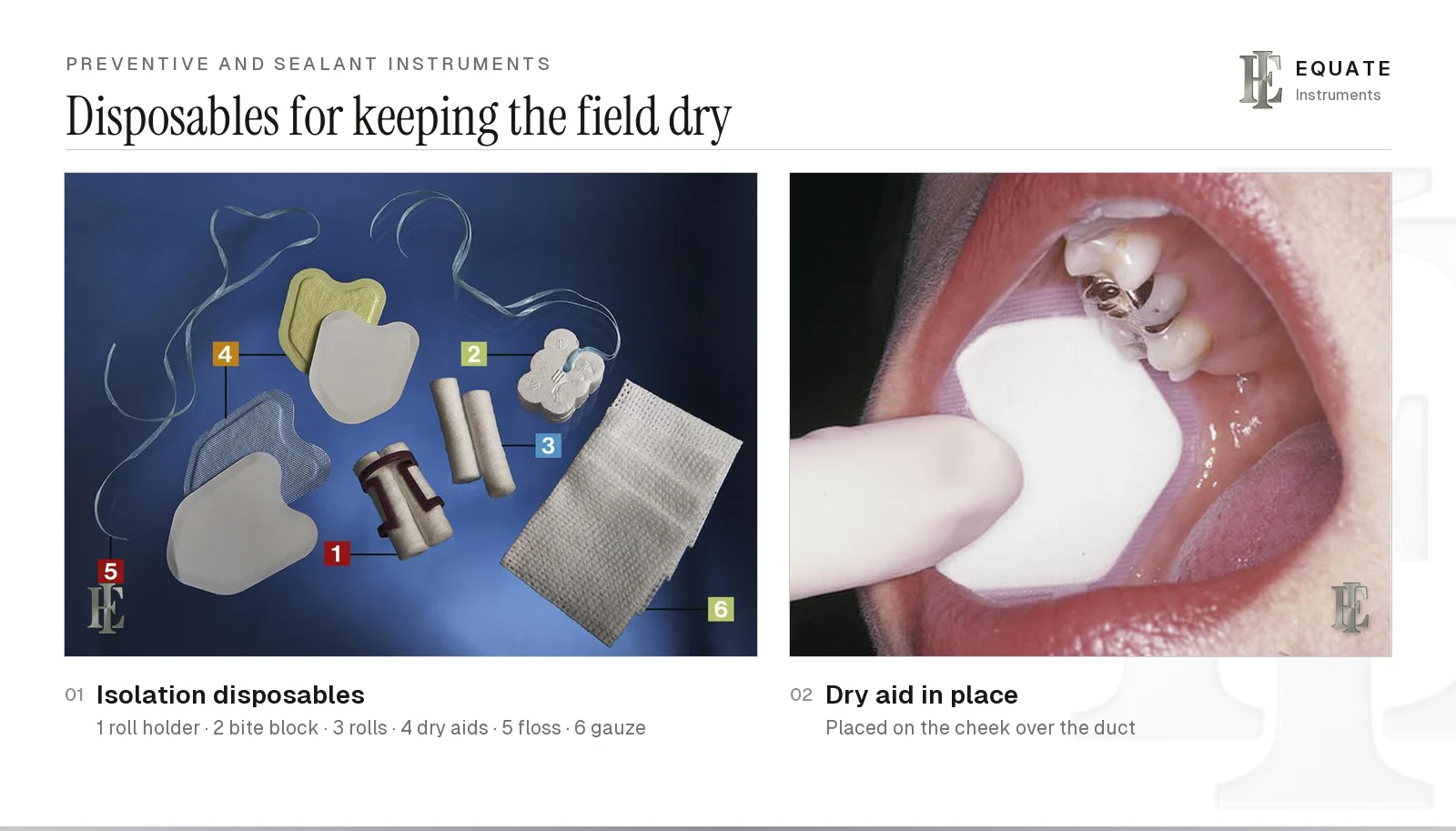
Isolation disposables: cotton rolls, dry aids and bite blocks
Saliva is the main enemy of a sealant and of most bonded work. Cotton rolls are packed in the vestibule and along the tongue side of the lower teeth, and a disposable cotton roll holder clips a buccal and a lingual roll together so both stay put on the lower arch. Dry aids are thin absorbent pads that stick to the inside of the cheek. The parotid gland, the largest source of watery saliva during treatment, drains through Stensen's duct, which opens at the parotid papilla on the cheek opposite the upper second molar, so a pad stuck over that spot catches the flow at its source.
A bite block rests between the back teeth so a patient, often a child, can relax the jaw while staying open. Disposable blocks come with a length of floss or a tie attached, so the block can be pulled back if it slips. Gauze squares and floss complete the set: gauze for drying and wiping, floss for checking that sealant hasn't run into a contact. Rolls, pads and blocks are relative isolation. For longer or more demanding work, a dental dam, set up as in the rubber dam tray setup, gives a far drier field. A 2025 systematic review and meta-analysis by Shukla and colleagues in Evidence-Based Dentistry (seven randomised trials and one non-randomised study) found sealant retention much the same under cotton rolls or a dam at six months, but clearly better under the dam at twelve months.
- Change soaked rolls promptly; a saturated roll wicks moisture back onto the tooth.
- Moisten a dry aid or roll before removing it so it doesn't peel the mucosa.
- Keep a high-volume or saliva ejector tip running during etching and rinsing.
- Everything in this group is single use and is discarded after the appointment according to your national healthcare waste rules.
Fluoride trays
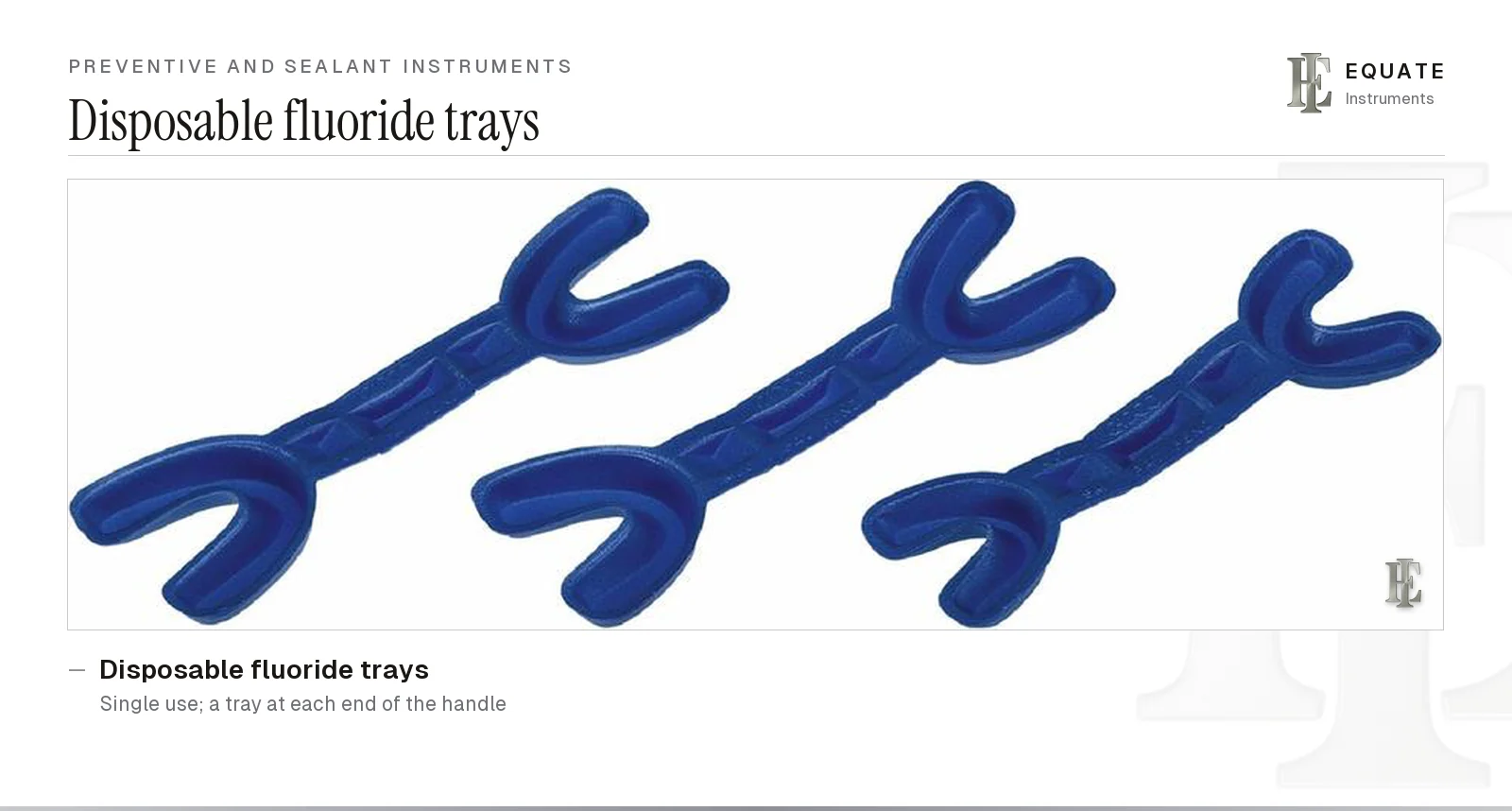
Disposable fluoride trays are soft U-shaped trays made in several designs: some cover both arches at once, while others, like those pictured, carry a single tray at each end of a handle. They're filled with a professional-strength fluoride gel or foam and seated over the teeth for the time the product's instructions give, with the patient sitting upright and a saliva ejector in place.
Trays come in sizes for primary, mixed and permanent dentitions, and fit matters: a tray that's too short leaves the back teeth uncovered, and one that's overfilled encourages swallowing. The American Dental Association's 2013 clinical recommendations on topical fluoride (Weyant and colleagues) recommend 2.26% fluoride varnish at any age for people at raised caries risk, and 1.23% APF gel as an alternative from age six; gel in trays is not used for young children. The same review notes that every APF gel trial it found used a four-minute application and none tested less than three minutes, so shorter one-minute gels lack trial support. UK guidance centres on varnish: the government's Delivering Better Oral Health toolkit advises 2.26% sodium fluoride varnish twice a year for all children from 3 to 18, and two or more times a year for those giving concern, while Scotland's SDCEP advises 5% sodium fluoride varnish at least twice a year from age 2, rising to four times a year when risk is higher. Neither UK document lists fluoride gel in trays. Trays are single use.
Caries detection aids before sealing
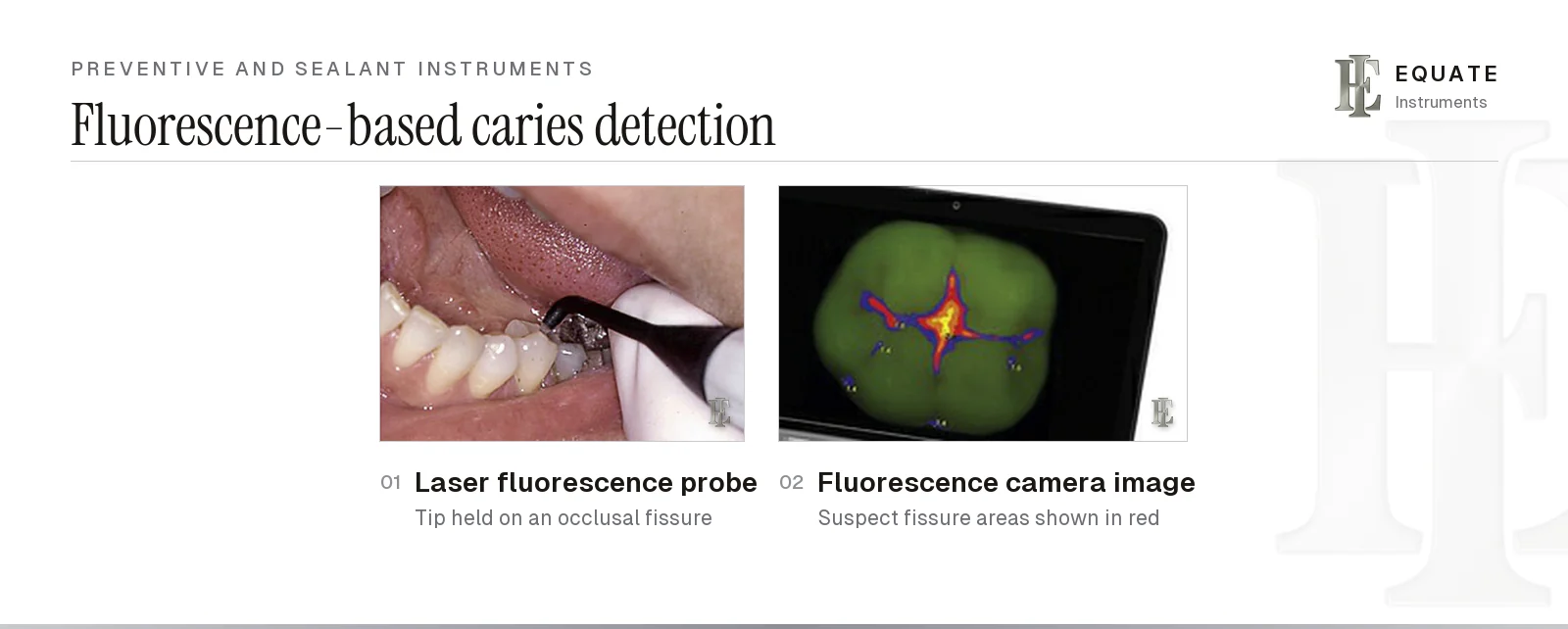
Sealing over active decay that needs restoring is one of the main risks of fissure sealing, so some practices add a detection aid to the sealant tray. Two types appear in Boyd's chapter. A laser fluorescence caries detector shines red laser light into the fissure through a fine tip and shows a number on its display; higher readings suggest deeper or more advanced caries in the fissure. A fluorescence camera is an intraoral camera linked to a computer screen; suspect areas show up in a contrasting colour against sound enamel, which also makes the image a useful way to show patients what the clinician is watching. The same camera has restorative uses beyond sealing, during and after cavity preparation.
Both are aids, not a diagnosis on their own. Stains, calculus, prophy paste, plaque and existing sealant can all raise a reading, so the tooth must be cleaned and dried first and the result read alongside a visual examination and radiographs. A 2020 Cochrane review by Macey and colleagues found that accuracy varied widely between studies and devices, on low-certainty evidence drawn mostly from extracted teeth; at a summary sensitivity of 0.70 and specificity of 0.78, a group of 1,000 sites in which 57% had early enamel caries would see roughly 171 lesions missed and 95 sound sites flagged. Any tactile check stays gentle and uses a ball-ended probe rather than a sharp point, because pressing hard with a sharp tip can damage demineralised enamel and may create a cavity. A 2016 BMC Oral Health study by Mattos-Silveira and colleagues, which reviews earlier microscope work on this risk, found ball-ended probes did less surface damage than sharp explorers; sharp and ball-ended tips are compared on the dental explorers page. The handpieces are covered with a barrier for each patient; the units are wiped with a disinfectant the manufacturer approves, and intraoral tips or spacers are cleaned and sterilised as their instructions specify.
The prophylaxis polishing tray
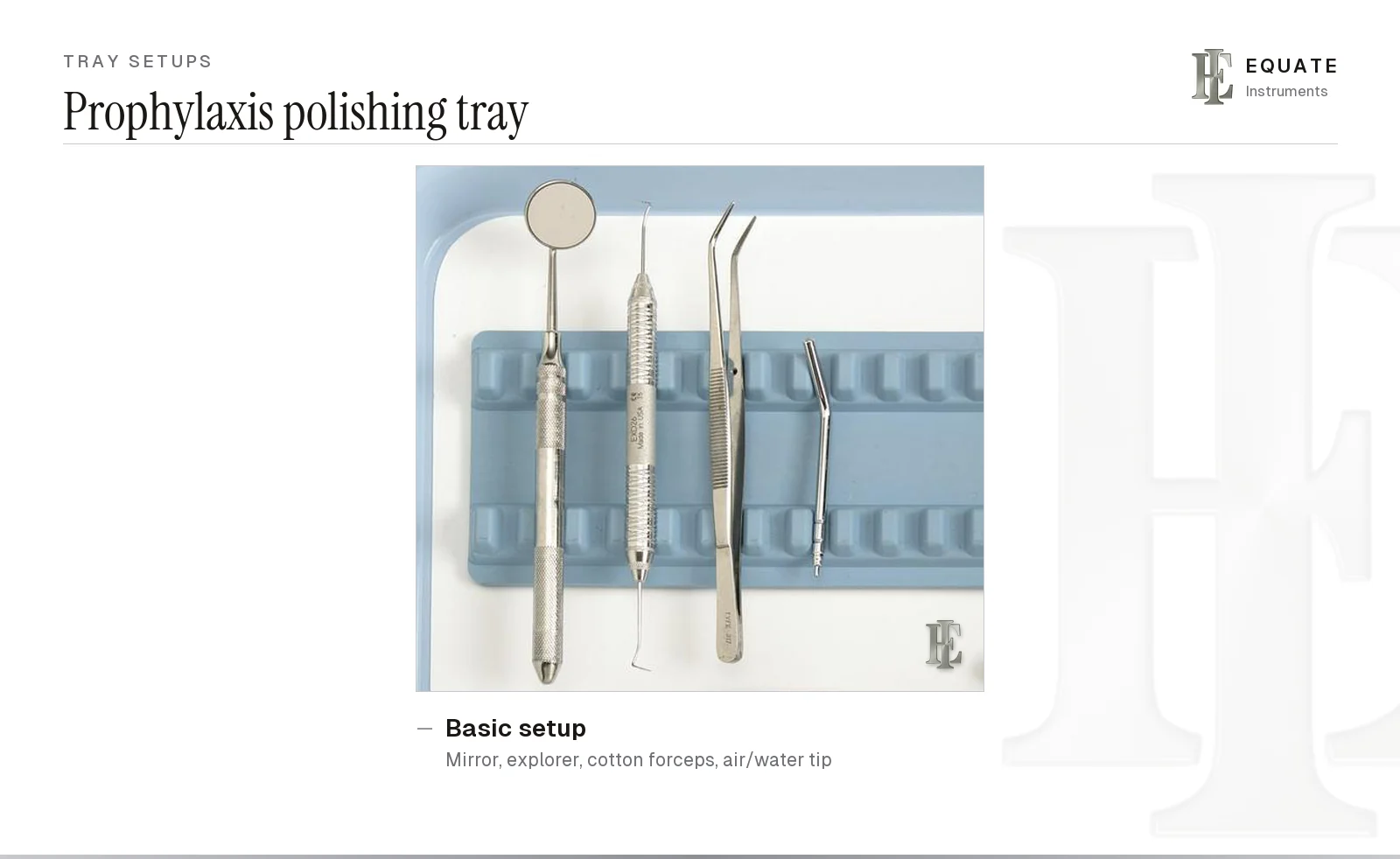
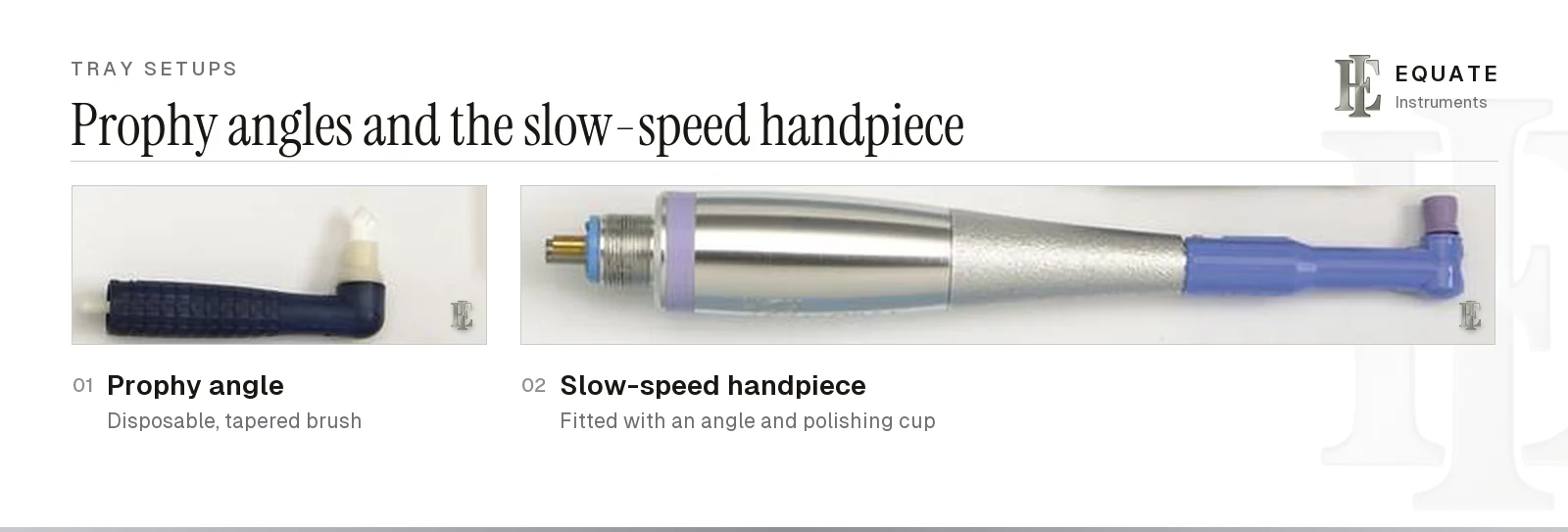
A prophylaxis polish removes plaque and extrinsic stain and is often the first step before a sealant. The tray starts with the mirror, explorer and cotton forceps, an air/water syringe tip, floss, a polishing paste and both a saliva ejector and a high-volume evacuator tip. The working instrument is a slow-speed straight handpiece carrying a disposable prophy angle, fitted either with a soft rubber cup for smooth surfaces or a small tapered bristle brush for pits and fissures.
Before etching, many protocols polish with a paste that contains no fluoride or oil, or with plain pumice, and rinse thoroughly, so nothing on the enamel interferes with the etch. Run the cup at low speed with light, intermittent contact to avoid heating the tooth. Disposable angles save reprocessing time; reusable metal prophy angles must be cleaned, lubricated and steam sterilised like any other handpiece attachment. More on cups, brushes and angles is in the dental handpieces guide. The same polishing tray also follows scaling on a hygiene visit; for polishing after scaling, see the hygiene tray setup.
The sealant tray setup, step by step
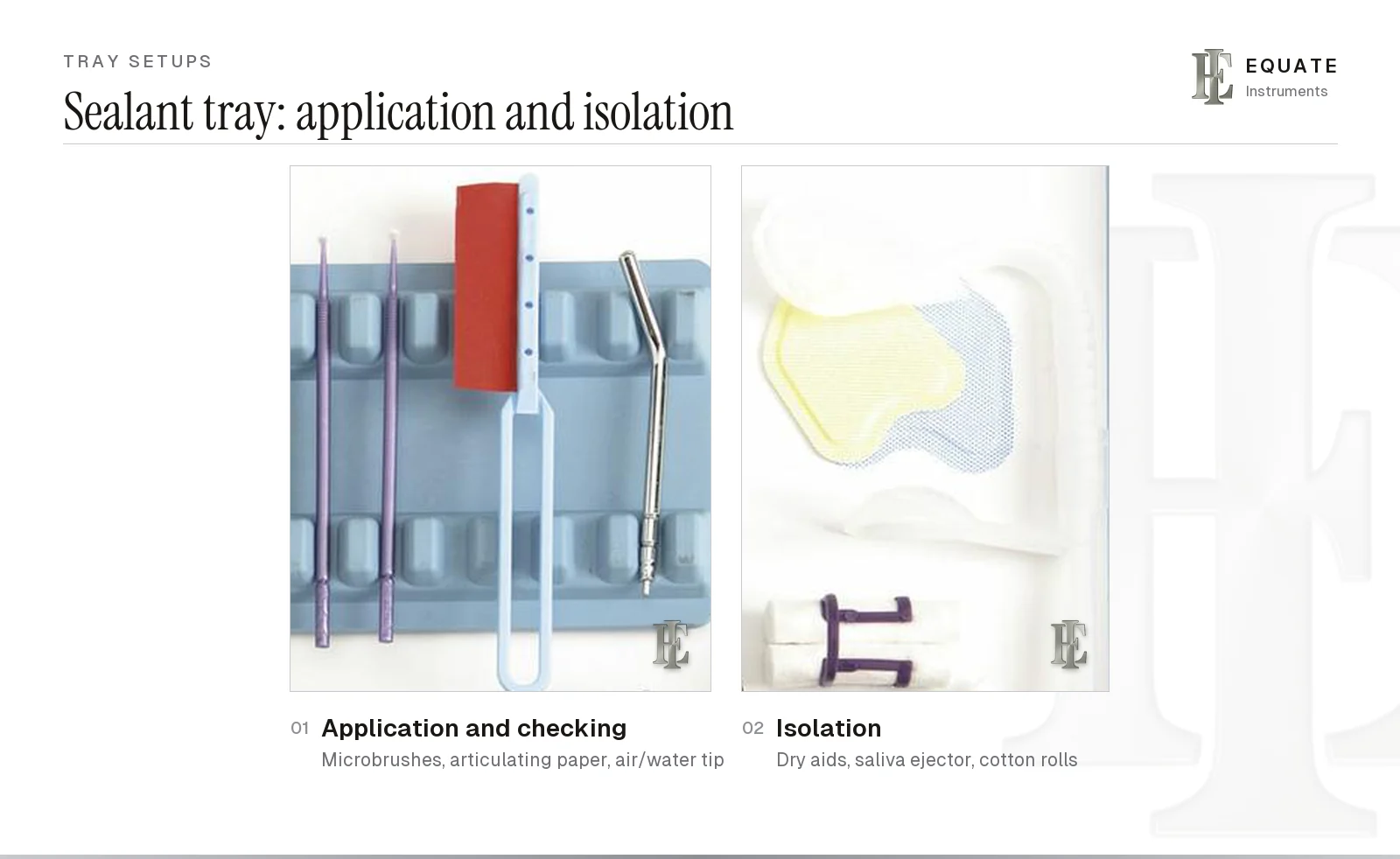
The sealant tray adds application and checking items to the prophy tray: an etchant syringe, microbrushes, the sealant syringe with its fine tip, articulating paper in a holder, cotton rolls in a disposable holder, dry aids, a bite block and a low-volume evacuator shaped for the lower arch. A curing light is used alongside it for light-cured materials.
The 2016 clinical practice guideline from the American Dental Association and the American Academy of Pediatric Dentistry (Wright and colleagues) found that sealants on the occlusal surfaces of primary and permanent molars prevent caries and arrest non-cavitated lesions in children and adolescents, compared with no sealant or fluoride varnish. Cavitated lesions that need restoring are not sealed. The US Centers for Disease Control and Prevention puts the benefit at up to 80% fewer cavities over two years and about 50% over four, for sealants on the chewing surfaces of back teeth placed soon after the first permanent molars (around age 6) and second molars (around age 12) erupt. Scotland's SDCEP makes a resin-based sealant the first choice, keeps glass ionomer for uncooperative children whose teeth have fully erupted, and asks for permanent molars to be sealed as soon as possible after eruption, including the buccal pits of lower and the palatal fissures of upper first molars. They work only as long as they stay bonded, which is why the sequence below puts so much weight on keeping the tooth dry.
- Clean the fissures with a brush or cup on the prophy angle, then rinse well.
- Isolate with cotton rolls in a holder, dry aids, a bite block and evacuation.
- Etch the pits and fissures, rinse, and dry until the enamel looks chalky and frosted; if saliva touches it, etch again.
- Apply sealant with the syringe tip or a microbrush, working it into the fissures without overfilling, then cure it.
- Check with the explorer that the sealant is retained and has no voids, then check the bite with articulating paper and adjust any high spot.
- Floss the contacts to make sure no sealant has run between the teeth.
- At every recall, check sealants for wear and leakage and top up any that are worn or damaged.
The vacuum former and making whitening trays
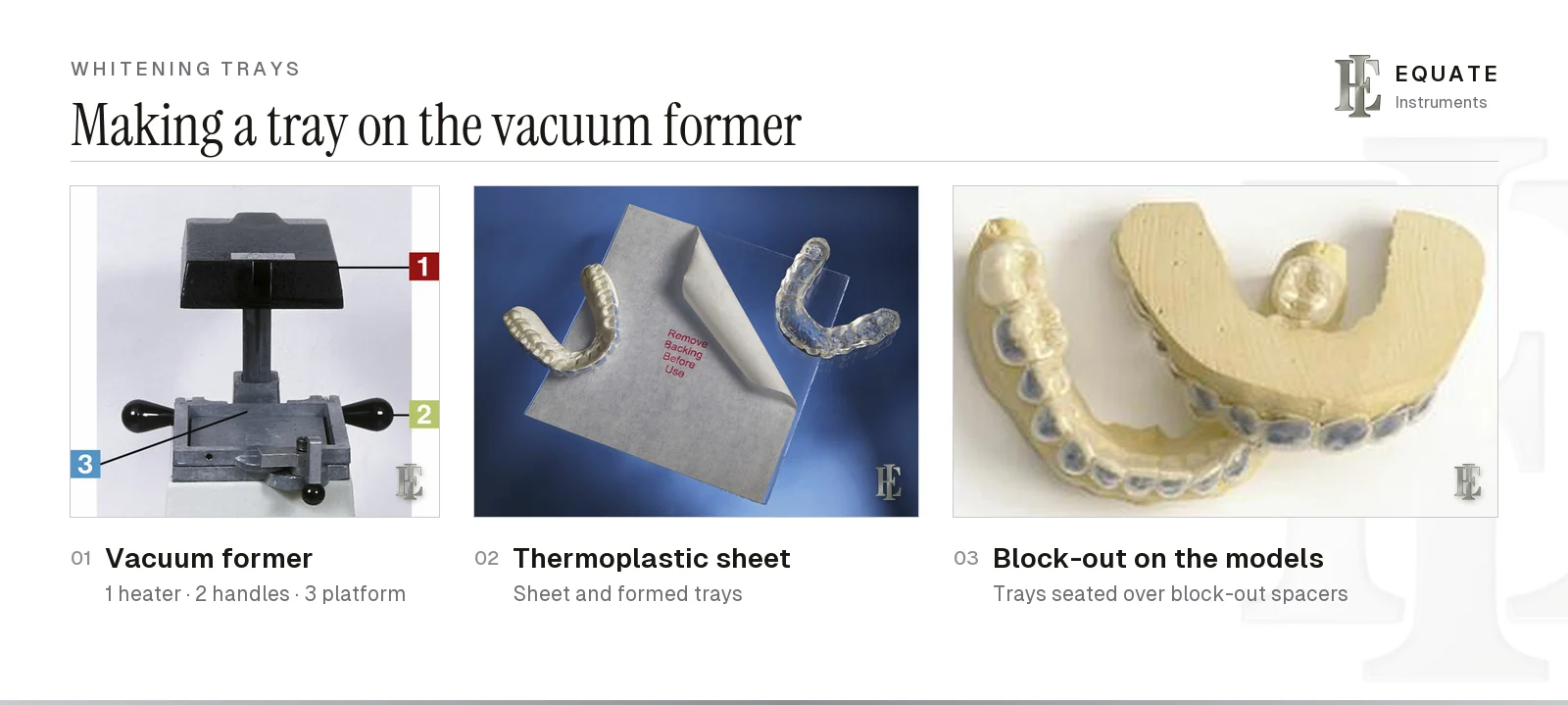
A vacuum former makes thin, close-fitting appliances in the practice or laboratory: whitening trays, provisional crown matrices, night guards, sports mouthguards and some orthodontic retainers and positioners. It has a heating element above, a frame with handles that holds a square of thermoplastic sheet, and a perforated platform below that is connected to a vacuum. When the heated sheet sags, the frame is pulled down over a stone model on the platform and the vacuum draws the plastic tight against it.
For whitening trays, the model is trimmed flat and free of air bubbles, and block-out resin is light cured on the facial surfaces of the teeth to be treated. The block-out leaves small reservoirs inside the finished tray that hold the gel against the teeth. Soft, thin sheet suits whitening trays; mouthguards need much thicker material. Heat the sheet only until it sags evenly, since overheating thins it and underheating gives a loose, blurred fit. The machine itself isn't sterilised: wipe it down with a disinfectant the manufacturer approves, and disinfect impressions and models before they reach the bench.
Custom-fitted whitening trays and short-blade scissors
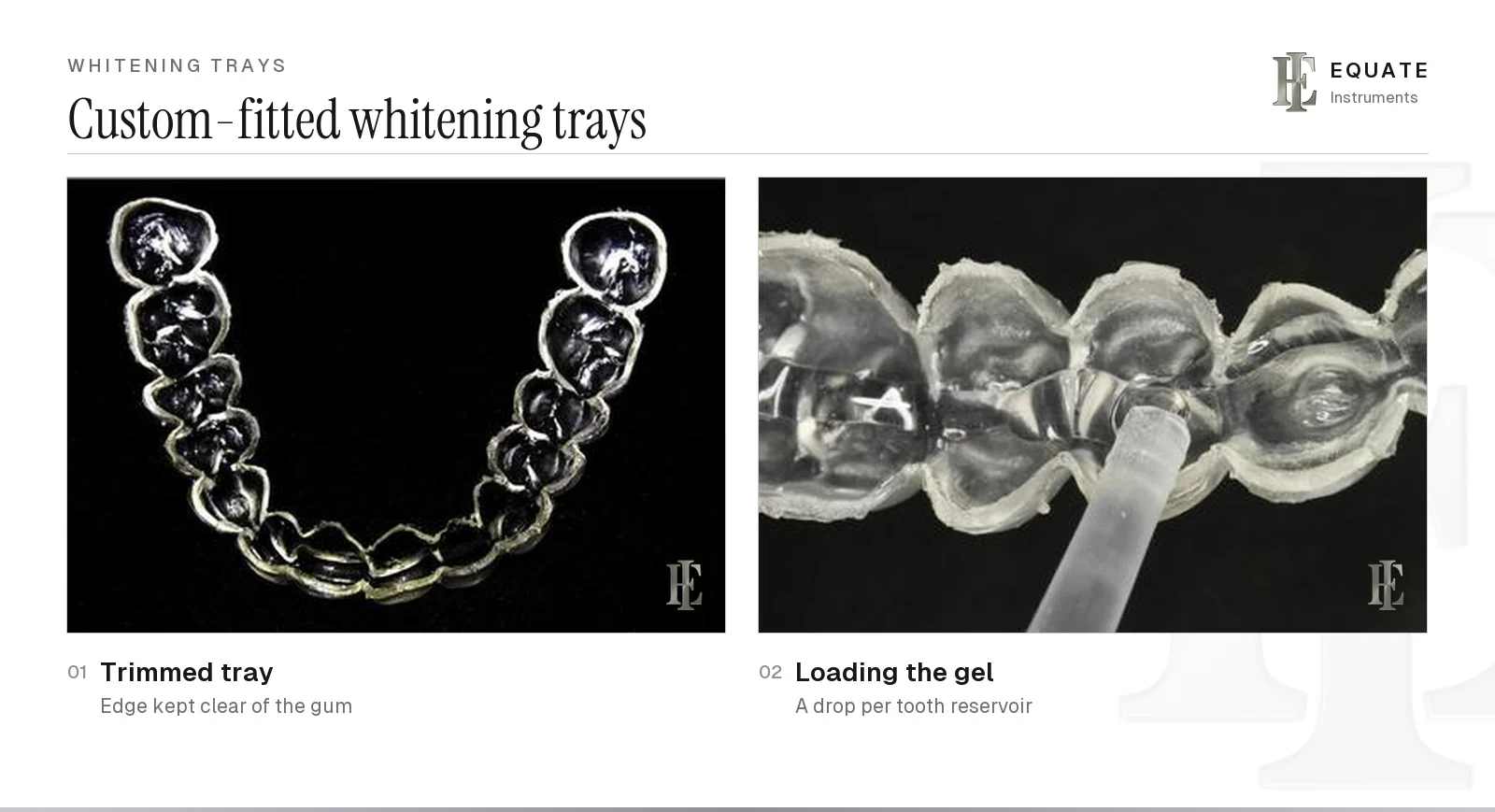
A custom-fitted whitening tray holds a peroxide-based gel against the teeth during home or in-practice whitening. Gel strength and the wearing schedule are set by the dentist for each patient. In the European Union, tooth whitening products that contain or release more than 0.1% and up to 6% hydrogen peroxide may be supplied only through dental practitioners, the first use of each course must be done or directly supervised by a dentist, and they must not be used on anyone under 18 (Council Directive 2011/84/EU, whose conditions are now set out for hydrogen peroxide in Annex III of Regulation (EC) No 1223/2009 on cosmetic products). Products above 6% are not permitted as cosmetic whitening products. The Annex III entry covers hydrogen peroxide and any compound or mixture that releases it, carbamide peroxide included, so for carbamide gels the limits apply to the peroxide released, and the label must state that percentage. In the UK, the Oral Health Foundation explains that whitening counts as dentistry: it may be provided only by a registered dentist, or by a dental hygienist or therapist working to a dentist's prescription, and the dentist examines the patient first. Check your national rules for anything beyond this.
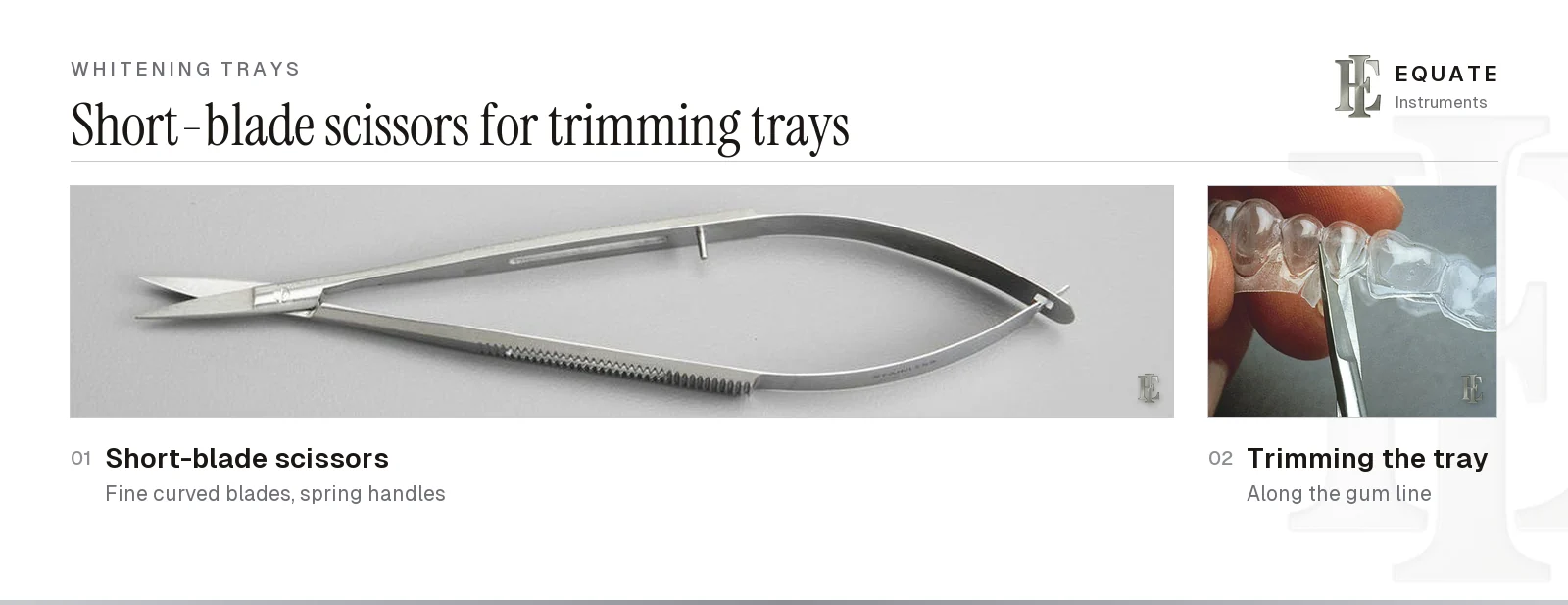
Once formed, the tray is cut from the sheet and trimmed with short-blade scissors. The fine, often curved, blades follow the scallop of the gingival outline closely. Finish the edge just short of the gum: a tray that overlaps the gingiva lets gel sit on soft tissue and is a common cause of irritation, while a ragged edge rubs. Ask the patient to apply only a small drop of gel to each tooth reservoir and to wipe away any excess.
Keep a dedicated pair of tray scissors rather than borrowing fine surgical scissors, as plastic and sheet material dull a blade made for tissue. Curved crown and collar scissors also work well for trays, since curved blades follow a rounded outline. Between patients the scissors are cleaned, packed open in a pouch with a process indicator and steam sterilised. The patient keeps the finished trays and cleans them as the dentist advises, following any instructions supplied with the tray material.
Cleaning, disinfection and sterilisation
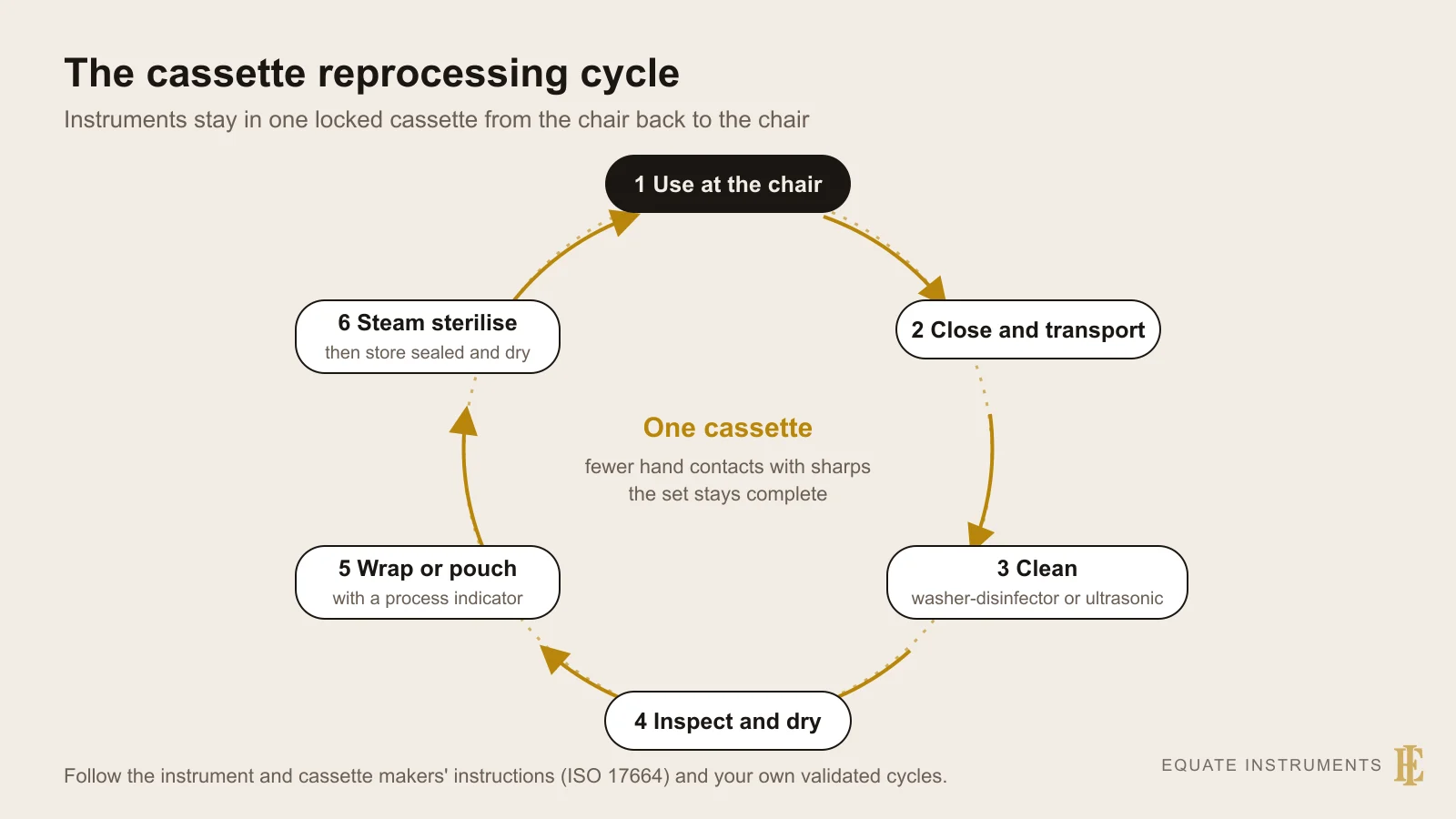
Most of this chapter's items are single use, so reprocessing is mainly about the few reusable instruments and the equipment surfaces. The US Centers for Disease Control and Prevention guidelines (Kohn and colleagues, 2003) and the Department of Health's HTM 01-05 for dental practices in England both expect heat-tolerant instruments that touch mucous membranes to be cleaned and heat sterilised between patients, and surfaces and equipment that can't be sterilised to be protected with barriers or disinfected. Follow each manufacturer's instructions and your national regulations.
- Disposables (rolls, dry aids, bite blocks, gauze, fluoride trays, microbrushes, disposable prophy angles): discard after one patient as your national healthcare waste rules require; never reprocess.
- Mirror, explorer, cotton forceps, air/water tips and scissors: clean, pack with an internal process indicator (scissors open and unlocked) and steam sterilise.
- Slow-speed handpiece and any reusable prophy angle: clean, lubricate and sterilise as their instructions require.
- Caries detectors and fluorescence cameras: a fresh barrier on the handpiece for each patient, wipe-down disinfection of the unit, and tips or spacers reprocessed as the manufacturer specifies.
- Vacuum former: disinfect after use with a product its manufacturer approves.
- Check the external indicator when the load comes out and the internal indicator when the pack is opened, and record the cycle as your national rules require.
Buying for preventive and whitening trays: what to check
- Isolation disposables: roll diameter and dry-aid size to suit both children and adults; bite blocks with a retrieval tie.
- Fluoride trays: a range of sizes, soft margins and a wall high enough to cover the cervical areas.
- Prophy angles: smooth-running heads that fit your slow-speed handpiece, with both cups and brushes in stock.
- Tray scissors: short, fine blades that meet cleanly to the tip, a comfortable spring or ring handle and a finish that takes repeated steam sterilisation.
- Explorer for sealant checks: a fine, flexible shepherd's hook for retention and void checks.
- Articulating paper forceps or a holder to check the bite after sealing.
- Organisation: a procedure tray or instrument cassette that keeps the reusable items together through cleaning and sterilisation.
The Equate difference
Equate doesn't supply the disposable or powered items in this chapter (fluoride trays, whitening sheets, vacuum formers or caries detectors). For the reusable side of these trays its catalogue lists 9 crown and collar scissors in straight, curved and angled patterns, 3 articulating paper forceps and a full-arch articulating paper holder, 4 cotton pliers and 19 college tweezers, 46 shepherd's hook explorers, a stainless steel dappen dish, 7 cotton dispensers (2 of them multi-hole pellet dispensers), 18 procedure trays and 19 instrument cassettes.
Equate Preventive, Sealant and Whitening Tray Instruments options

Explorer 3A - Single-Ended Curved Hook
EI-0033
Shepherd's Hook Explorer No.23
EI-0035
Explorer 2H - Double-Ended Shepherd Hook
EI-0042
Double-Ended Explorer with 6 mm Solid Knurled Handle
EI-0043
Explorer 5 - Double-Ended Diagnostic Explorer
EI-0044
Explorer Fig. 2 Extra Thin - Solid Handle 6mm
EI-0132
Explorer Fig. 2 - Hollow Handle 10mm
EI-0133
Fig. 9 Extra Thin Dental Explorer - 6 mm Solid Handle
EI-0178
Weston Dental Explorer - 6 mm Solid Handle
EI-0179
Explorer 17-23 - Double-Ended Dental Explorer with Grey Ergonomic Handle
EI-0878
Explorer 5-9 - Double-Ended Dental Explorer with Grey Ergonomic Handle
EI-0879
Explorer 17C-23 Double-Ended - Grey Silicone Handle
EI-0880Browse all accessories & supplies instruments Browse all diagnostic instruments Browse all sterilization & organization instruments
Buying in your market
Frequently asked questions
What instruments are on a dental sealant tray?
A mirror, explorer and cotton forceps, an air/water syringe tip, evacuation tips, cotton rolls in a holder, dry aids, a bite block, floss, etchant and sealant syringes, microbrushes, articulating paper in a holder, and a slow-speed handpiece with disposable prophy angles for cleaning the fissures. A curing light is used alongside.
Why is isolation so important when placing sealants?
Sealant bonds to etched enamel, and even a brief touch of saliva on the etched surface weakens that bond. A poorly bonded sealant can leak or come off. If saliva contaminates the tooth after etching, it's rinsed, re-etched and dried again.
How are custom whitening trays made?
An impression or scan of the teeth gives a stone model. Block-out resin is cured on the facial surfaces to create gel reservoirs, a heated thermoplastic sheet is pulled over the model on a vacuum former, and the formed tray is cut out and trimmed with short-blade scissors just short of the gum.
What strength of whitening gel is allowed in the EU?
Cosmetic tooth whitening products may contain or release up to 6% hydrogen peroxide; carbamide peroxide counts by the hydrogen peroxide it releases. Above 0.1% they are supplied only through dentists, the first use of each course is carried out or directly supervised by a dentist, and they are not for under-18s. Who else in the team may carry out treatment depends on national rules.
Are laser fluorescence caries detectors accurate?
Not reliably enough to use alone. A 2020 Cochrane review found accuracy varied widely between studies and devices, with a summary sensitivity of about 0.70 at a specificity of 0.78, on low-certainty evidence mostly from extracted teeth; in 1,000 sites where 57% had early caries, that means about 171 lesions missed and 95 sound sites flagged. Stains, plaque, calculus and paste can raise a reading, so clean and dry the tooth first and read the result with a visual examination, radiographs and gentle probing.
Are fluoride trays reusable?
No. Disposable fluoride trays are single use and are discarded after the appointment. Patients using home fluoride may have custom trays made on a vacuum former, which they keep and clean themselves.
How effective are dental sealants?
Very, while they stay in place. The US CDC says sealants can prevent up to 80% of cavities for two years and about half for up to four years when placed on back teeth soon after the permanent molars erupt, and the 2016 ADA and AAPD guideline found they prevent and arrest early occlusal caries in children and adolescents.
Should sealants be resin or glass ionomer?
Resin-based sealant is the usual first choice in SDCEP's guidance for children in Scotland, and the UK's Delivering Better Oral Health toolkit advises resin sealant on permanent teeth as they erupt for children aged 7 to 18 who are giving concern. SDCEP reports that both materials prevent caries but resin is retained better, and advises glass ionomer for uncooperative children with fully erupted teeth.
How long do dental sealants last?
It varies with the patient, the tooth and how dry the field stayed during placement; a 2025 meta-analysis found better twelve-month retention under rubber dam than under cotton rolls. Sealants are checked for wear and leakage at each recall, and any that are partly lost or worn are topped up or replaced, since a sealant only protects while it stays bonded.
How long are fluoride trays left in?
As long as the product's instructions state. In the ADA's 2013 evidence review every trial of 1.23% APF gel in trays used a four-minute application and none tested less than three minutes, so one-minute gels lack trial evidence. UK guidance (Delivering Better Oral Health, SDCEP) recommends fluoride varnish, applied at least twice a year, and does not list tray gel.
References
- Boyd LB. Dental Instruments: A Pocket Guide, 7th edition. Saunders/Elsevier, 2020 (photographs used under licence)
- Wright JT, Crall JJ, Fontana M, et al. Evidence-based clinical practice guideline for the use of pit-and-fissure sealants: a report of the American Dental Association and the American Academy of Pediatric Dentistry. J Am Dent Assoc 2016;147(8):672-682
- Weyant RJ, et al. Topical fluoride for caries prevention: executive summary of the updated clinical recommendations and supporting systematic review. J Am Dent Assoc 2013;144(11):1279-1291
- Council Directive 2011/84/EU of 20 September 2011 amending Directive 76/768/EEC concerning cosmetic products (tooth whitening products)
- Regulation (EC) No 1223/2009 of the European Parliament and of the Council of 30 November 2009 on cosmetic products, Annex III (hydrogen peroxide)
- Kohn WG, et al. Guidelines for Infection Control in Dental Health-Care Settings, 2003. MMWR 52(RR-17), Centers for Disease Control and Prevention
- Department of Health. Health Technical Memorandum 01-05: Decontamination in primary care dental practices, 2013 edition
- US Centers for Disease Control and Prevention. About Dental Sealants
- Scottish Dental Clinical Effectiveness Programme (SDCEP). Prevention and Management of Dental Caries in Children: professionally delivered interventions
- Delivering Better Oral Health: an evidence-based toolkit for prevention. Chapter 2: summary guidance tables for dental teams. GOV.UK
- Macey R, Walsh T, Riley P, et al. Fluorescence devices for the detection of dental caries. Cochrane Database of Systematic Reviews 2020, Issue 12 (CD013811)
- Shukla N, Akram Z, Naveen Kumar PG, et al. Comparative evaluation of pit & fissure sealant retention using cotton roll & rubber dam isolation techniques: a systematic review & meta-analysis. Evid Based Dent 2025;26(2):112
- Mattos-Silveira J, Oliveira MM, Matos R, et al. Do the ball-ended probe cause less damage than sharp explorers? An ultrastructural analysis. BMC Oral Health 2016;16:39
- Regulation (EC) No 1223/2009 on cosmetic products, Annex III entry 12 (hydrogen peroxide and compounds releasing it, including carbamide peroxide), legislation.gov.uk
- Oral Health Foundation. Tooth whitening and the law
I am a…
Related
- Basic Dental Instruments: Mirror, Explorer, Cotton Forceps and Handles
- Dental Handpieces: Types, Attachments and Reprocessing
- Dental Evacuation Devices, the Air/Water Syringe and the Dental Unit
- Dental Hygiene Instruments: Curettes, Sickle Scalers, Ultrasonic Inserts and Sharpening
- Composite Restorative Instruments, from Matrix Band to Finishing Strip
- Orthodontic Instruments: What Each One Does, Stage by Stage
- Dental Explorers
- Dental Materials Equipment: From Impression to Finished Model
- Dental Hygiene Tray Setup: Scaling, Root Planing and Polishing
- Crown and Bridge Scissors, Contouring and Holding Pliers
- Dental Cotton Pliers (Dental Tweezers)
- Basic Dental Tray Setup (Dental Exam Tray)
- Dental Instrument Cassettes, Trays and Boxes
- Rubber Dam (Dental Dam) Tray Setup and Placement